JN0-361 Exam Details
-
Exam Code
:JN0-361 -
Exam Name
:Service Provider Routing and Switching, Specialist (JNCIS-SP) -
Certification
:Juniper Certifications -
Vendor
:Juniper -
Total Questions
:542 Q&As -
Last Updated
:May 25, 2026
Juniper JN0-361 Online Questions & Answers
-
Question 471:
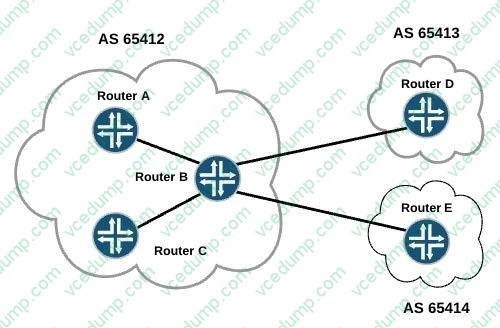
In the exhibit, all devices are sending routes to Router B. Which routes will be advertised from Router B to Router C?
A. BGP routes learned from Router A only
B. BGP routes learned from Router E only
C. BGP routes learned from Routers D and E only
D. BGP routes learned from Routers A, D, and E -
Question 472:
Which action does the local router take after sending a Notification message to a remote peer?
A. It begins to send route update information
B. It tears down the TCP session and attempts to re-establish it
C. It waits for the remote router to acknowledge that it is ready to receive routes
D. It changes its local state to Established -
Question 473:
Which three statements are true about BGP default operations? (Choose three.)
A. IBGP peers advertise routes received from EBGP peers to other IBGP peers.
B. IBGP peers do not advertise routes received from IBGP peers to other IBGP peers.
C. IBGP peers do not advertise routes received from EBGP peers to other IBGP peers.
D. IBGP peers change the next hop for routes received from EBGP peers.
E. EBGP peers advertise routes learned from IBGP or EBGP peers to other EBGP peers. -
Question 474:
Which two statements are true about NSR? (Choose two.)
A. NSR requires graceful restart to function properly
B. NSR requires redundant REs.
C. NSR requires only one RE.
D. NSR requires GRES to function properly. -
Question 475:
-- Exhibit -
user@R1> show route protocol bgp
inet.0: 6 destinations, 6 routes (6 active, 0 holddown, 0 hidden)
+
= Active Route, - = Last Active, * = Both 200.200.0.0/24 *[BGP/170] 00:00:47, localpref 100 AS path: 65001 I > to 192.168.100.1 via ge-1/1/5.435 200.200.1.0/24 *[BGP/170] 00:00:47, localpref 100 AS path: 65001 I > to 192.168.100.1 via ge-1/1/5.435 200.200.2.0/24 *[BGP/170] 00:00:47, localpref 100 AS path: 65001 I > to 192.168.100.1 via ge-1/1/5.435 200.200.3.0/24 *[BGP/170] 00:00:47, localpref 100 AS path: 65001 I > to 192.168.100.1 via ge-1/1/5.435
user@R2> show route 200.200/16 inet.0: 36 destinations, 36 routes (36 active, 0 holddown, 0 hidden) Restart Complete
+
= Active Route, - = Last Active, * = Both 200.200.0.0/24 *[Static/5] 00:09:12 Reject 200.200.1.0/24 *[Static/5] 00:09:12 Reject 200.200.2.0/24 *[Static/5] 00:09:12 Reject 200.200.3.0/24 *[Static/5] 00:09:12 Reject 200.200.4.0/24 *[Static/5] 00:09:12 Reject
user@R2> show configuration protocols bgp
export export-200;
group c5 {
neighbor 192.168.100.2 {
export export-200.200;
peer-as 65002;
}
}
user@R2> show configuration policy-options policy-statement export-200.200
term 1 {
from {
route-filter 200.200.0.0/22 longer;
}
then accept;
}
user@R2> show configuration policy-options policy-statement export-200
term 1 {
from {
route-filter 200.200.0.0/21 longer;
}
then accept;
}
Click the Exhibit button.
R2 is exporting static routes to R1 using BGP. R1 is not receiving one of the five static routes that is configured on R2.
Referring to the exhibit, what should be changed under the BGP configuration to resolve this issue?
A. Delete the global export policy.
B. Delete the neighbor export policy.
C. Move policy export-200 to the group level.
D. Move policy export-200.200 to the group level. -
Question 476:
Click the Exhibit button.
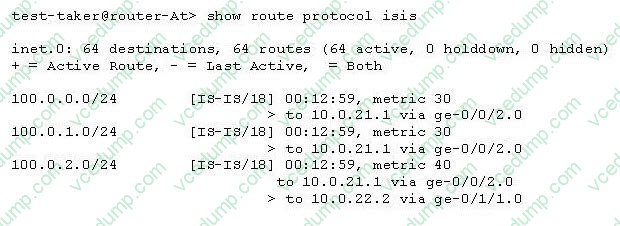
What does IS-IS/18 mean in the output displayed in the exhibit?
A. These routes are internal Level 1 routes.
B. These routes are internal Level 2 routes.
C. These routes are external Level 1 routes.
D. These routes are external Level 2 routes. -
Question 477:
Which two interface names can be used within the Junos OS to reference GRE or IP-IP tunnels? (Choose two.)
A. gr-1/2/0.0
B. gre-1/2/0.0
C. ip-2/3/0.0
D. ipip-2/3/0.0 -
Question 478:
Which two elements are valid in the BGP path selection algorithm? (Choose two.)
A. lowest local preference value
B. lowest multi-exit discriminator
C. highest multi-exit discriminator
D. highest local preference value -
Question 479:
How can you control the selection of the designated intermediate system (DIS) on a specific link in an IS-IS network?
A. Configure the interface as passive
B. Configure a priority on the interface
C. Configure the hello interval on the interface
D. DIS selection is random in the Junos OS -
Question 480:
Your customer would like to forward traffic using DLCI 600 and maintain Layer 2 information across a VPN. Which solution will meet these requirements?
A. a Layer 3 VPN
B. a Layer 2 VPN
C. Virtual Private LAN Service (VPLS)
D. an IPsec VPN
Related Exams:
-
JN0-102
Internet Associate, Junos(JNCIA-Junos) -
JN0-104
Junos, Associate (JNCIA-Junos) -
JN0-105
Junos, Associate (JNCIA-Junos) -
JN0-106
Junos - Associate (JNCIA-Junos) Junos OS 21.2 -
JN0-1101
Juniper Networks Certified Design Associate (JNCDA) -
JN0-1103
Design, Associate (JNCIA-Design) -
JN0-130
Juniper networks Certified internet specialist.e(jncis-e) -
JN0-1301
Data Center Design, Specialist (JNCDS-DC) -
JN0-1302
Data Center Design Specialist (JNCDS-DC) -
JN0-1331
Security Design, Specialist (JNCDS-SEC)
Tips on How to Prepare for the Exams
Nowadays, the certification exams become more and more important and required by more and more enterprises when applying for a job. But how to prepare for the exam effectively? How to prepare for the exam in a short time with less efforts? How to get a ideal result and how to find the most reliable resources? Here on Vcedump.com, you will find all the answers. Vcedump.com provide not only Juniper exam questions, answers and explanations but also complete assistance on your exam preparation and certification application. If you are confused on your JN0-361 exam preparations and Juniper certification application, do not hesitate to visit our Vcedump.com to find your solutions here.