JN0-361 Exam Details
-
Exam Code
:JN0-361 -
Exam Name
:Service Provider Routing and Switching, Specialist (JNCIS-SP) -
Certification
:Juniper Certifications -
Vendor
:Juniper -
Total Questions
:542 Q&As -
Last Updated
:May 25, 2026
Juniper JN0-361 Online Questions & Answers
-
Question 441:
Which role does the router ID (RID) have in the BGP route selection process?
A. The router ID is evaluated immediately after MED to determine route preference
B. The router ID is evaluated last in the route selection process
C. The router ID is evaluated after the cluster length and a lower router ID is chosen
D. The router ID is evaluated after analyzing the IGP metric cost -
Question 442:
-- Exhibit -user@router> show route 0/0 exact detail inet.0: 14 destinations, 14 routes (14 active, 0 holddown, 0 hidden)
0.0.0.0/0 (1 entry, 1 announced) *Aggregate PreferencE. 130 Next hop typE. Router, Next hop index: Next-hop reference count: 4 Next hop: 172.30.25.1 via ge-0/0/1.100, selected StatE. Local AS: 65400 AgE. 1:03:46 Task: Aggregate Announcement bits (2): 0-KRT 2-OSPF AS path: I Flags: Generate Depth: 0 Active Contributing Routes (1): 10.0.0.0/16 proto BGP -- Exhibit -
Click the Exhibit button.
You are advertising the route in the exhibit to your OSPF neighbors.
What happens if the 10.0.0.0/16 route is unavailable?
A. The default route will remain active and will "blackhole" all traffic from your OSPF peers.
B. The default route will become unavailable and will no longer be advertised to your OSPF peers.
C. The default route will remain active and will continue to be advertised to your OSPF peers.
D. The default route will become unavailable and will continue to be advertised to your OSPF peers. -
Question 443:
In an IS-IS network, which device represents the pseudonode?
A. a designated intermediate system
B. an area border router
C. a router with an IS-IS export policy
D. a router connected to the backbone -
Question 444:
Which packet type does the router use to request up-to-date link-state information?
A. IIH
B. LSP
C. PSNP
D. CSNP -
Question 445:
Click the Exhibit.
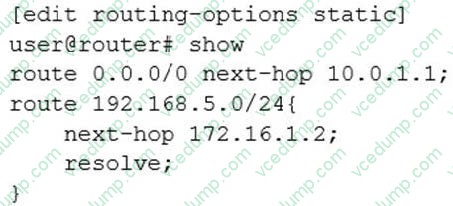
Referring to the configuration in the exhibit, which statement is true?
A. The next-hop 172.16.1.2 must be directly connected to the router for route 192.168.5.0/24 to be active.
B. The next-hop 172.16.1.2 must be part of an active route in route table inet.0 for route 192.168.5.0/24 to be active.
C. The next-hop 172.16.1.2 must respond to ping commands for the route 192.168.5.0/24 to be active.
D. The next-hop 172.16.1.2 must be active in route table inet.3 for the route 192.168.5.0/24 to be active. -
Question 446:
Your area border router (ABR) receives type 1.2 and 5 link-state advertisements (LSAs) from a non-backbone area. What would the ABR do with the information learned from the non-backbone area?
A. The ABR will generate type 2 and 3 LSAs and flood type 5 LSAs to the backbone area
B. The ABR will generate only type 3 LSAs and flood only type 5 LSAs to the backbone area
C. The ABR will generate type 3 and 4 LSAs. And flood type 5 LSAs to the backbone area
D. The ABR will generate only type 4 LSAs and flood only type 5 LSAs to the backbone area -
Question 447:
What is the default interval for a VRRP advertisement?
A. 1 second
B. 2 seconds
C. 10 seconds
D. 30 seconds -
Question 448:
You have been asked to identify what the contributing routes are for route 204.7.15/21. Which command will show this information?
A. show route 204.7.15/21
B. show route 204.7.15/21 extended
C. show route 204.7.15/21 exact summary
D. show route 204.7.15/21 detail -
Question 449:
What is the maximum number of MSTIs supported in an MST region?
A. 32
B. 64
C. 128
D. 256 -
Question 450:
Click the exhibit.
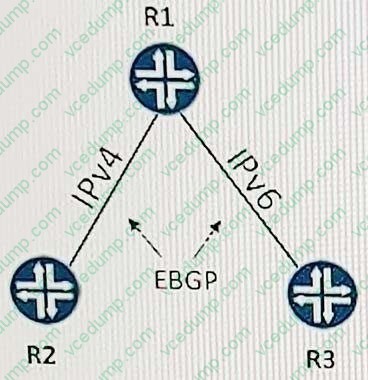
You are asked to enable a new BGP connection on R1, which has an existing IPv4 peering with R2. The new peering with R3 will use IPv6. Referring to the exhibit, which two steps are required to enable the new IPv6 peering? (Choose two.)
A. Configure an IPv6 address on the appropriate interface.
B. Configure the rib inet6.0 statement under the BGP group.
C. Configure an IPv6 neighbor address under the BGP group.
D. Configure an IPv6 local address under the BGP group.
Related Exams:
-
JN0-102
Internet Associate, Junos(JNCIA-Junos) -
JN0-104
Junos, Associate (JNCIA-Junos) -
JN0-105
Junos, Associate (JNCIA-Junos) -
JN0-106
Junos - Associate (JNCIA-Junos) Junos OS 21.2 -
JN0-1101
Juniper Networks Certified Design Associate (JNCDA) -
JN0-1103
Design, Associate (JNCIA-Design) -
JN0-130
Juniper networks Certified internet specialist.e(jncis-e) -
JN0-1301
Data Center Design, Specialist (JNCDS-DC) -
JN0-1302
Data Center Design Specialist (JNCDS-DC) -
JN0-1331
Security Design, Specialist (JNCDS-SEC)
Tips on How to Prepare for the Exams
Nowadays, the certification exams become more and more important and required by more and more enterprises when applying for a job. But how to prepare for the exam effectively? How to prepare for the exam in a short time with less efforts? How to get a ideal result and how to find the most reliable resources? Here on Vcedump.com, you will find all the answers. Vcedump.com provide not only Juniper exam questions, answers and explanations but also complete assistance on your exam preparation and certification application. If you are confused on your JN0-361 exam preparations and Juniper certification application, do not hesitate to visit our Vcedump.com to find your solutions here.