JN0-349 Exam Details
-
Exam Code
:JN0-349 -
Exam Name
:Enterprise Routing and Switching, Specialist (JNCIS-ENT) -
Certification
:Juniper Certifications -
Vendor
:Juniper -
Total Questions
:110 Q&As -
Last Updated
:Jul 14, 2026
Juniper JN0-349 Online Questions & Answers
-
Question 51:
Which three link-specific fields must match between OSPF neighbors before they form an adjacency over a broadcast medium? (Choose three.)
A. router priority
B. hello interval
C. neighbor
D. dead interval
E. options -
Question 52:
What are three reasons a router would send out an IS-IS link-state PDU? (Choose three.)
A. A new external route is imported from BGP.
B. The router's link to a neighbor goes down.
C. A new neighbor exists on the link.
D. The cost of a link to an existing neighbor has changed.
E. IS-IS sends link-state PDUs at random intervals. -
Question 53:
Each PC and IP phone in your network is connected to a switch using the same port. All incoming data traffic is untagged and belongs to the v10 VLAN, while traffic coming from the IP phones is tagged with a VLAN value of 20 and should belong to the v20 VLAN on your switch.
In this scenario, which statement is correct?
A. You must enable the voice VLAN feature on the incoming interfaces and assign the v20 VLAN.
B. You must enable an IRB interface and assign it to the v10 and v20 VLANs.
C. You must enable LLDP-MED on the incoming interfaces and assign the v20 VLAN.
D. You must enable the guest VLAN feature on the incoming interfaces and assign the v20 VLAN. -
Question 54:
Click the Exhibit button.
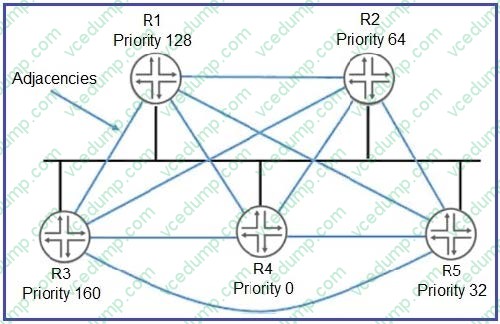
Referring to the exhibit, which router will be selected as the DR?
A. R1
B. R5
C. R4
D. R3 -
Question 55:
Which two statements about the default load-balancing behavior for the Junos OS are correct? (Choose two.)
A. By default, the Junos OS performs a per-packet load-balancing operation.
B. By default, the Junos OS installs multiple equal-cost next hops in the forwarding table for a destination prefix.
C. By default, the Junos OS selects one of the equal-cost next hops for received destination prefixes.
D. By default, all Packet Forwarding Engine slots are assigned the same hash value on the Junos device. -
Question 56:
You are configuring IBGP and you must ensure that reachability is maintained between participating routers, even if the physical topology changes.
Which two actions should you perform in this scenario? (Choose two.)
A. Configure DHCP on all IBGP devices.
B. Configure an IGP within your IBGP network.
C. Configure static routes to all IBGP peers.
D. Configure IBGP peerings to loopback addresses. -
Question 57:
Click the Exhibit button.
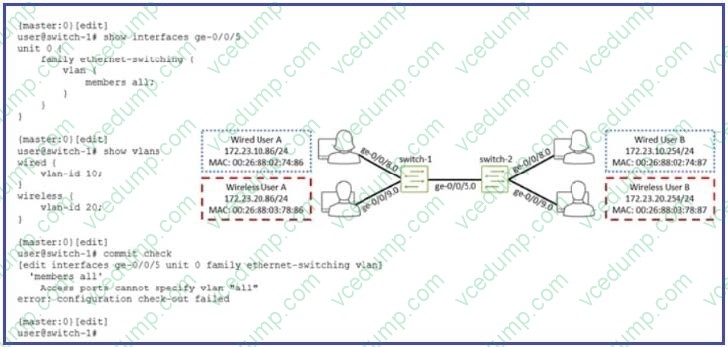
You are building a network and make some configuration changes. While trying to validate these changes, you receive the error shown in the exhibit. How would you solve this problem?
A. You must create a new VLAN called all using the VLAN ID of 30.
B. You must configure the ge-0/0/5.0 interface with family inet instead of family ethernet- switching.
C. You must configure the port mode as trunk on the ge-0/0/5.0 interface.
D. You must create two sub-interfaces on ge-0/0/5 with the appropriate VLAN member assigned to each. -
Question 58:
Which two statements about Layer 2 loop prevention protocols are correct? (Choose two.)
A. With STP, a designated port can transition to the forwarding state without waiting for the protocol times to expire.
B. STP uses point-to-point and edge port designations.
C. With RSTP, a designated port can transition to the forwarding state without waiting for the protocol times to expire.
D. RSTP uses point-to-point and edge port designations. -
Question 59:
Which two statements about the root bridge election process are correct? (Choose two.)
A. The highest root bridge priority is preferred over lower root bridge priorities.
B. The highest root bridge identifier is preferred over lower root bridge identifiers.
C. The lowest root bridge priority is preferred over higher root bridge priorities.
D. The lowest root bridge identifier is preferred over higher root bridge identifiers. -
Question 60:
What are two interarea OSPF LSA types? (Choose two.)
A. Type 1 router LSAs
B. Type 2 network LSAs
C. Type 3 summary LSAs
D. Type 4 ASBR summary LSAs
Related Exams:
-
JN0-102
Internet Associate, Junos(JNCIA-Junos) -
JN0-104
Junos, Associate (JNCIA-Junos) -
JN0-105
Junos, Associate (JNCIA-Junos) -
JN0-106
Junos - Associate (JNCIA-Junos) Junos OS 21.2 -
JN0-1101
Juniper Networks Certified Design Associate (JNCDA) -
JN0-1103
Design, Associate (JNCIA-Design) -
JN0-130
Juniper networks Certified internet specialist.e(jncis-e) -
JN0-1301
Data Center Design, Specialist (JNCDS-DC) -
JN0-1302
Data Center Design Specialist (JNCDS-DC) -
JN0-1331
Security Design, Specialist (JNCDS-SEC)
Tips on How to Prepare for the Exams
Nowadays, the certification exams become more and more important and required by more and more enterprises when applying for a job. But how to prepare for the exam effectively? How to prepare for the exam in a short time with less efforts? How to get a ideal result and how to find the most reliable resources? Here on Vcedump.com, you will find all the answers. Vcedump.com provide not only Juniper exam questions, answers and explanations but also complete assistance on your exam preparation and certification application. If you are confused on your JN0-349 exam preparations and Juniper certification application, do not hesitate to visit our Vcedump.com to find your solutions here.