CompTIA JK0-022 Online Practice
Questions and Exam Preparation
JK0-022 Exam Details
Exam Code
:JK0-022
Exam Name
:CompTIA Security+ Certification
Certification
:CompTIA Security+
Vendor
:CompTIA
Total Questions
:1149 Q&As
Last Updated
:Feb 05, 2025
CompTIA JK0-022 Online Questions &
Answers
Question 291:
Which of the following would Pete, a security administrator, do to limit a wireless signal from penetrating the exterior walls?
A. Implement TKIP encryption B. Consider antenna placement C. Disable the SSID broadcast D. Disable WPA
B. Consider antenna placement Cinderblock walls, metal cabinets, and other barriers can reduce signal strength significantly. Therefore, antenna placement is critical. Incorrect Answers: A: This option deals with encryption, not signal strength. C: This option would "cloak" the network, not limit its signal strength. D: This option deals with authentication, not signal strength. References: Dulaney, Emmett and Chuck Eastton, CompTIA Security+ Study Guide, Sixth Edition, Sybex, Indianapolis, 2014, pp 172, 173, 177, 183.
Question 292:
Which of the following statements is MOST likely to be included in the security awareness training about P2P?
A. P2P is always used to download copyrighted material. B. P2P can be used to improve computer system response. C. P2P may prevent viruses from entering the network. D. P2P may cause excessive network bandwidth.
D. P2P may cause excessive network bandwidth. P2P networking by definition involves networking which will reduce available bandwidth for the rest of the users on the network. Incorrect Answers: A: P2P connections are used commonly for sharing files, printers, even songs, etc. This can also be done with personally owned devices. B: P2P is not used to improve computer system response in a corporate setting. C: This is not necessarily correct since the virus may be introduced to the network with a P2P connection which is done within the network in a corporate setting. References: Dulaney, Emmett and Chuck Eastton, CompTIA Security+ Study Guide, Sixth Edition, Sybex, Indianapolis, 2014, p 404
Question 293:
Which of the following is built into the hardware of most laptops but is not setup for centralized management by default?
A. Whole disk encryption B. TPM encryption C. USB encryption D. Individual file encryption
B. TPM encryption Trusted Platform Module (TPM) is a hardware-based encryption solution that is embedded in the system's motherboard and is enabled or disable in BIOS. It helps with hash key generation and stores cryptographic keys, passwords, or certificates. Incorrect Answers: A Whole disk and device encryption encrypts the data on the device. This feature ensures that the data on the device cannot be accessed in a useable form should the device be stolen. This encryption can be provided by a hardware solution, such as TPM or HSM, or a software solution. C: USB encryption is provided by the vendor of the USB device or by a tool from a third party. It is not included in the hardware of a laptop. D. File encryption can be used to protect the contents of individual files. It uses randomly generated symmetric encryption keys for the file and stores the key in an encrypted form using the user's public key on the encrypted file. References: Dulaney, Emmett and Chuck Eastton, CompTIA Security+ Study Guide, Sixth Edition, Sybex, Indianapolis, 2014, pp 418-419 Stewart, James Michael, CompTIA Security+ Review Guide, Sybex, Indianapolis, 2014, pp 236, 237, 252, 255
Question 294:
Users are utilizing thumb drives to connect to USB ports on company workstations. A technician is concerned that sensitive files can be copied to the USB drives. Which of the following mitigation techniques would address this concern? (Select TWO).
A. Disable the USB root hub within the OS. B. Install anti-virus software on the USB drives. C. Disable USB within the workstations BIOS. D. Apply the concept of least privilege to USB devices. E. Run spyware detection against all workstations.
A. Disable the USB root hub within the OS. C. Disable USB within the workstations BIOS. A: The USB root hub can be disabled from within the operating system. C: USB can also be configured and disabled in the system BIOS. Incorrect Answers: B: Anti-virus is installed on a device, not on removable storage. Anti-virus also does not prevent the unauthorized copying of data. D: The principle of least privilege is used to ensure that users are only provided with the minimum privileges and permissions to resources that allow them to perform their duties. E: Spyware monitors a user's activity and uses network protocols to reports it to a third party without the user's knowledge. Detecting spyware does not prevent the unauthorized copying of data. References: Dulaney, Emmett and Chuck Eastton, CompTIA Security+ Study Guide, Sixth Edition, Sybex, Indianapolis, 2014, pp 153, 247-248, 300 Stewart, James Michael, CompTIA Security+ Review Guide, Sybex, Indianapolis, 2014, pp 82,
Question 295:
The Chief Security Officer (CSO) is contacted by a first responder. The CSO assigns a handler. Which of the following is occurring?
A. Unannounced audit response B. Incident response process C. Business continuity planning D. Unified threat management E. Disaster recovery process
B. Incident response process
Question 296:
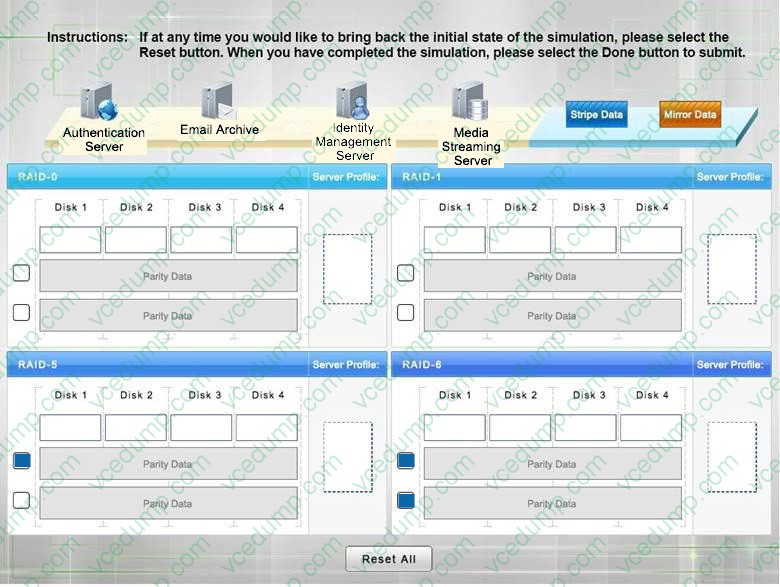
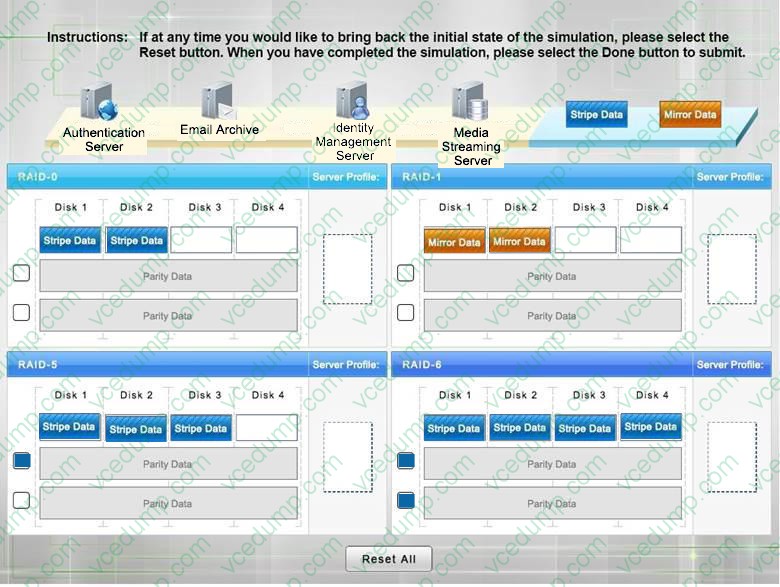
DRAG DROP A security administrator is given the security and availability profiles for servers that are being deployed. 1) Match each RAID type with the correct configuration and MINIMUM number of drives. 2) Review the server profiles and match them with the appropriate RAID type based on integrity, availability, I/O, storage requirements. Instructions: ꞏ All drive definitions can be dragged as many times as necessary ꞏ Not all placeholders may be filled in the RAID configuration boxes ꞏ If parity is required, please select the appropriate number of parity checkboxes ꞏ Server profiles may be dragged only once If at any time you would like to bring back the initial state of the simulation, please select the Reset button. When you have completed the simulation, please select the Done button to submit. Once the simulation is submitted, please select the Next button to continue.
Select and Place:
Question 297:
Which of the following is characterized by an attack against a mobile device?
A. Evil twin B. Header manipulation C. Blue jacking D. Rogue AP
C. Blue jacking A bluejacking attack is where unsolicited messages are sent to mobile devices using Bluetooth. Bluejacking is the sending of unsolicited messages over Bluetooth to Bluetooth-enabled devices such as mobile phones, PDAs or laptop computers, sending a vCard which typically contains a message in the name field (i.e., for bluedating or bluechat) to another Bluetooth-enabled device via the OBEX protocol. Bluetooth has a very limited range, usually around 10 metres (32.8 ft) on mobile phones, but laptops can reach up to 100 metres (328 ft) with powerful (Class 1) transmitters. Bluejacking is usually harmless, but because bluejacked people generally don't know what has happened, they may think that their phone is malfunctioning. Usually, a bluejacker will only send a text message, but with modern phones it's possible to send images or sounds as well. Bluejacking has been used in guerrilla marketing campaigns to promote advergames. Incorrect Answers: A: An evil twin, in the context of network security, is a rogue or fake wireless access point (WAP) that appears as a genuine hotspot offered by a legitimate provider. In an evil twin attack, an eavesdropper or hacker fraudulently creates this rogue hotspot to collect the personal data of unsuspecting users. Sensitive data can be stolen by spying on a connection or using a phishing technique. For example, a hacker using an evil twin exploit may be positioned near an authentic Wi-Fi access point and discover the service set identifier (SSID) and frequency. The hacker may then send a radio signal using the exact same frequency and SSID. To end users, the rogue evil twin appears as their legitimate hotspot with the same name. A mobile device could connect to an evil twin access point but an evil twin is does not attack a mobile device. Therefore, this answer is incorrect. B: Header manipulation is an attack on an application that access web pages or web services. It involves introducing unvalidated data in an HTTP response header which can enable cache- poisoning, cross-site scripting, cross-user defacement, page hijacking, cookie manipulation or open redirect. It is not used as a direct attack on a mobile device. Therefore, this answer is incorrect. D: A rogue access point is a wireless access point that has either been installed on a secure company network without explicit authorization from a local network administrator, or has been created to allow a hacker to conduct a man-in-themiddle attack. Rogue access points of the first kind can pose a security threat to large organizations with many employees, because anyone with access to the premises can install (maliciously or non-maliciously) an inexpensive wireless router that can potentially allow access to a secure network to unauthorized parties. Rogue access points of the second kind target networks that do not employ mutual authentication (client-server server-client) and may be used in conjunction with a rogue RADIUS server, depending on security configuration of the target network. Similar to an evil twin, a mobile device could connect to a rogue access point but an evil twin is does not attack a mobile device. Therefore, this answer is incorrect. References: http://en.wikipedia.org/wiki/Bluejacking http://www.techopedia.com/definition/5057/evil-twin http://en.wikipedia.org/wiki/Rogue_access_point
Question 298:
A system administrator has concerns regarding their users accessing systems and secured areas using others' credentials. Which of the following can BEST address this concern?
A. Create conduct policies prohibiting sharing credentials. B. Enforce a policy shortening the credential expiration timeframe. C. Implement biometric readers on laptops and restricted areas. D. Install security cameras in areas containing sensitive systems.
C. Implement biometric readers on laptops and restricted areas. Biometrics is an authentication process that makes use of physical characteristics to establish identification. This will prevent users making use of others credentials. Incorrect Answers: A: Policies need to be implemented and making use of biometrics would be to a way to prohibit sharing credentials. B: This is still granting the same type of access that is already being abused with a time limit the only difference. D: Security cameras are used to surveil and record; not to prevent access. References: Dulaney, Emmett and Chuck Eastton, CompTIA Security+ Study Guide, Sixth Edition, Sybex, Indianapolis, 2014, p 375
Question 299:
Employee badges are encoded with a private encryption key and specific personal information. The encoding is then used to provide access to the network. Which of the following describes this access control type?
A. Smartcard B. Token C. Discretionary access control D. Mandatory access control
A. Smartcard Smart cards are credit-card-sized IDs, badges, or security passes with an embedded integrated circuit chip that can include data regarding the authorized bearer. This data can then be used for identification and/or authentication purposes. Incorrect Answers: B: A token is a type of authentication factor, usually a hardware device. C: Discretionary access control (DAC) allows access to be granted or restricted by an object's owner based on user identity and on the discretion of the object owner. DAC does not involve badges. D: Mandatory Access Control allows access to be granted or restricted based on the rules of classification. MAC does not involve badges. References: Stewart, James Michael, CompTIA Security+ Review Guide, Sybex, Indianapolis, 2014, pp 278- 282.
Question 300:
A new web server has been provisioned at a third party hosting provider for processing credit card transactions. The security administrator runs the netstat command on the server and notices that ports 80, 443, and 3389 are in a 'listening' state. No other ports are open. Which of the following services should be disabled to ensure secure communications?
Nowadays, the certification exams become more and more important and required by more and more
enterprises when applying for a job. But how to prepare for the exam effectively? How to prepare
for the exam in a short time with less efforts? How to get a ideal result and how to find the
most reliable resources? Here on Vcedump.com, you will find all the answers.
Vcedump.com provide not only CompTIA exam questions,
answers and explanations but also complete assistance on your exam preparation and certification
application. If you are confused on your JK0-022 exam preparations
and CompTIA certification application, do not hesitate to visit our
Vcedump.com to find your solutions here.