CompTIA JK0-022 Online Practice
Questions and Exam Preparation
JK0-022 Exam Details
Exam Code
:JK0-022
Exam Name
:CompTIA Security+ Certification
Certification
:CompTIA Security+
Vendor
:CompTIA
Total Questions
:1149 Q&As
Last Updated
:Feb 05, 2025
CompTIA JK0-022 Online Questions &
Answers
Question 121:
A security analyst implemented group-based privileges within the company active directory. Which of the following account management techniques should be undertaken regularly to ensure least privilege principles?
A. Leverage role-based access controls. B. Perform user group clean-up. C. Verify smart card access controls. D. Verify SHA-256 for password hashes.
B. Perform user group clean-up. Active Directory (AD) has no built-in clean-up feature. This can result in obsolete user, group and computer objects accumulating over time and placing security and compliance objectives in jeopardy. You would therefore need to regularly clean-up these settings. Incorrect Answers: A: Reusing role-based access controls would not ensure least privilege principles. C: Smart cards are credit-card-sized IDs, badges, or security passes with an embedded integrated circuit chip that allows you to physically access secure facilities. This would not ensure least privilege principles. D: Hashing is used to detect violations of data integrity. This would not ensure least privilege principles. References: http://www.cayosoft.com/active-directory-cleanup/
Question 122:
Timestamps and sequence numbers act as countermeasures against which of the following types of attacks?
A. Smurf B. DoS C. Vishing D. Replay
D. Replay A replay attack (also known as playback attack) is a form of network attack in which a valid data transmission is maliciously or fraudulently repeated or delayed. This is carried out either by the originator or by an adversary who intercepts the data and retransmits it, possibly as part of a masquerade attack by IP packet substitution (such as stream cipher attack). For example: Suppose Alice wants to prove her identity to Bob. Bob requests her password as proof of identity, which Alice dutifully provides (possibly after some transformation like a hash function); meanwhile, Eve is eavesdropping on the conversation and keeps the password (or the hash). After the interchange is over, Eve (posing as Alice) connects to Bob; when asked for a proof of identity, Eve sends Alice's password (or hash) read from the last session, which Bob accepts thus granting access to Eve. Countermeasures: A way to avoid replay attacks is by using session tokens: Bob sends a one- time token to Alice, which Alice uses to transform the password and send the result to Bob (e.g. computing a hash function of the session token appended to the password). On his side Bob performs the same computation; if and only if both values match, the login is successful. Now suppose Eve has captured this value and tries to use it on another session; Bob sends a different session token, and when Eve replies with the captured value it will be different from Bob's computation. Session tokens should be chosen by a (pseudo-) random process. Otherwise Eve may be able to pose as Bob, presenting some predicted future token, and convince Alice to use that token in her transformation. Eve can then replay her reply at a later time (when the previously predicted token is actually presented by Bob), and Bob will accept the authentication. Onetime passwords are similar to session tokens in that the password expires after it has been used or after a very short amount of time. They can be used to authenticate individual transactions in addition to sessions. The technique has been widely implemented in personal online banking systems. Bob can also send nonces but should then include a message authentication code (MAC), which Alice should check. Timestamping is another way of preventing a replay attack. Synchronization should be achieved using a secure protocol. For example Bob periodically broadcasts the time on his clock together with a MAC. When Alice wants to send Bob a message, she includes her best estimate of the time on his clock in her message, which is also authenticated. Bob only accepts messages for which the timestamp is within a reasonable tolerance. The advantage of this scheme is that Bob does not need to generate (pseudo-) random numbers, with the trade-off being that replay attacks, if they are performed quickly enough i.e. within that 'reasonable' limit, could succeed. Incorrect Answers: A: A smurf attack is a type of network security breach in which a network connected to the Internet is swamped with replies to ICMP echo (PING) requests. A smurf attacker sends PING requests to an Internet broadcast address. These are special addresses that broadcast all received messages to the hosts connected to the subnet. Each broadcast address can support up to 255 hosts, so a single PING request can be multiplied 255 times. The return address of the request itself is spoofed to be the address of the attacker's victim. All the hosts receiving the PING request reply to this victim's address instead of the real sender's address. A single attacker sending hundreds or thousands of these PING messages per second can fill the victim's T-1 (or even T-3) line with ping replies, bring the entire Internet service to its knees. Smurfing falls under the general category of Denial of Service attacks -- security attacks that don't try to steal information, but instead attempt to disable a computer or network. Timestamps are not used to defend against this type of attack. Therefore, this answer is incorrect. B: DoS, short for denial-of-service attack, a type of attack on a network that is designed to bring the network to its knees by flooding it with useless traffic. Many DoS attacks, such as the Ping of Death and Teardrop attacks, exploit limitations in the TCP/IP protocols. For all known DoS attacks, there are software fixes that system administrators can install to limit the damage caused by the attacks. But, like viruses, new DoS attacks are constantly being dreamed up by hackers. Timestamps are not used to defend against this type of attack. Therefore, this answer is incorrect. C: Vishing is the telephone equivalent of phishing. Vishing is the act of using the telephone in an attempt to scam the user into surrendering private information that will be used for identity theft. The scammer usually pretends to be a legitimate business, and fools the victim into thinking he or she will profit. Timestamps are not used to defend against this type of attack. Therefore, this answer is incorrect. References: http://en.wikipedia.org/wiki/Replay_attack http://www.webopedia.com/TERM/S/smurf.html http://www.webopedia.com/TERM/D/DoS_attack.html http://www.webopedia.com/TERM/V/vishing.html
Question 123:
Users report that after downloading several applications, their systems' performance has noticeably decreased. Which of the following would be used to validate programs prior to installing them?
A. Whole disk encryption B. SSH C. Telnet D. MD5
D. MD5 MD5 can be used to locate the data which has changed. The Message Digest Algorithm (MD) creates a hash value and uses a one-way hash. The hash value is used to help maintain integrity. There are several versions of MD; the most common are MD5, MD4, and MD2. Incorrect Answers: A: Disk encryption would not help in checking integrity of downloaded files. B: Secure Shell (SSH) is a tunnelling protocol originally used on Unix systems. It is not used to validate the integrity of files. C: Telnet cannot be used to protect integrity of program files. Telnet is an interactive terminal emulation protocol. It allows a remote user to conduct an interactive session with a Telnet server. This session can appear to the client as if it were a local session. References: Dulaney, Emmett and Chuck Eastton, CompTIA Security+ Study Guide, Sixth Edition, Sybex, Indianapolis, 2014, pp 76, 255, 271, 290
Question 124:
Joe Has read and write access to his own home directory. Joe and Ann are collaborating on a project, and Joe would like to give Ann write access to one particular file in this home directory. Which of the following types of access control would this reflect?
A. Role-based access control B. Rule-based access control C. Mandatory access control D. Discretionary access control
D. Discretionary access control Discretionary access control (DAC) allows access to be granted or restricted by an object's owner based on user identity and on the discretion of the object owner. Incorrect Answers: A: Basically, Role-based Access Control is based on a user's job description. B: Rule-based access control is used for network devices that filter traffic based on filtering rules. C: Mandatory Access Control allows access to be granted or restricted based on the rules of classification. References: Stewart, James Michael, CompTIA Security+ Review Guide, Sybex, Indianapolis, 2014, pp 278- 284.
Question 125:
DRAG DROP
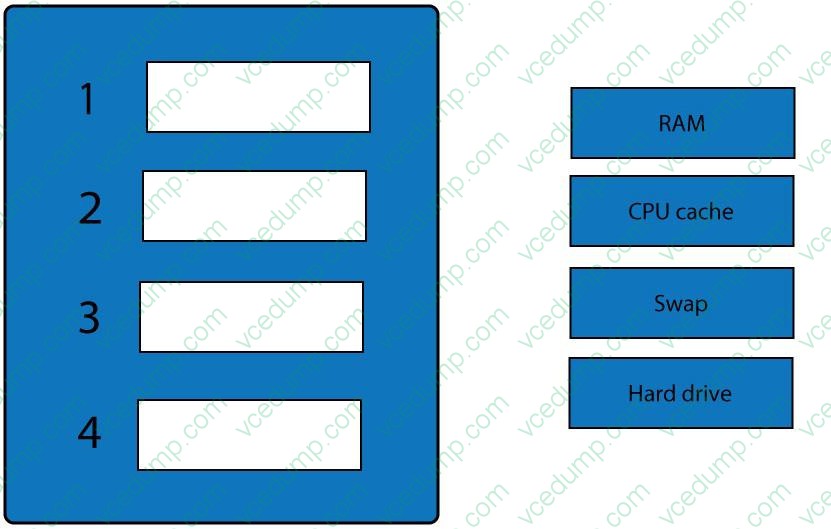
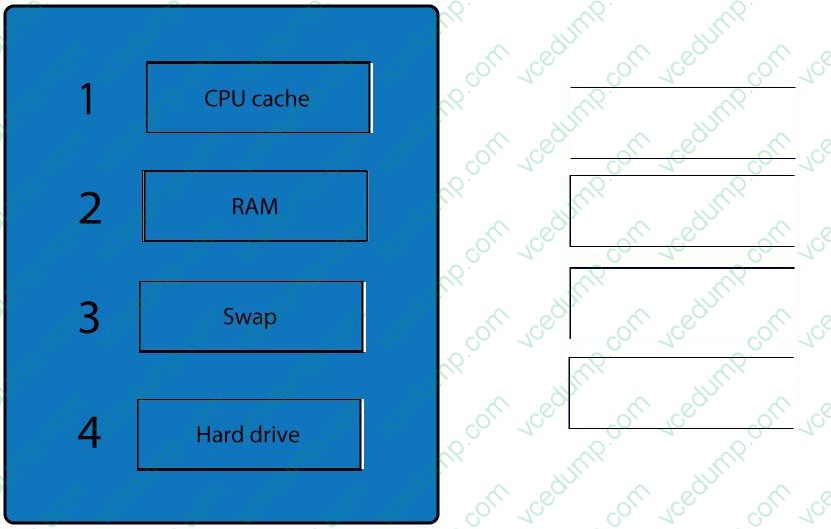
A forensic analyst is asked to respond to an ongoing network attack on a server. Place the items in the list below in the correct order in which the forensic analyst should preserve them.
Select and Place:
When dealing with multiple issues, address them in order of volatility (OOV); always deal with the most volatile first. Volatility can be thought of as the amount of time that you have to collect certain data before a window of opportunity is gone.
Naturally, in an investigation you want to collect everything, but some data will exist longer than others, and you cannot possibly collect all of it once. As an example, the OOV in an investigation may be RAM, hard drive data, CDs/DVDs, and
printouts.
Order of volatility: Capture system images as a snapshot of what exists, look at network traffic and logs, capture any relevant video/screenshots/hashes, record time offset on the systems, talk to witnesses, and track total man-hours and
expenses associated with the investigation.
References:
Dulaney, Emmett and Chuck Eastton, CompTIA Security+ Study Guide, Sixth Edition, Sybex, Indianapolis, 2014, p 453
Question 126:
Which of the following describes a type of malware which is difficult to reverse engineer in a virtual lab?
A. Armored virus B. Polymorphic malware C. Logic bomb D. Rootkit
A. Armored virus An armored virus is a type of virus that has been designed to thwart attempts by analysts from examining its code by using various methods to make tracing, disassembling and reverse engineering more difficult. An Armored Virus may also protect itself from antivirus programs, making it more difficult to trace. To do this, the Armored Virus attempts to trick the antivirus program into believing its location is somewhere other than where it really is on the system. Incorrect Answers: B: In computer terminology, polymorphic code is code that uses a polymorphic engine to mutate while keeping the original algorithm intact. That is, the code changes itself each time it runs, but the function of the code (its semantics) will not change at all. For example, 1+3 and 6-2 both achieve the same result while using different code. This technique is sometimes used by computer viruses, shellcodes and computer worms to hide their presence. This is not what is described in this question. Therefore, this answer is incorrect. C: A logic bomb is a piece of code intentionally inserted into a software system that will set off a malicious function when specified conditions are met. For example, a programmer may hide a piece of code that starts deleting files should they ever be terminated from the company. Software that is inherently malicious, such as viruses and worms, often contain logic bombs that execute a certain payload at a pre-defined time or when some other condition is met. This technique can be used by a virus or worm to gain momentum and spread before being noticed. Some viruses attack their host systems on specific dates, such as Friday the 13th or April Fool's Day. Trojans that activate on certain dates are often called "time bombs". A logic bomb is not what is described in this question. Therefore, this answer is incorrect. D: A rootkit is a collection of tools (programs) that enable administrator-level access to a computer or computer network. Typically, a cracker installs a rootkit on a computer after first obtaining user-level access, either by exploiting a known vulnerability or cracking a password. Once the rootkit is installed, it allows the attacker to mask intrusion and gain root or privileged access to the computer and, possibly, other machines on the network. A rootkit may consist of spyware and other programs that: monitor traffic and keystrokes; create a "backdoor" into the system for the hacker's use; alter log files; attack other machines on the network; and alter existing system tools to escape detection. A rootkit is not what is described in this question. Therefore, this answer is incorrect. References: http://www.webopedia.com/TERM/A/Armored_Virus.html http://en.wikipedia.org/wiki/Polymorphic_code http://en.wikipedia.org/wiki/Logic_bomb http://searchmidmarketsecurity.techtarget.com/definition/rootkit
Question 127:
A system administrator is configuring UNIX accounts to authenticate against an external server. The configuration file asks for the following information DC=ServerName and DC=COM. Which of the following authentication services is being used?
A. RADIUS B. SAML C. TACACS+ D. LDAP
D. LDAP The Lightweight Directory Access Protocol is an open, vendor-neutral, industry standard application protocol for accessing and maintaining distributed directory information services over an Internet Protocol (IP) network. Directory services play an important role in developing intranet and Internet applications by allowing the sharing of information about users, systems, networks, services, and applications throughout the network. As examples, directory services may provide any organized set of records, often with a hierarchical structure, such as a corporate email directory. Similarly, a telephone directory is a list of subscribers with an address and a phone number. An entry can look like this when represented in LDAP Data Interchange Format (LDIF) (LDAP itself is a binary protocol): dn: cn=John Doe,dc=example,dc=com cn: John Doe givenName: John sn: Doe telephoneNumber: +1 888 555 6789 telephoneNumber: +1 888 555 1232 mail: [email protected] manager: cn=Barbara Doe,dc=example,dc=com objectClass: inetOrgPerson objectClass: organizationalPerson objectClass: person objectClass: top "dn" is the distinguished name of the entry; it is neither an attribute nor a part of the entry. "cn=John Doe" is the entry's RDN (Relative Distinguished Name), and "dc=example,dc=com" is the DN of the parent entry, where "dc" denotes 'Domain Component'. The other lines show the attributes in the entry. Attribute names are typically mnemonic strings, like "cn" for common name, "dc" for domain component, "mail" for e-mail address, and "sn" for surname. Incorrect Answers: A: A RADIUS server is a server with a database of user accounts and passwords used as a central authentication database for users requiring network access. The authentication method described in this question is not using a RADIUS server. B: Security Assertion Markup Language (SAML) is an XML-based, open-standard data format for exchanging authentication and authorization data between parties, in particular, between an identity provider and a service provider. The authentication method described in this question is not SAML. C: Terminal Access Controller Access-Control System (TACACS) refers to a family of related protocols handling remote authentication and related services for networked access control through a centralized server. The authentication method described in this question is not TACACS+. References: http://en.wikipedia.org/wiki/Lightweight_Directory_Access_Protocol#Directory_structure
Question 128:
A security administrator must implement all requirements in the following corporate policy:
Passwords shall be protected against offline password brute force attacks. Passwords shall be protected against online password brute force attacks. Which of the following technical controls must be implemented to enforce the corporate
policy? (Select THREE).
A. Account lockout B. Account expiration C. Screen locks D. Password complexity E. Minimum password lifetime F. Minimum password length
A. Account lockout D. Password complexity F. Minimum password length A brute force attack is a trial-and-error method used to obtain information such as a user password or personal identification number (PIN). In a brute force attack, automated software is used to generate a large number of consecutive guesses as to the value of the desired data. Brute force attacks may be used by criminals to crack encrypted data, or by security analysts to test an organization's network security. A brute force attack may also be referred to as brute force cracking. For example, a form of brute force attack known as a dictionary attack might try all the words in a dictionary. Other forms of brute force attack might try commonly-used passwords or combinations of letters and numbers. The best defense against brute force attacks strong passwords. The following password policies will ensure that users have strong (difficult to guess) passwords: F: Minimum password length. This policy specifies the minimum number of characters a password should have. For example: a minimum password length of 8 characters is regarded as good security practice. D: Password complexity determines what characters a password should include. For example, you could require a password to contain uppercase and lowercase letters and numbers. This will ensure that passwords don't consist of dictionary words which are easy to crack using brute force techniques. A: Account lockout policy: This policy ensures that a user account is locked after a number of incorrect password entries. For example, you could specify that if a wrong password is entered three times, the account will be locked for a period of time or indefinitely until the account is unlocked by an administrator. Incorrect Answers: B: Account expiration settings determine when an account will expire. This is usually a time or date. An account configured with an expiration date will not prevent an attacker trying to brute force a password as the attacker could make as many attempts as he wants until the time or date of the account expiration. Therefore, this answer is incorrect. C: A screen lock will cause the screen of a computer or mobile device to lock after a period of inactivity. It is not used to prevent brute force attacks. Therefore, this answer is incorrect. E: Password history determines the number of previous passwords that cannot be used when a user changes his password. For example, a password history value of 5 would disallow a user from changing his password to any of his previous 5 passwords. When a user is forced to change his password due to a maximum password age period expiring, he could change his password to a previously used password. Or if a password history value of 5 is configured, the user could change his password six times to cycle back round to the original password. This is where the minimum password age (minimum password lifetime) comes in. This is the period that a password must be used for. For example, a minimum password age of 30 would determine that when a user changes his password, he must continue to use the same password for at least 30 days. A minimum password age would not protect against brute force attacks. Therefore, this answer is incorrect. References: https://technet.microsoft.com/enus/library/cc757692%28v=ws.10%29.aspx#w2k3tr_sepol_accou_set_kuwh
Question 129:
Digital Signatures provide which of the following?
A. Confidentiality B. Authorization C. Integrity D. Authentication E. Availability
C. Integrity A digital signature is similar in function to a standard signature on a document. It validates the integrity of the message and the sender. Incorrect Answers: A: A cryptographic system would be needed to provide Confidentiality. B: Digital signatures are not used for authorization. D: Digital signature is one methods of verifying authenticity but there are other methods as well. E: Digital signatures are not helpful in providing availability. References: Dulaney, Emmett and Chuck Eastton, CompTIA Security+ Study Guide, Sixth Edition, Sybex, Indianapolis, 2014, p 414
Question 130:
Which of the following disaster recovery strategies has the highest cost and shortest recovery time?
A. Warm site B. Hot site C. Cold site D. Co-location site
B. Hot site A hot site is a location that can provide operations within hours of a failure. This type of site would have servers, networks, and telecommunications equipment in place to reestablish service in a short time. Hot sites provide network connectivity, systems, and preconfigured software to meet the needs of an organization. Databases can be kept up-to-date using network connections. These types of facilities are expensive, and they're primarily suitable for short-term situations. Incorrect Answers: A: A warm site provides some of the capabilities of a hot site, but it requires the customer to do more work to become operational. Warm sites provide computer systems and compatible media capabilities. C: A cold site is a facility that isn't immediately ready to use. The organization using it must bring along its equipment and network. A cold site may provide network capability, but this isn't usually the case; the site provides a place for operations to resume, but it doesn't provide the infrastructure to support those operations. D: A co-location site is type of site where your web hosting is done, e.g. an ISP, or a web hosting company where many different customers host their web presence. References: Dulaney, Emmett and Chuck Eastton, CompTIA Security+ Study Guide, Sixth Edition, Sybex, Indianapolis, 2014, pp 443-444
Nowadays, the certification exams become more and more important and required by more and more
enterprises when applying for a job. But how to prepare for the exam effectively? How to prepare
for the exam in a short time with less efforts? How to get a ideal result and how to find the
most reliable resources? Here on Vcedump.com, you will find all the answers.
Vcedump.com provide not only CompTIA exam questions,
answers and explanations but also complete assistance on your exam preparation and certification
application. If you are confused on your JK0-022 exam preparations
and CompTIA certification application, do not hesitate to visit our
Vcedump.com to find your solutions here.