ISO-IEC-27001-LEAD-AUDITOR Exam Details
-
Exam Code
:ISO-IEC-27001-LEAD-AUDITOR -
Exam Name
:PECB Certified ISO/IEC 27001 Lead Auditor exam -
Certification
:PECB Certifications -
Vendor
:PECB -
Total Questions
:289 Q&As -
Last Updated
:May 25, 2026
PECB ISO-IEC-27001-LEAD-AUDITOR Online Questions & Answers
-
Question 181:
Select two options that describe an advantage of using a checklist.
A. Using the same checklist for every audit without review
B. Restricting interviews to nominated parties
C. Ensuring relevant audit trails are followed
D. Ensuring the audit plan is implemented
E. Reducing audit duration F. Not varying from the checklist when necessary -
Question 182:
You are performing an ISMS audit at a residential nursing home called ABC that provides healthcare services.
The next step in your audit plan is to verify the information security on ABC's healthcare mobile app development, support, and lifecycle process. During the audit, you learned the organization outsourced the mobile app development to a professional software development company with CMMI Level 5, ITSM (ISO /IEC 20000-1), BCMS (ISO 22301) and ISMS (ISO/IEC 27001) certified. The IT Manager presented the software security management procedure and summarised the process as follows:
The mobile app development shall adopt "security-by-design" and "security-by-default" principles, as a minimum. The following security functions for personal data protection shall be available: Access control.
Personal data encryption, i.e., Advanced Encryption Standard (AES) algorithm, key lengths: 256 bits; and Personal data pseudonymization.
Vulnerability checked and no security backdoor
You sample the latest Mobile App Test report - details as follows:
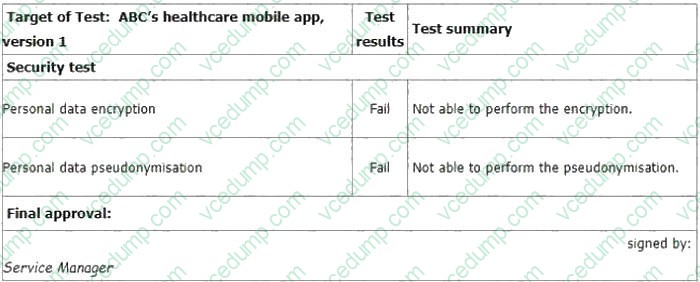
You ask the IT Manager why the organisation still uses the mobile app while personal data encryption and pseudonymization tests failed. Also, whether the Service Manager is authorized to approve the test.
The IT Manager explains the test results should be approved by him according to the software security management procedure. The reason why the encryption and pseudonymization functions failed is that these functions heavily slowed
down the system and service performance. An extra 150% of resources are needed to cover this. The Service Manager agreed that access control is good enough and acceptable. That's why the Service Manager signed the approval.
You sample one of the medical staff's mobile and found that ABC's healthcare mobile app, version 1.01 is installed. You found that version 1.01 has no test record.
The IT Manager explains that because of frequent ransomware attacks, the outsourced mobile app development company gave a free minor update on the tested software, performed an emergency release of the updated software, and gave
a verbal guarantee that there will be no impact on any security functions. Based on his 20 years of information security experience, there is no need to re-test.
You are preparing the audit findings Select two options that are correct.
A. There is a nonconformity (NC). The IT. Manager does not comply with the software security management procedure. (Relevant to clause 8.1, control A.8.30)
B. There is a nonconformity (NC). The organisation does not control planned changes and review the consequences of unintended changes. (Relevant to clause 8.1)
C. There is an opportunity for improvement (OI). The IT Manager should make the decision to continue the service based on appropriate testing. (Relevant to clause 8.1, control A.8.30)
D. There is an opportunity for improvement (OI). The organisation selects an external service provider based on the extent of free services it will provide. (Relevant to clause 8.1, control A.5.21)
E. There is NO nonconformity (NC). The IT Manager demonstrates good leadership. (Relevant to clause 5.1, control 5.4)
F. There is NO nonconformity (NC). The IT Manager demonstrates he is fully competent. (Relevant to clause 7.2) -
Question 183:
Which two of the following standards are used as ISMS third-party certification audit criteria?
A. ISO/IEC 27002
B. ISO/IEC 20000-1
C. ISO 19011
D. ISO/IEC 27001
E. Relavent legal, statutory, and regulatory requirements
F. ISO/IEC 17021-1 -
Question 184:
Which two activities align with the "Check'' stage of the Plan-Do-Check-Act cycle when applied to the process of managing an internal audit program as described in ISO 19011?
A. Retains records of internal audits
B. Define audit criteria and scope for each internal audit
C. Update the internal audit programme
D. Establish a risk-based internal audit programme
E. Conduct internal audits
F. Verify effectiveness of the internal audit programme
G. Review trends in internal audit result -
Question 185:
Costs related to nonconformities and failures to comply with legal and contractual requirements are assessed when defining:
A. Materiality
B. Audit risks
C. Reasonable assurance -
Question 186:
Scenario 2: Knight is an electronics company from Northern California, US that develops video game consoles. Knight has more than 300 employees worldwide. On the fifth anniversary of their establishment, they have decided to deliver the G-Console, a new generation video game console aimed for worldwide markets. G-Console is considered to be the ultimate media machine of 2021 which will give the best gaming experience to players.
The console pack will include a pair of VR headset, two games, and other gifts.
Over the years, the company has developed a good reputation by showing integrity, honesty, and respect toward their customers. This good reputation is one of the reasons why most passionate gamers aim to have Knight's G-console as soon as it is released in the market.
Besides being a very customer-oriented company, Knight also gained wide recognition within the gaming industry because of the developing quality. Their prices are a bit higher than the reasonable standards allow.
Nonetheless, that is not considered an issue for most loyal customers of Knight, as their quality is top-notch.
Being one of the top video game console developers in the world, Knight is also often the center of attention for malicious activities. The company has had an operational ISMS for over a year. The ISMS scope includes all departments of
Knight, except Finance and HR departments.
Recently, a number of Knight's files containing proprietary information were leaked by hackers. Knight's incident response team (IRT) immediately started to analyze every part of the system and the details of the incident.
The IRT's first suspicion was that Knight's employees used weak passwords and consequently were easily cracked by hackers who gained unauthorized access to their accounts. However, after carefully investigating the incident, the IRT
determined that hackers accessed accounts by capturing the file transfer protocol (FTP) traffic.
FTP is a network protocol for transferring files between accounts. It uses clear text passwords for authentication.
Following the impact of this information security incident and with IRT's suggestion, Knight decided to replace the FTP with Secure Shell (SSH) protocol, so anyone capturing the traffic can only see encrypted data.
Following these changes, Knight conducted a risk assessment to verify that the implementation of controls had minimized the risk of similar incidents. The results of the process were approved by the ISMS project manager who claimed that
the level of risk after the implementation of new controls was in accordance with the company's risk acceptance levels.
Based on this scenario, answer the following question:
According to scenario 2, the ISMS scope was not applied to the Finance and HR Department of Knight. Is this acceptable?
A. Yes, the ISMS must be applied only to processes and assets that may directly impact information security
B. Yes, the ISMS scope can include the whole organization or only particular departments within the organization
C. No, the ISMS scope must include all organizational units and processes -
Question 187:
An audit team leader is planning a follow-up audit after the completion of a third-party surveillance audit earlier in the year. They have decided they will verify the nonconformities that require corrections before they move on to consider corrective actions.
Based on the descriptions below, which four of the following are corrections for nonconformities identified at the surveillance?
A. A signature missing from a client's contract for the supply of data services was added
B. A software installation guide which had not been sent to the client along with their new system was posted out
C. An incorrectly dated purchase order for a new network switch was rectified
D. Data centre staff not carrying out backups in accordance with specified procedures were retrained
E. Hard drive HD302 which had been colour-coded green (available for use) instead of red (to be destroyed) was removed from the system
F. Scheduled management reviews, having been missed, were prioritised by the General Manager for holding on a specific date twice each following year
G. The documented process for product shipment, which did not reflect how this activity was conducted by the despatch team, was re-written and the team trained accordingly
H. The organisation, having failed to maintain its Schedule of Applicability, re-allocated responsibility for its updating to the Technical Director -
Question 188:
Which of the options below presents a minor nonconformity?
A. The risk assessment methodology prevents evaluation of information security risks
B. The contract of the company with its supplier does not have the appropriate document version control
C. The backup of data is performed once a month, while the company's procedure requires daily backups -
Question 189:
After completing Stage 1 and in preparation for a Stage 2 initial certification audit, the auditee informs the audit team leader that they wish to extend the audit scope to include two additional sites that have recently been acquired by the organisation.
Considering this information, what action would you expect the audit team leader to take?
A. Increase the length of the Stage 2 audit to include the extra sites
B. Obtain information about the additional sites to inform the certification body
C. Arrange to complete a remote Stage 1 audit of the two sites using a video conferencing platform
D. Inform the auditee that the request can be accepted but a full Stage 1 audit must be repeated -
Question 190:
Which one of the following options best describes the purpose of a Stage 2 audit?
A. To check for legal compliance by the organisation
B. To ensure that the audit plan is carried out
C. To evaluate the implementation of the management system
D. To get to know the organisation's processes
Related Exams:
-
ISO-20000-FND
ISO/IEC 20000 Foundation -
ISO-22301-BCMS-CLA
ISO 22301 BCMS - Certified Lead Auditor -
ISO-22301-LA
ISO 22301 Lead Auditor -
ISO-22301-LEAD-AUDITOR
PECB Certified ISO 22301 Lead Auditor Exam -
ISO-22301-LI
ISO 22301 Lead Implementer -
ISO-27001-ISMS-FND
ISO 27001:2013 ISMS - Foundation -
ISO-27001-LA
ISO/IEC 27001:2022 Lead Auditor -
ISO-27001-LI
ISO/IEC 27001:2022 Lead Implementer -
ISO-27002-LI
ISO/IEC 27002 - Lead Implementer -
ISO-27005-RM
ISO/IEC 27005 Risk Manager
Tips on How to Prepare for the Exams
Nowadays, the certification exams become more and more important and required by more and more enterprises when applying for a job. But how to prepare for the exam effectively? How to prepare for the exam in a short time with less efforts? How to get a ideal result and how to find the most reliable resources? Here on Vcedump.com, you will find all the answers. Vcedump.com provide not only PECB exam questions, answers and explanations but also complete assistance on your exam preparation and certification application. If you are confused on your ISO-IEC-27001-LEAD-AUDITOR exam preparations and PECB certification application, do not hesitate to visit our Vcedump.com to find your solutions here.