PECB ISO-27001-LA Online Practice
Questions and Exam Preparation
ISO-27001-LA Exam Details
Exam Code
:ISO-27001-LA
Exam Name
:ISO/IEC 27001:2022 Lead Auditor
Certification
:PECB Certifications
Vendor
:PECB
Total Questions
:394 Q&As
Last Updated
:May 31, 2026
PECB ISO-27001-LA Online Questions &
Answers
Question 161:
You are preparing the audit findings. Select two options that are correct.
A. There is an opportunity for improvement (OFI). The iLiirmation security incident training effectiveness can be improved. This is relevant to clause 7.2 and control A.6.3. B. There is no nonconformance. The information security weaknesses, events, and incidents are reported. This conforms with clause 9.1 and control A.5.24. C. There is no nonconformance. The information security handling training has performed, and its effectiveness was evaluated. This conforms with clause 7.2 and control A.6.3. D. There is a nonconformity (NC). Based on sampling interview results, none of the interviewees were able to describe the incident management procedure reporting process including the role and responsibilities of personnel. This is not conforming with clause 9.1 and control A.5.24. E. There is a nonconformity (NC). The information security incident training has failed. This is not conforming with clause 7.2 and control A.6.3. F. There is an opportunity for improvement (OFI). The information security weaknesses, events, and madents are reported. This is relevant to clause 9.1 and control A.5.24.
A. There is an opportunity for improvement (OFI). The iLiirmation security incident training effectiveness can be improved. This is relevant to clause 7.2 and control A.6.3. D. There is a nonconformity (NC). Based on sampling interview results, none of the interviewees were able to describe the incident management procedure reporting process including the role and responsibilities of personnel. This is not conforming with clause 9.1 and control A.5.24.
According to ISO/IEC 27001:2022, which specifies the requirements for establishing, implementing, maintaining and continually improving an information security management system (ISMS), clause 7.2 requires an organization to determine the necessary competence of persons doing work under its control that affects its ISMS performance, and to provide training or take other actions to acquire or maintain the necessary competence1. Control A.6.3 requires an organization to ensure that all employees and contractors are aware of information security threats and concerns, their responsibilities and liabilities, and are equipped to support organizational policies and procedures in this respect2. Therefore, if an ISMS auditor finds that the information security incident training effectiveness can be improved, this indicates an opportunity for improvement (OFI) that is relevant to clause 7.2 and control A.6.3.
According to ISO/IEC 27001:2022, clause 9.1 requires an organization to monitor, measure, analyze and evaluate its ISMS performance and effectiveness1. Control A.5.24 requires an organization to define and apply procedures for reporting information security events and weaknesses2. Therefore, if an ISMS auditor finds that based on sampling interview results, none of the interviewees were able to describe the incident management procedure reporting process including the role and responsibilities of personnel, this indicates a nonconformity (NC) that is not conforming with clause 9.1 and control A.5.24. The other options are not correct options for preparing the audit findings based on the given information. For example, there is no nonconformance if the information security weaknesses, events, and incidents are reported, as this conforms with clause 9.1 and control A.5.24; there is no nonconformance if the information security handling training has performed, and its effectiveness was evaluated, as this conforms with clause 7.2 and control A.6.3; there is no nonconformity if the information security incident training has failed, as this may not necessarily indicate a lack of conformity with clause 7.2 or control A.6.3; there is no opportunity for improvement if the information security weaknesses, events, and incidents are reported, as this is already conforming with clause 9.1 and control A.5.24.
References: ISO/IEC 27001:2022 - Information technology -Security techniques -Information security management systems ?Requirements, ISO/IEC 27002:2013 - Information technology -Security techniques -Code of practice for information security controls
Question 162:
You are performing an ISMS audit at a residential nursing home called ABC that provides healthcare services. You find all nursing home residents wear an electronic wristband for monitoring their location, heartbeat, and blood pressure always. You learned that he electronic wristband automatically uploads all data to the artificial intelligence (AI) cloud server for healthcare monitoring and analysis by healthcare staff.
To verify the scope of ISMS, you interview the management system representative (MSR) who explains that the ISMS scope covers an outsourced data center.
Select four options for the clauses and/or controls of ISO/IEC 27001:2022 that are directly relevant to the verification of the scope of the ISMS.
A. Control 5.3 Organizational roles, responsibilites and authorities B. Clause 4.2 Understanding the needs and expectations of interested parties C. Control 5.3 Legal, statutory, regulatory and contractual requirements D. Control 6.3 Information security awareness, education, and training E. Clause 5.2 Policy F. Clause 4.1 Understanding the organization and its context G. Control 7.6 Working in secure areas H. Clause 4.3 Determining the scope of the information security management system
B. Clause 4.2 Understanding the needs and expectations of interested parties E. Clause 5.2 Policy F. Clause 4.1 Understanding the organization and its context H. Clause 4.3 Determining the scope of the information security management system
B. This clause requires the organisation to determine the interested parties that are relevant to the ISMS, and the requirements of these interested parties12. This clause is relevant to the verification of the scope of the ISMS because it helps the organisation to identify the stakeholders that have an influence or an interest in the information security of the organisation, such as customers, suppliers, regulators, employees, etc. The organisation should also consider the needs and expectations of these interested parties when defining the scope of the ISMS, and ensure that they are met and communicated.
E. This clause requires the organisation to establish an information security policy that provides the framework for setting the information security objectives and guiding the information security activities13. This clause is relevant to the verification of the scope of the ISMS because it helps the organisation to define the direction and principles of the ISMS, and to align them with the strategic goals and context of the organisation. The information security policy should also be consistent with the scope of the ISMS, and should be communicated and understood within the organisation and by relevant interested parties. F. This clause requires the organisation to determine the internal and external issues that are relevant to the purpose and the context of the organisation, and that affect its ability to achieve the intended outcomes of the ISMS14. This clause is relevant to the verification of the scope of the ISMS because it helps the organisation to understand the factors and conditions that influence the information security of the organisation, such as the legal, technological, social, economic, environmental, etc. The organisation should also monitor and review these issues, and consider them when defining the scope of the ISMS. H. This clause requires the organisation to determine the boundaries and applicability of the ISMS to establish its scope15. This clause is relevant to the verification of the scope of the ISMS because it helps the organisation to describe the information and processes that are included in the ISMS, and to document the scope in a clear and concise manner. The organisation should also consider the issues, requirements, and interfaces identified in clauses 4.1, 4.2, and 4.3 when determining the scope of the ISMS, and ensure that the scope is appropriate to the nature and scale of the organisation.
References:
1: PECB Candidate Handbook - ISO 27001 Lead Auditor, page 17
2: ISO/IEC 27001:2022 - Information technology -- Security techniques -- Information security management systems -- Requirements, clause 4.2
3: ISO/IEC 27001:2022 - Information technology -- Security techniques -- Information security management systems -- Requirements, clause 5.2
4: ISO/IEC 27001:2022 - Information technology -- Security techniques -- Information security management systems -- Requirements, clause 4.1
5: ISO/IEC 27001:2022 - Information technology -- Security techniques -- Information security management systems -- Requirements, clause 4.3
Question 163:
Scenario 1: Fintive is a distinguished security provider for online payments and protection solutions. Founded in 1999 by Thomas Fin in San Jose, California, Fintive offers services to companies that operate online and want to improve their information security, prevent fraud, and protect user information such as PII. Fintive centers its decision-making and operating process based on previous cases. They gather customer data, classify them depending on the case, and analyze them. The company needed a
large number of employees to be able to conduct such complex analyses. After some years, however, the technology that assists in conducting such analyses advanced as well. Now, Fintive is planning on using a modern tool, a chatbot, to achieve pattern analyses toward preventing fraud in real-time. This tool would also be used to assist in improving customer service.
This initial idea was communicated to the software development team, who supported it and were assigned to work on this project. They began integrating the chatbot on their existing system. In addition, the team set an objective regarding the chatbot which was to answer 85% of all chat queries.
After the successful integration of the chatbot, the company immediately released it to their customers for use.
The chatbot, however, appeared to have some issues.
Due to insufficient testing and lack of samples provided to the chatbot during the training phase, in which it was supposed "to learn" the queries pattern, the chatbot failed to address user queries and provide the right answers. Furthermore, the chatbot sent random files to users when it received invalid inputs such as odd patterns of dots and special characters. Therefore, the chatbot was unable to properly answer customer queries and the traditional customer support was overwhelmed with chat queries and
thus was unable to help customers with their requests.
Consequently, Fintive established a software development policy. This policy specified that whether the software is developed in-house or outsourced, it will undergo a black box testing prior to its implementation on operational systems.
Based on this scenario, answer the following question:
Insufficient testing and lack of samples provided to Fintive's chatbot during the training phase are considered as 1.Refer to scenario
A. Threats B. Vulnerabilities C. Risks
B. Vulnerabilities
Question 164:
DRAG DROP
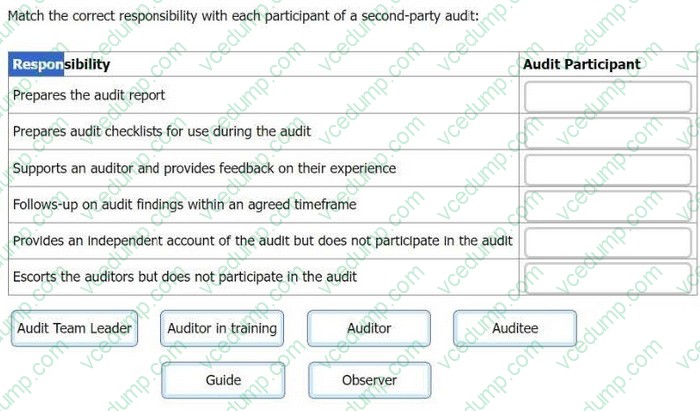
Match the correct responsibility with each participant of a second-party audit:
Select and Place:
Explanation:
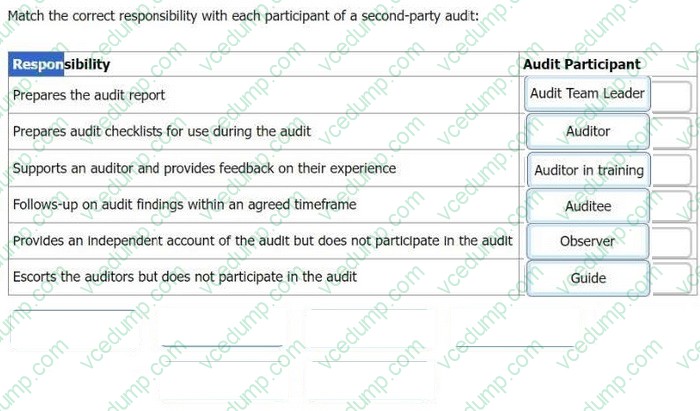
Prepares the audit report: Audit Team Leader. The audit team leader is responsible for coordinating the audit activities, communicating with the auditee and the customer, and preparing and delivering the audit report that summarizes the audit findings and conclusions.
Prepares audit checklists for use during the audit: Auditor. The auditor is responsible for collecting and verifying objective evidence during the audit, using audit checklists as a tool to guide the audit process and ensure that all relevant aspects of the audit criteria are covered.
Supports an auditor and provides feedback on their experience: Auditor in training. The auditor in training is a person who is learning how to perform audits under the supervision of an experienced auditor. The auditor in training supports the auditor by observing and participating in the audit activities, and provides feedback on their experience to improve their skills and competence. Follows-up on audit findings within an agreed timeframe: Auditee. The auditee is the organisation that is being audited by the
customer or a third party on behalf of the customer. The auditee is responsible for providing access and cooperation to the auditors, and for following up on the audit findings within an agreed timeframe, by implementing corrective actions or improvement measures as needed. Provides an independent account of the audit but does not participate in the audit:
Observer. The observer is a person who accompanies the audit team but does not participate in the audit activities. The observer may be a representative of the customer, a regulatory body, or another interested party. The observer provides an independent account of the audit but does not interfere with or influence the audit process or outcome.
Escorts the auditors but does not participate in the audit: Guide. The guide is a person who is appointed by the auditee to assist the audit team during the audit. The guide may escort the auditors to different locations, facilitate access to information and personnel, or provide clarification or explanation as requested by the auditors. The guide does not participate in the audit or influence its results.
Question 165:
Which of the following is not a type of Information Security attack?
A. Legal Incidents B. Vehicular Incidents C. Technical Vulnerabilities D. Privacy Incidents
B. Vehicular Incidents
Vehicular incidents are not a type of information security attack. A vehicular incident is an event that involves a vehicle or its driver causing damage or injury to people or property. A vehicular incident may have an impact on information security if it affects the availability or integrity of information or systems that are transported or accessed by vehicles, but it is not an intentional or malicious attack on information security. Legal incidents are a type of information security attack that involve legal actions or disputes that may compromise the confidentiality or integrity of information or systems. Technical vulnerabilities are a type of information security attack that exploit weaknesses or flaws in software or hardware that may compromise the confidentiality, integrity, or availability of information or systems. Privacy incidents are a type of information security attack that involve unauthorized access or disclosure of personal or sensitive information that may compromise the confidentiality or integrity of information or systems.
References: CQI and IRCA ISO 27001:2022 Lead Auditor Course Handbook, page 25. : [ISO/IEC 27001 LEAD AUDITOR - PECB], page 13.
Question 166:
How are internal audits and external audits related?
A. Internal audits ensure that the organization regularly monitors the external audit reports and action plans B. Internal audits ensure the implementation of the corrective actions before the organization is recommended for certification by the external auditor C. Internal audits and external audits are included in the certification cycle, which ensures the monitoring of the management system on a regular basis
C. Internal audits and external audits are included in the certification cycle, which ensures the monitoring of the management system on a regular basis
Internal audits and external audits are integral components of the certification cycle, ensuring regular monitoring of the management system. Internal audits help organizations prepare for external audits by identifying and addressing potential nonconformities, while external audits validate the compliance of the management system with ISO/IEC 27001 standards.
References: PECB ISO/IEC 27001 Lead Auditor Course Material; ISO/IEC 27001:2013, Clauses 9.2 (Internal audit) and 9.3 (Management review)
Question 167:
You are an ISMS audit team leader tasked with conducting a follow-up audit at a client's data centre. Following two days on-site you conclude that of the original 12 minor and 1 major nonconformities that prompted the follow-up audit, only 1 minor nonconformity still remains outstanding. Select four options for the actions you could take.
A. Book another follow-up audit on-site to review the one outstanding minor nonconformity once it has been cleared B. Recommend that the outstanding minor nonconformity is dealt with at the next surveillance audit C. Advise the auditee that you will arrange an online audit to deal with the outstanding nonconformity D. Note the progress made but hold the audit open until all corrective action has been cleared E. Agree with the auditee/audit client how the remaining nonconformity will be cleared, by when, and how its clearance will be verified F. Advise the individual managing the audit programme of any decision taken regarding the outstanding nonconformity G. Recommend suspension of the organisation's certification as they have failed to implement the agreed corrections and corrective actions within the agreed timescale H. Close the follow-up audit as the organisation has demonstrated it is committed to clearing the nonconformities raised
B. Recommend that the outstanding minor nonconformity is dealt with at the next surveillance audit E. Agree with the auditee/audit client how the remaining nonconformity will be cleared, by when, and how its clearance will be verified F. Advise the individual managing the audit programme of any decision taken regarding the outstanding nonconformity H. Close the follow-up audit as the organisation has demonstrated it is committed to clearing the nonconformities raised
According to ISO 19011:2018, which provides guidelines for auditing management systems, clause 6.7 requires the audit team leader to conduct a follow-up audit to verify the implementation and effectiveness of the corrective actions taken by the auditee in response to the nonconformities identified during a previous audit1. The follow-up audit should be conducted in accordance with the same principles and processes as the initial audit, and should result in a conclusion on the status of the nonconformities and any remaining issues1. Therefore, when conducting a follow-up audit, an ISMS auditor should consider the following actions:
Recommend that the outstanding minor nonconformity is dealt with at the next surveillance audit: This action is appropriate because it reflects the fact that the auditee has cleared most of the nonconformities, including the major one, and only one minor nonconformity remains outstanding. A minor nonconformity is defined as a failure to achieve one or more requirements of ISO/IEC 27001:2022 or a situation which raises significant doubt about the ability of an ISMS process to achieve its intended output, but does not affect its overall effectiveness or conformity2. Therefore, this finding does not prevent or preclude the continuation of certification, as long as it is addressed by appropriate corrective actions within a reasonable time frame. The auditor should recommend that the outstanding minor nonconformity is dealt with at the next surveillance audit, which is a regular audit conducted by the certification body to confirm the ongoing conformity and effectiveness of an ISMS.
Agree with the auditee/audit client how the remaining nonconformity will be cleared, by when, and how its clearance will be verified: This action is appropriate because it reflects the fact that the auditee has demonstrated commitment and capability to implement corrective actions for the nonconformities identified during the previous audit. The auditor should agree with the auditee/audit client on a realistic, achievable, and effective corrective action plan for the remaining nonconformity, including a clear deadline and verification method. The auditor should also document this agreement in the follow-up audit report.
Advise the individual managing the audit programme of any decision taken regarding the outstanding nonconformity: This action is appropriate because it reflects the fact that the auditor has followed a systematic and consistent approach to conducting and reporting the follow-up audit. The auditor should advise the individual managing the audit programme of any decision taken regarding the outstanding nonconformity, such as recommending its closure at the next surveillance audit or agreeing on a corrective action plan with the auditee/audit client. The auditor should also provide sufficient information and evidence to support their decision.
Close the follow-up audit as the organisation has demonstrated it is committed to clearing the nonconformities raised: This action is appropriate because it reflects the fact that the organisation has achieved satisfactory results in the follow-up audit. The auditor should close the follow-up audit as the organisation has demonstrated it is committed to clearing the nonconformities raised by implementing effective corrective actions for most of them and agreeing on a plan for the remaining one. The auditor should also communicate the follow-up audit conclusion to the auditee/audit client and other relevant parties.
Question 168:
Scenario 6: Sinvestment is an insurance company that offers home, commercial, and life insurance. The company was founded in North Carolina, but have recently expanded in other locations, including Europe and Africa.
Sinvestment is committed to complying with laws and regulations applicable to their industry and preventing any information security incident. They have implemented an ISMS based on ISO/IEC 27001 and have applied for ISO/IEC 27001 certification.
Two auditors were assigned by the certification body to conduct the audit. After signing a confidentiality agreement with Sinvestment. they started the audit activities. First, they reviewed the documentation required by the standard, including the declaration of the ISMS scope, information security policies, and internal audits reports. The review process was not easy because, although Sinvestment stated that they had a documentation procedure in place, not all documents had the same format.
Then, the audit team conducted several interviews with Sinvestment's top management to understand their role in the ISMS implementation. All activities of the stage 1 audit were performed remotely, except the review of documented information, which took place on-site, as requested by Sinvestment.
During this stage, the auditors found out that there was no documentation related to information security training and awareness program. When asked, Sinvestment's representatives stated that the company has provided information security training sessions to all employees. Stage 1 audit gave the audit team a general understanding of Sinvestment's operations and ISMS.
The stage 2 audit was conducted three weeks after stage 1 audit. The audit team observed that the marketing department (which was not included in the audit scope) had no procedures in place to control employees' access rights. Since controlling employees' access rights is one of the ISO/IEC 27001 requirements and was included in the information security policy of the company, the issue was included in the audit report. In addition, during stage 2 audit, the audit team observed that Sinvestment did not
record logs of user activities. The procedures of the company stated that "Logs recording user activities should be retained and regularly reviewed," yet the company did not present any evidence of the implementation of such procedure.
During all audit activities, the auditors used observation, interviews, documented information review, analysis, and technical verification to collect information and evidence. All the audit findings during stages 1 and 2 were analyzed and the audit team decided to issue a positive recommendation for certification.
According to scenario 6, the marketing department employees were not following the access control policy.
Which option is correct in this case?
A. The marketing department is not included in the audit scope, so the issue should only be communicated to Sinvestment's representatives B. The employees' access right control is included in Sinvestment's information security policy, so the issue must be communicated to Sinvestment's representatives and included in the audit report C. Sinvestment is not controlling the employees' access rights, which represents a potential information security risk and should be reported as a major nonconformity
B. The employees' access right control is included in Sinvestment's information security policy, so the issue must be communicated to Sinvestment's representatives and included in the audit report
Even though the marketing department was not included in the audit scope, the issue of employees' access rights control must be communicated to Sinvestment's representatives and included in the audit report because it is part of Sinvestment's information security policy. It reflects on the overall adherence to the ISMS requirements.
You are an ISMS auditor conducting a third-party surveillance audit of a telecom's provider. You are in the equipment staging room where network switches are pre-programmed before being despatched to clients. You note that recently there has been a significant increase in the number of switches failing their initial configuration test and being returned for reprogramming. You ask the Chief Tester why and she says, 'It's a result of the recent ISMS upgrade'. Before the upgrade each technician had their own hard copy work instructions. Now, the eight members of my team have to share two laptops to access the clients' configuration instructions online. These delays put pressure on the technicians, resulting in more mistakes being made'. Based solely on the information above, which clause of ISO to raise a nonconformity against' Select one.
A. Clause 7.5 - Documented information B. Clause 8.1 - Operational planning and control C. Clause 10.2 - Nonconformity and corrective action D. Clause 7.3 - Awareness E. Clause 7.2 - Competence F. Clause 7.4 - Communication
B. Clause 8.1 - Operational planning and control
According to ISO/IEC 27001:2022, which specifies the requirements for establishing, implementing, maintaining and continually improving an information security management system (ISMS), clause 8.1 requires an organization to plan, implement and control its processes needed to meet ISMS requirements. This includes determining what needs to be done, how it will be done, who will do it, when it will be done, what resources are required, how performance will be evaluated, etc. Therefore, if an ISMS auditor conducting a third-party surveillance audit of a telecom's provider notes that there has been a significant increase in the number of switches failing their initial configuration test and being returned for reprogramming due to a recent ISMS upgrade that reduced access to work instructions, this indicates a nonconformity against clause 8.1 of ISO/IEC 27001:2022. The organization has failed to plan and control its operational processes effectively to ensure information security and quality. The other options are not correct clauses to raise a nonconformity against based solely on this information. For example, clause 7.5 deals with documented information required by ISMS or determined by an organization as necessary for its effectiveness, but it does not specify how many copies or formats of work instructions should be available; clause 10.2 deals with nonconformity and corrective action as a response to an identified problem or incident, but it does not address how to prevent or avoid such problems or incidents in operational processes; clause 7.3 deals with awareness of ISMS policy, objectives, roles and responsibilities among persons doing work under an organization's control, but it does not relate to how work instructions are accessed or followed; clause 7.2 deals with competence of persons doing work under an organization's control that affects its ISMS performance, but it does not imply that lack of competence is caused by insufficient work instructions; clause 7.4 deals with communication about ISMS among internal and external interested parties, but it does not cover how operational information is communicated within an organization.
References: ISO/IEC 27001:2022 - Information technology ?Security techniques Information security management systems
Question 170:
Scenario:
Webvue. headquartered in Japan, is a technology company specializing in the development, support, and maintenance of computer software. Webvue provides solutions across various technology fields and business sectors. Its flagship service is CloudWebvue, a comprehensive cloud computing platform offering storage, networking, and virtual computing services. Designed for both businesses and individual users. CloudWebvue is known for its flexibility, scalability, and reliability.
Webvue has decided to only include CloudWebvue in its ISO/IEC 27001 certification scope. Thus, the stage 1 and 2 audits were performed simultaneously Webvue takes pride in its strictness regarding asset confidentiality They protect the information stored in CloudWebvue by using appropriate cryptographic controls. Every piece of information of any classification level, whether for internal use. restricted, or confidential, is first encrypted with a unique corresponding hash and then stored in the cloud
The audit team comprised five persons Keith. Sean. Layla, Sam. and Tina. Keith, the most experienced auditor on the IT and information security auditing team, was the audit team leader. His responsibilities included planning the audit and managing the audit team. Sean and Layla were experienced in project planning, business analysis, and IT systems (hardware and application) Their tasks included audit planning according to Webvue's internal systems and processes Sam and Tina, on the other hand,
who had recently completed their education, were responsible for completing the day- to-day tasks while developing their audit skills
While verifying conformity to control 8.24 Use of cryptography of ISO/IEC 27001 Annex A through interviews with the relevant staff, the audit team found out that the cryptographic keys have been initially generated based on random bit generator (RBG) and other best practices for the generation of the cryptographic keys. After checking Webvue's cryptography policy, they concluded that the information obtained by the interviews was true. However, the cryptographic keys are still in use because the policy
does not address the use and lifetime of cryptographic keys.
As later agreed upon between Webvue and the certification body, the audit team opted to conduct a virtual audit specifically focused on verifying conformity to control 8.11 Data Masking of ISO/IEC 27001 within Webvue, aligning with the certification scope and audit objectives. They examined the processes involved in protecting data within CloudWebvue. focusing on how the company adhered to its policies and regulatory standards. As part of this process. Keith, the audit team leader, took screenshot
copies of relevant documents and cryptographic key management procedures to document and analyze the effectiveness of Webvue's practices.
Webvue uses generated test data for testing purposes. However, as determined by both the interview with the manager of the QA Department and the procedures used by this department, sometimes live system data are used. In such scenarios, large amounts of data are generated while producing more accurate results. The test data is protected and controlled, as verified by the simulation of the encryption process performed by Webvue's personnel during the audit
While interviewing the manager of the QA Department, Keith observed that employees in the Security Training Department were not following proper procedures, even though this department fell outside the audit scope. Despite the exclusion in the audit scope, the non conformity in the Security Training Department has potential implications for the processes within the audit scope, specifically impacting data security and cryptographic practices in CloudWebvue. Therefore, Keith incorporated this finding into
the audit report and accordingly informed the auditee.
Based on the scenario above, answer the following question:
Question:
Based on Scenario, which audit procedure was used to verify conformity to the use of test data?
A. Documented information review B. Corroboration C. Technical verification
C. Technical verification
C.
Correct Answer:
Technical verification involves directly testing or simulating controls.
Webvue's personnel simulated the encryption process, confirming test data security measures .
A. Incorrect:
Document review is passive, while technical verification is active and includes real-time assessments .
B. Incorrect:
Corroboration is about cross-checking information, whereas technical verification tests controls in practice .
Relevant Standard Reference:
ISO 19011:2018 Clause 6.4.9 (Technical Verification in Audits)
Nowadays, the certification exams become more and more important and required by more and more
enterprises when applying for a job. But how to prepare for the exam effectively? How to prepare
for the exam in a short time with less efforts? How to get a ideal result and how to find the
most reliable resources? Here on Vcedump.com, you will find all the answers.
Vcedump.com provide not only PECB exam questions,
answers and explanations but also complete assistance on your exam preparation and certification
application. If you are confused on your ISO-27001-LA exam preparations
and PECB certification application, do not hesitate to visit our
Vcedump.com to find your solutions here.