ISO-27001-LA Exam Details
-
Exam Code
:ISO-27001-LA -
Exam Name
:ISO/IEC 27001:2022 Lead Auditor -
Certification
:PECB Certifications -
Vendor
:PECB -
Total Questions
:394 Q&As -
Last Updated
:May 31, 2026
PECB ISO-27001-LA Online Questions & Answers
-
Question 151:
You are an experienced ISMS audit team leader. During the conducting of a third-party surveillance audit, you decide to test your auditee's knowledge of ISO/IEC 27001's risk management requirements. You ask her a series of questions to which the answer is either 'that is true' or 'that is false'. Which four of the following should she answer 'that is true'?
A. The results of risk assessments must be maintained
B. Risk identification is used to determine the severity of an information security risk
C. ISO/IEC 27001 provides an outline approach for the management of risk
D. The organisation must produce a risk treatment plan for every business risk identified
E. The organisation must operate a risk treatment process to eliminate it's information security risks
F. The initial phase in an organisation's risk management process should be information security risk assessment
G. Risks assessments should be undertaken at monthly intervals
H. Risk assessments should be undertaken following significant changes -
Question 152:
An organization has completed an ISO/IEC 27001:2022 internal audit and identified two minor nonconformities. The ISMS manager wants to close them by updating the risk assessment results only, without addressing root cause or evaluating effectiveness of actions. Which option below best describes this approach?
A. Acceptable, because updating risk assessment results is sufficient to demonstrate continual improvement
B. Unacceptable, because ISO/IEC 27001 requires only corrections, not corrective actions
C. Unacceptable, because ISO/IEC 27001 requires cause analysis and evaluation of corrective action effectiveness
D. Acceptable, because minor nonconformities do not require evaluation of effectiveness -
Question 153:
Which two of the following statements are true?
A. The benefits of implementing an ISMS primarily result from a reduction in information security risks
B. The benefit of certifying an ISMS is to obtain contracts from governmental institutions
C. The purpose of an ISMS is to apply a risk management process for preserving information security
D. The purpose of an ISMS is to demonstrate compliance with regulatory requirements -
Question 154:
Scenario:
Northstorm is an online retail shop offering unique vintage and modern accessories. It initially entered a small market but gradually grew thanks to the development of the overall e-commerce landscape. Northstorm works exclusively online and ensures efficient payment processing, inventory management, marketing tools, and shipment orders. It uses prioritized ordering to receive, restock, and ship its most popular products.
Northstorm has traditionally managed its IT operations by hosting its website and maintaining full control over its infrastructure, including hardware, software, and data administration. However, this approach hindered its growth due to the lack of responsive infrastructure. Seeking to enhance its e-commerce and payment systems, Northstorm opted to expand its in-house data centers, completing the expansion in two phases over three months. Initially, the company upgraded its core servers, point-of-sale,
ordering, billing, database, and backup systems. The second phase involved improving mail, payment, and network functionalities. Additionally, during this phase, Northstorm adopted an international standard for personally identifiable information (PII) controllers and PII processors regarding PII processing to ensure its data handling practices were secure and compliant with global regulations.
Despite the expansion, Northstorm's upgraded data centers failed to meet its evolving business demands. This inadequacy led to several new challenges, including issues with order prioritization. Customers reported not receiving priority orders, and the company struggled with responsiveness. This was largely due to the main server's inability to process orders from YouDecide, an application designed to prioritize orders and simulate customer interactions. The application, reliant on advanced algorithms,
was incompatible with the new operating system (OS) installed during the upgrade.
Faced with urgent compatibility issues, Northstorm quickly patched the application without proper validation, leading to the installation of a compromised version. This security lapse resulted in the main server being affected and the company's website going offline for a week. Recognizing the need for a more reliable solution, the company decided to outsource its website hosting to an e-commerce provider. The company signed a confidentiality agreement concerning product ownership and conducted a
thorough review of user access rights to enhance security before transitioning.
Question:
Which of the following is a preventive control based on Scenario?
A. Using an application that prioritized orders based on its prior knowledge
B. Signing a confidentiality agreement
C. Expanding the capacity of the in-house data center -
Question 155:
DRAG DROP
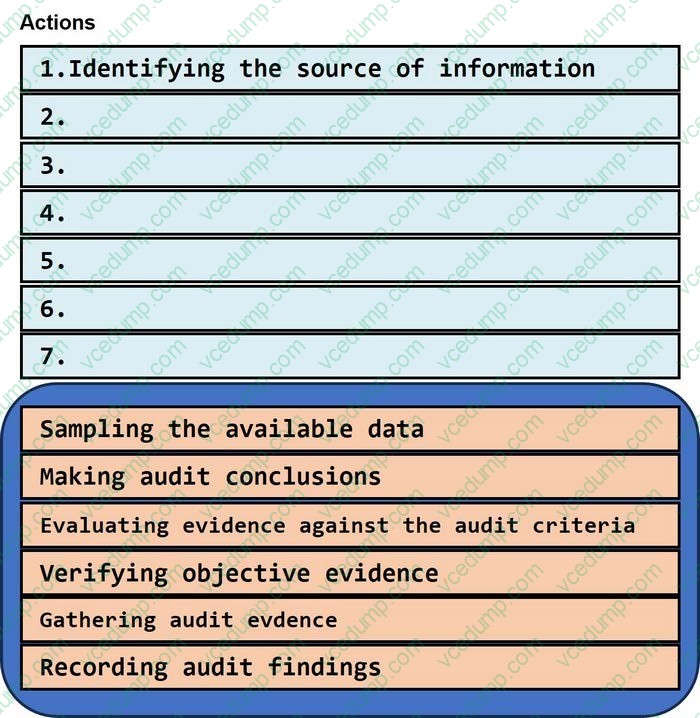
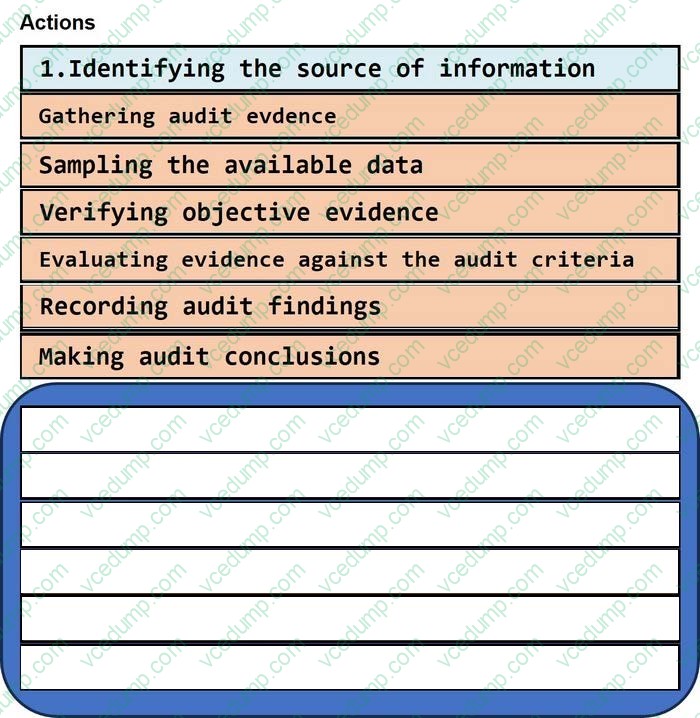
In the context of a management system audit, please identify the sequence of a typical process of collecting and verifying information. The first one has been done for you.
Select and Place:
-
Question 156:
Scenario:
Branding is a marketing company that works with some of the most famous companies in the US. To reduce internal costs. Branding has outsourced the software development and IT helpdesk operations to Techvology for over two years. Techvology. equipped with the necessary expertise, manages Branding's software, network, and hardware needs. Branding has implemented an information security management system (ISMS) and is certified against ISO/IEC 27001, demonstrating its commitment to
maintaining high standards of information security. It actively conducts audits on Techvology to ensure that the security of its outsourced operations complies with ISO/IEC 27001 certification requirements.
During the last audit. Branding's audit team defined the processes to be audited and the audit schedule. They adopted an evidence based approach, particularly in light of two information security incidents reported by Techvology in the past year The focus was on evaluating how these incidents were addressed and ensuring compliance with the terms of the outsourcing agreement
The audit began with a comprehensive review of Techvology's methods for monitoring the quality of outsourced operations, assessing whether the services provided met Branding's expectations and agreed-upon standards The auditors also verified whether Techvology complied with the contractual requirements established between the two entities This involved thoroughly examining the terms and conditions in the outsourcing agreement to guarantee that all aspects, including information security
measures, are being adhered to.
Furthermore, the audit included a critical evaluation of the governance processes Techvology uses to manage its outsourced operations and other organizations. This step is crucial for Branding to verify that proper controls and oversight mechanisms are in place to mitigate potential risks associated with the outsourcing arrangement.
The auditors conducted interviews with various levels of Techvology's personnel and analyzed the incident resolution records. In addition, Techvology provided the records that served as evidence that they conducted awareness sessions for the staff regarding incident management. Based on the information gathered, they predicted that both information security incidents were caused by incompetent personnel. Therefore, auditors requested to see the personnel files of the employees involved in the
incidents to review evidence of their competence, such as relevant experience, certificates, and records of attended trainings.
Branding's auditors performed a critical evaluation of the validity of the evidence obtained and remained alert for evidence that could contradict or question the reliability of the documented information received. During the audit at Techvology, the auditors upheld this approach by critically assessing the incident resolution records and conducting thorough interviews with employees at different levels and functions. They did not merely take the word of Techvology's representatives for facts; instead, they sought
concrete evidence to support the representatives' claims about the incident management processes.
Based on the scenario above, answer the following question:
Question:
Were the auditors diligent in adhering to the auditing process for outsourced operations?
A. Yes, they demonstrated diligence and judgment in their auditing practices
B. No, the auditors did not request a sample of employment contracts until the end of the audit
C. No, the auditors did not interview any of Techvology's top management during the audit -
Question 157:
Scenario:
Webvue. headquartered in Japan, is a technology company specializing in the development, support, and maintenance of computer software. Webvue provides solutions across various technology fields and business sectors. Its flagship service is CloudWebvue, a comprehensive cloud computing platform offering storage, networking, and virtual computing services. Designed for both businesses and individual users. CloudWebvue is known for its flexibility, scalability, and reliability.
Webvue has decided to only include CloudWebvue in its ISO/IEC 27001 certification scope. Thus, the stage 1 and 2 audits were performed simultaneously Webvue takes pride in its strictness regarding asset confidentiality They protect the information stored in CloudWebvue by using appropriate cryptographic controls. Every piece of information of any classification level, whether for internal use. restricted, or confidential, is first encrypted with a unique corresponding hash and then stored in the cloud.
The audit team comprised five persons Keith. Sean. Layla, Sam. and Tina. Keith, the most experienced auditor on the IT and information security auditing team, was the audit team leader. His responsibilities included planning the audit and managing the audit team. Sean and Layla were experienced in project planning, business analysis, and IT systems (hardware and application) Their tasks included audit planning according to Webvue's internal systems and processes Sam and Tina, on the other hand,
who had recently completed their education, were responsible for completing the day- to-day tasks while developing their audit skills
While verifying conformity to control 8.24 Use of cryptography of ISO/IEC 27001 Annex A through interviews with the relevant staff, the audit team found out that the cryptographic keys have been initially generated based on random bit generator (RBG) and other best practices for the generation of the cryptographic keys. After checking Webvue's cryptography policy, they concluded that the information obtained by the interviews was true. However, the cryptographic keys are still in use because the policy
does not address the use and lifetime of cryptographic keys.
As later agreed upon between Webvue and the certification body, the audit team opted to conduct a virtual audit specifically focused on verifying conformity to control 8.11 Data Masking of ISO/IEC 27001 within Webvue, aligning with the certification scope and audit objectives. They examined the processes involved in protecting data within CloudWebvue. focusing on how the company adhered to its policies and regulatory standards. As part of this process. Keith, the audit team leader, took screenshot
copies of relevant documents and cryptographic key management procedures to document and analyze the effectiveness of Webvue's practices.
Webvue uses generated test data for testing purposes. However, as determined by both the interview with the manager of the QA Department and the procedures used by this department, sometimes live system data are used. In such scenarios, large amounts of data are generated while producing more accurate results. The test data is protected and controlled, as verified by the simulation of the encryption process performed by Webvue's personnel during the audit
While interviewing the manager of the QA Department, Keith observed that employees in the Security Training Department were not following proper procedures, even though this department fell outside the audit scope. Despite the exclusion in the audit scope, the non conformity in the Security Training Department has potential implications for the processes within the audit scope, specifically impacting data security and cryptographic practices in CloudWebvue. Therefore, Keith incorporated this finding into
the audit report and accordingly informed the auditee.
Based on the scenario above, answer the following question:
Question:
Based on Scenario, the audit team checked Webvue's cryptography policy to obtain reasonable assurance of the information obtained during interviews . Which type of audit procedure has been used?
A. Observation
B. Corroboration
C. Evaluation -
Question 158:
Scenario: During stage 2, you discover that the organization has not performed management review at planned intervals, but has performed frequent informal leadership meetings without documented outputs. What is the most appropriate audit finding?
A. Conformity, because informal meetings satisfy leadership involvement
B. Opportunity for improvement, because management review is optional if leadership meets often
C. Nonconformity, because management review requires planned intervals and retained documented information
D. Observation, because this is a documentation-only issue without impact -
Question 159:
During which stage of the audit do auditors identify key processes to be audited and prioritize based on materiality?
A. Initial contact
B. Stage 1 audit
C. Stage 2 audit -
Question 160:
You are an ISMS audit team leader who has been assigned by your certification body to carry out a follow-up audit of a client. You are preparing your audit plan for this audit. Which two of the following statements are true?
A. Verification should focus on whether any action undertaken taken has been undertaken efficiently
B. Corrections should be verified first, followed by corrective actions and finally opportunities for improvement
C. Verification should focus on whether any action undertaken is complete
D. Opportunities for improvement should be verified first, followed by corrections and finally corrective actions
E. Corrective actions should be reviewed first, followed by corrections and finally opportunities for improvement
F. Verification should focus on whether any action undertaken has been undertaken effectively
Related Exams:
-
ISO-20000-FND
ISO/IEC 20000 Foundation -
ISO-22301-BCMS-CLA
ISO 22301 BCMS - Certified Lead Auditor -
ISO-22301-LA
ISO 22301 Lead Auditor -
ISO-22301-LEAD-AUDITOR
PECB Certified ISO 22301 Lead Auditor Exam -
ISO-22301-LI
ISO 22301 Lead Implementer -
ISO-27001-ISMS-FND
ISO 27001:2013 ISMS - Foundation -
ISO-27001-LA
ISO/IEC 27001:2022 Lead Auditor -
ISO-27001-LI
ISO/IEC 27001:2022 Lead Implementer -
ISO-27002-LI
ISO/IEC 27002 - Lead Implementer -
ISO-27005-RM
ISO/IEC 27005 Risk Manager
Tips on How to Prepare for the Exams
Nowadays, the certification exams become more and more important and required by more and more enterprises when applying for a job. But how to prepare for the exam effectively? How to prepare for the exam in a short time with less efforts? How to get a ideal result and how to find the most reliable resources? Here on Vcedump.com, you will find all the answers. Vcedump.com provide not only PECB exam questions, answers and explanations but also complete assistance on your exam preparation and certification application. If you are confused on your ISO-27001-LA exam preparations and PECB certification application, do not hesitate to visit our Vcedump.com to find your solutions here.