ISO-27001-LA Exam Details
-
Exam Code
:ISO-27001-LA -
Exam Name
:ISO/IEC 27001:2022 Lead Auditor -
Certification
:PECB Certifications -
Vendor
:PECB -
Total Questions
:394 Q&As -
Last Updated
:May 31, 2026
PECB ISO-27001-LA Online Questions & Answers
-
Question 131:
You are the audit team leader conducting a third-party audit of an online insurance company. During Stage 1, you found that the organization took a very cautious risk approach and included all the information security controls in ISO/IEC 27001:2022 Appendix A in their Statement of Applicability.
During the Stage 2 audit, your audit team found that there was no evidence of a risk treatment plan for the implementation of the three controls (5.3 Segregation of duties, 6.1 Screening, 7.12 Cabling security). You raise a nonconformity against clause 6.1.3.e of ISO 27001:2022.
At the closing meeting, the Technical Director issues an extract from an amended Statement of Applicability (as shown) and asks for the nonconformity to be withdrawn.
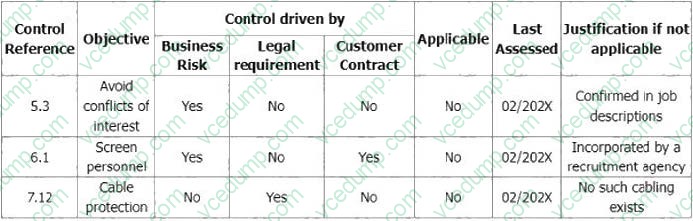
Select three options of the correct responses of an audit team leader to the request of the Technical Director.
A. Advise management that the information provided will be reviewed when the auditors have more time.
B. Advise the Technical Director that his request will be included in the audit report.
C. Advise the Technical Director that once a nonconformity is raised it cannot be withdrawn.
D. Advise the Technical Director that the nonconformity must stand since the evidence obtained for it was clear.
E. Ask the auditor who raised the issue for their opinion on how you should respond to the request.
F. Inform the Technical Director that the nonconformity will be changed to an Opportunity for Improvement.
G. Review the documentation produced and withdraw the nonconformity.
H. State that a follow up audit will be necessary to review the evidence for the updated Statement of Applicability. -
Question 132:
Scenario 4: SendPay is a financial company that provides its services through a network of agents and financial institutions. One of their main services is transferring money worldwide. SendPay, as a new company, seeks to offer top quality services to its clients. Since the company offers international transactions, it requires from their clients to provide personal information, such as their identity, the reason for the transactions, and other details that might be needed to complete the transaction. Therefore,
SendPay has implemented security measures to protect their clients' information, including detecting, investigating, and responding to any information security threats that may emerge. Their commitment to offering secure services was also reflected during the ISMS implementation where the company invested a lot of time and resources.
Last year, SendPay unveiled their digital platform that allows money transactions through electronic devices, such as smartphones or laptops, without requiring an additional fee. Through this platform, SendPay's clients can send and receive money from anywhere and at any time. The digital platform helped SendPay to simplify the company's operations and further expand its business. At the time, SendPay was outsourcing its software operations, hence the project was completed by the software
development team of the outsourced company. The same team was also responsible for maintaining the technology infrastructure of SendPay.
Recently, the company applied for ISO/IEC 27001 certification after having an ISMS in place for almost a year. They contracted a certification body that fit their criteria. Soon after, the certification body appointed a team of four auditors to audit SendPay's ISMS.
During the audit, among others, the following situations were observed:
1.The outsourced software company had terminated the contract with SendPay without prior notice. As a result, SendPay was unable to immediately bring the services back in-house and its operations were disrupted for five days. The auditors requested from SendPay's representatives to provide evidence that they have a plan to follow in cases of contract terminations. The representatives did not provide any documentary evidence but during an interview, they told the auditors that the top management of
SendPay had identified two other software development companies that could provide services immediately if similar situations happen again.
2.There was no evidence available regarding the monitoring of the activities that were outsourced to the software development company. Once again, the representatives of SendPay told the auditors that they regularly communicate with the software development company and that they are appropriately informed for any possible change that might occur.
3.There was no nonconformity found during the firewall testing. The auditors tested the firewall configuration in order to determine the level of security provided by these services. They used a packet analyzer to test the firewall policies which enabled them to check the packets sent or received in real-time.
Based on this scenario, answer the following question:
How do you evaluate the evidence obtained related to the monitoring process of outsourced operations? Refer to scenario 4.
A. Irrelevant, monitoring the outsourced operations is not a requirement of the standard
B. Not reliable. SendPay provided only verbal evidence regarding the monitoring of its outsourced operations
C. Appropriate and sufficient, verbal confirmation from the SendPay's representatives indicates that the they were aware that outsourced operations must be monitored -
Question 133:
Select two options that describe an advantage of using a checklist.
A. Using the same checklist for every audit without review
B. Restricting interviews to nominated parties
C. Ensuring relevant audit trails are followed
D. Ensuring the audit plan is implemented
E. Reducing audit duration
F. Not varying from the checklist when necessary -
Question 134:
Scenario: BrightLink is a SaaS provider offering HR payroll services to multiple clients. BrightLink defines its ISMS scope as "Payroll SaaS platform operations," but excludes the customer support process. Customer support agents can reset user passwords and access customer tickets containing PII. According to ISO/IEC 27001:2022, what is the most appropriate audit conclusion regarding scope?
A. Acceptable, because scope may exclude any department if documented
B. Acceptable, because customer support is not part of the payroll platform
C. Unacceptable, because scope determination must consider interfaces and dependencies relevant to information security
D. Unacceptable, because ISO/IEC 27001 requires all departments to be included in scope without exception -
Question 135:
You are performing an ISMS audit at a residential nursing home that provides healthcare services and are reviewing the Software Code Management (SCM) system. You found a total of 10 user accounts on the SCM. You confirm that one of the users, Scott, resigned 9-months ago. The SCM System Administrator confirmed Scott's last check-out of the source code was found 1 month ago. He was using one of the uthorized desktops from the local network in a secure area.
You check with the user de-registration procedure which states "Managers have to make sure of deregistration of the user account and authorisation immediately from the relevant ICT system and/or equipment after resignation approval." There was no deregistration record for user Scott.
The IT Security Manager explains that Scott still comes back to the office every month after he resigned to provide support on source code maintenance. That's why his account on SCM still exists.
You would like to investigate other areas further to collect more audit evidence. Select three options that would not be valid audit trails.
A. Collect more evidence on how access controls are periodically reviewed to maintain security (Relevant to control A.5.35)
B. Collect more evidence on how the transition of Scott from full-time to part-time employment was managed (relevant to control A.6.5)
C. Collect more evidence from Scott's background verification checks performed by the human resource department under the new employment relationship. (Relevant to control A.6.1)
D. Collect more evidence of why Scott resigned and whether his re-engagement represents a conflict of interest. (relevant to control A.5.3)
E. Collect more evidence on how Scott can access the employee's desktop and local network. (Relevant to control A.5.15)
F. Collect more evidence on how Scott can access the secure area. (Relevant to control A.8.4)
G. Collect more evidence on how the organization pays for Scott's source code maintenance support service. (Relevant to control A.6.2)
H. Collect more evidence on where Scott kept the source code that he checked out and how it was secured. (Relevant to control A.8.4) -
Question 136:
Scenario:
Clinic, founded in the 1990s, is a medical device company that specializes in treatments for heart-related conditions and complex surgical interventions. Based in Europe, it serves both patients and healthcare professionals. Clinic collects patient data to tailor treatments, monitor outcomes, and improve device functionality. To enhance data security and build trust, Clinic is implementing an information security management system (ISMS) based on ISO/IEC 27001 . This initiative demonstrates Clinic's
commitment to securely managing sensitive patient information and proprietary technologies .
Clinic established the scope of its ISMS by solely considering internal issues, interfaces, dependencies between internal and outsourced activities, and the expectations of interested parties . This scope was carefully documented and made accessible. In defining its ISMS, Clinic chose to focus specifically on key processes within critical departments such as Research and Development, Patient Data Management, and Customer Support .
Despite initial challenges, Clinic remained committed to its ISMS implementation, tailoring security controls to its unique needs. The project team excluded certain Annex A controls from ISO/IEC 27001 while incorporating additional sector-specific controls to enhance security. The team evaluated the applicability of these controls against internal and external factors, culminating in the development of a comprehensive Statement of Applicability (SoA) detailing the rationale behind control selection and
implementation.
As preparations for certification progressed, Brian, appointed as the team leader , adopted a self-directed risk assessment methodology to identify and evaluate the company's strategic issues and security practices . This proactive approach ensured that Clinic's risk assessment aligned with its objectives and mission.
Question:
Based on Scenario, Clinic initially defined its information security objectives and then conducted a risk assessment. Is this acceptable?
A. Yes, because objectives can be adjusted later to fit the risk assessment results
B. No, because the risk assessment should be conducted only once objectives are fully implemented
C. No, information security objectives must be established, taking into account risk assessment results, as per ISO/IEC 27001 requirements -
Question 137:
Scenario:
Techmanic is a Belgian company founded in 1995 and currently operating in Brussels. It provides IT consultancy, software design, and hardware/software services, including deployment and maintenance. The company serves sectors like public services, finance, telecom, energy, healthcare, and education. As a customer-centered company, it prioritizes strong client relationships and leading security practices.
Techmanic has been ISO/IEC 27001 certified for a year and regards this certification with pride. During the certification audit, the auditor found some inconsistencies in its ISMS implementation. Since the observed situations did not affect the capability of its ISMS to achieve the intended results, Techmanic was certified after auditors followed up on the root cause analysis and corrective actions remotely During that year, the company added hosting to its list of services and requested to expand its certification
scope to include that area The auditor in charge approved the request and notified Techmanic that the extension audit would be conducted during the surveillance audit
Techmanic underwent a surveillance audit to verify its iSMS's continued effectiveness and compliance with ISO/IEC 27001. The surveillance audit aimed to ensure that Techmanic's security practices, including the recent addition of hosting services, aligned seamlessly with the rigorous requirements of the certification
The auditor strategically utilized the findings from previous surveillance audit reports in the recertification activity with the purpose of replacing the need for additional recertification audits, specifically in the IT consultancy sector. Recognizing the value of continual improvement and learning from past assessments. Techmanic implemented a practice of reviewing previous surveillance audit reports. This proactive approach not only facilitated identifying and resolving potential nonconformities but also aimed to
streamline the recertification process in the IT consultancy sector.
During the surveillance audit, several nonconformities were found. The ISMS continued to fulfill the ISO/IEC 27001*s requirements, but Techmanic failed to resolve the nonconformities related to the hosting services, as reported by its internal auditor. In addition, the internal audit report had several inconsistencies, which questioned the independence of the internal auditor during the audit of hosting services. Based on this, the extension certification was not granted. As a result. Techmanic requested a
transfer to another certification body. In the meantime, the company released a statement to its clients stating that the ISO/IEC 27001 certification covers the IT services, as well as the hosting services.
Based on the scenario above, answer the following question:
Question:
Which of the options below does an internal audit program NOT allow?
A. Verification of the effectiveness of corrective actions
B. The reduction of manual audit tasks
C. The prevention of nonconformities -
Question 138:
Which of the following can be considered a minor nonconformity?
A. Employees lack training to recognize phishing attempts, increasing malware risks
B. Lack of multi-factor authentication leaves accounts vulnerable to unauthorized access
C. The information security policy lacks reference to continual ISMS improvement -
Question 139:
Scenario:
Clinic, founded in the 1990s, is a medical device company that specializes in treatments for heart-related conditions and complex surgical interventions. Based in Europe, it serves both patients and healthcare professionals. Clinic collects patient data to tailor treatments, monitor outcomes, and improve device functionality. To enhance data security and build trust, Clinic is implementing an information security management system (ISMS) based on ISO/IEC 27001 . This initiative demonstrates Clinic's
commitment to securely managing sensitive patient information and proprietary technologies .
Clinic established the scope of its ISMS by solely considering internal issues, interfaces, dependencies between internal and outsourced activities, and the expectations of interested parties . This scope was carefully documented and made accessible. In defining its ISMS, Clinic chose to focus specifically on key processes within critical departments such as Research and Development, Patient Data Management, and Customer Support .
Despite initial challenges, Clinic remained committed to its ISMS implementation, tailoring security controls to its unique needs. The project team excluded certain Annex A controls from ISO/IEC 27001 while incorporating additional sector-specific controls to enhance security. The team evaluated the applicability of these controls against internal and external factors, culminating in the development of a comprehensive Statement of Applicability (SoA) detailing the rationale behind control selection and
implementation. As preparations for certification progressed, Brian, appointed as the team leader , adopted a self-directed risk assessment methodology to identify and evaluate the company's strategic issues and security practices . This proactive approach ensured that Clinic's risk assessment aligned with its objectives and mission.
Question:
Based on Scenario 2, the Clinic decided that the ISMS would cover only key processes and departments. Is this acceptable?
A. Yes, but the decision to exclude other processes and departments must be justified
B. Yes, organizations may limit the scope of the ISMS, but they cannot request a certification audit if the ISMS scope does not include all processes and departments
C. No, Clinic must include all processes and departments in the scope, regardless of their importance or relevance to the ISMS -
Question 140:
Which one of the following conclusions in the audit report is not required by the certification body when deciding to grant certification?
A. The corrections taken by the organisation related to major nonconformities have been accepted.
B. The organisation fully complies with all legal and other requirements applicable to the Information Security Management System.
C. The plans to address corrective actions related to minor nonconformities have been accepted
D. The scope of certification has been fulfilled
Related Exams:
-
ISO-20000-FND
ISO/IEC 20000 Foundation -
ISO-22301-BCMS-CLA
ISO 22301 BCMS - Certified Lead Auditor -
ISO-22301-LA
ISO 22301 Lead Auditor -
ISO-22301-LEAD-AUDITOR
PECB Certified ISO 22301 Lead Auditor Exam -
ISO-22301-LI
ISO 22301 Lead Implementer -
ISO-27001-ISMS-FND
ISO 27001:2013 ISMS - Foundation -
ISO-27001-LA
ISO/IEC 27001:2022 Lead Auditor -
ISO-27001-LI
ISO/IEC 27001:2022 Lead Implementer -
ISO-27002-LI
ISO/IEC 27002 - Lead Implementer -
ISO-27005-RM
ISO/IEC 27005 Risk Manager
Tips on How to Prepare for the Exams
Nowadays, the certification exams become more and more important and required by more and more enterprises when applying for a job. But how to prepare for the exam effectively? How to prepare for the exam in a short time with less efforts? How to get a ideal result and how to find the most reliable resources? Here on Vcedump.com, you will find all the answers. Vcedump.com provide not only PECB exam questions, answers and explanations but also complete assistance on your exam preparation and certification application. If you are confused on your ISO-27001-LA exam preparations and PECB certification application, do not hesitate to visit our Vcedump.com to find your solutions here.