HPE7-J02 Exam Details
-
Exam Code
:HPE7-J02 -
Exam Name
:Advanced HPE Storage Integrator Solutions Written -
Certification
:HP Certifications -
Vendor
:HP -
Total Questions
:60 Q&As -
Last Updated
:Jul 09, 2026
HP HPE7-J02 Online Questions & Answers
-
Question 11:
A growing technology company is planning to upgrade its data center infrastructure. Their considerations:
Budget: Predictable monthly payments, no upfront CapEx.
Flexibility: Long-term use, no forced returns.
Ownership: Prefer eventual ownership, spread payments.
Control: Full customization and upgrades.
Which procurement option best meets their needs?
A. Consumption based
B. Operating lease
C. Capital purchase
D. Capital lease -
Question 12:
Your customer is a software development company using Kubernetes, Canonical, and Tanzu. They are expanding their Dev/Ops container environment and are considering HPE Private Cloud Business Edition (PCBE) . What is a unique benefit that HPE PCBE would bring to this customer's environment?
A. Full stack intelligence
B. Multi-tenant VASA
C. Infinite scale to the customer at no additional cost
D. Container level protection -
Question 13:
You are analyzing a customer environment with two Alletra 6000 arrays in a VMware stretched cluster. Application latency differs slightly depending on whether the VM is on Datastore01 or Datastore02.
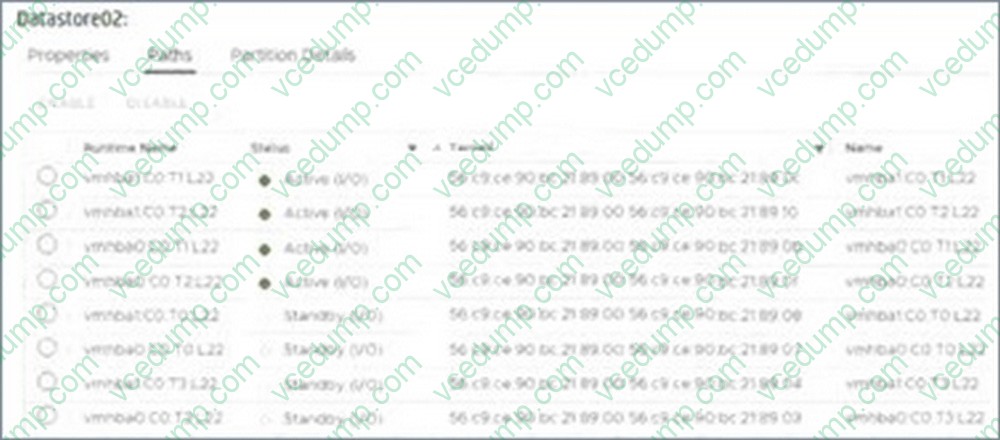
Based on this scenario, what would you recommend to equalize latency for the workload?
A. Relocate the workload on Datastore01 to a volume collection shared with Datastore02.
B. Relocate the workload on Datastore02 to a volume collection shared with Datastore01.
C. Issue handover to the volume collection hosting Datastore01.
D. Issue pinning option for Datastore02 for lower latency. -
Question 14:
A customer is deploying HPE Alletra 6000 for a new VMware cluster running latency-sensitive VDI. They want to start small but ensure that future growth increases both capacity and performance without adding operational complexity. Which design approach best meets the requirement?
A. Add additional Alletra 6000 arrays into the same scale-out group as demand grows
B. Add more 25GbE NICs to the existing hosts to increase throughput
C. Increase the snapshot reserve to reduce backend write amplification
D. Convert the deployment to a single large volume to reduce metadata overhead -
Question 15:
The storage solution based on the exhibit is deployed at a customer site.
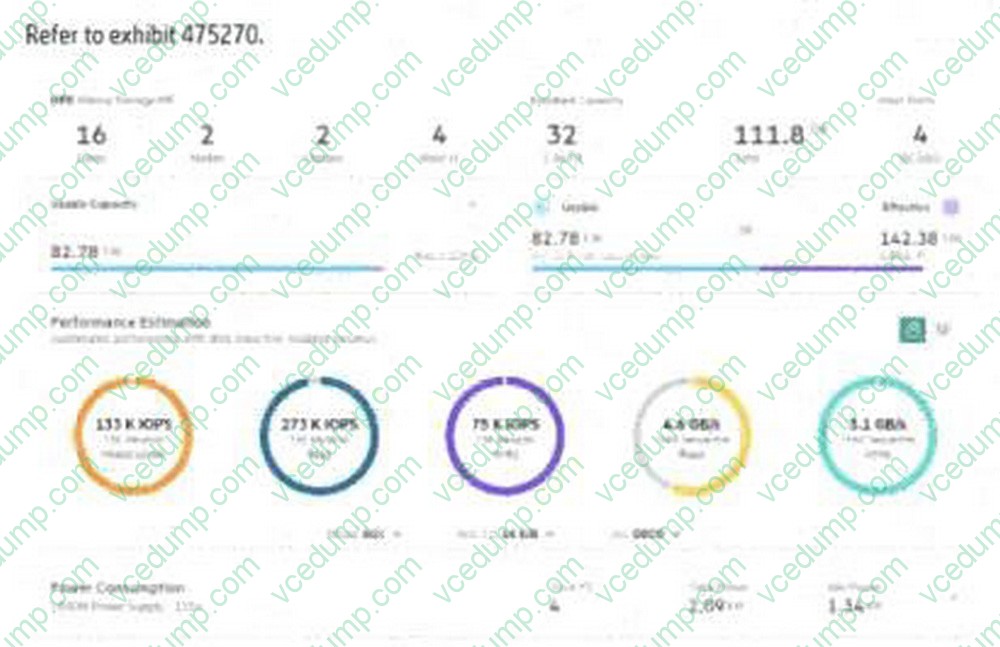
How can the sequential read performance be enhanced with this setup?
A. By increasing the amount of 10Gb NICs
B. By adding a third node to the solution
C. By upgrading the nodes to 32-core IOMs
D. By adding more NVMe media to the solution -
Question 16:
A junior engineer doing their first assessment makes the comment that all assessments are basically done "entirely by the assessment tool" and all they must do is start the process in the HPE website. You caution them that some assessment tools require a manual email by the engineer to HPE to really start the process. Which type of assessments require an email?
A. Backup
B. SAF
C. Non-HPE
D. CloudPhysics -
Question 17:
Your customer is deploying HPE Morpheus Enterprise Software as a single orchestration platform for compute and storage resources. To achieve a high-availability deployment in a single site, how many VMs must be deployed if distributed databases are not required?
A. 4 VMs with distributed database setup
B. 1 VM
C. 3 VMs
D. 1 VM with VMware HA and DRS active -
Question 18:
Refer to the exhibit.
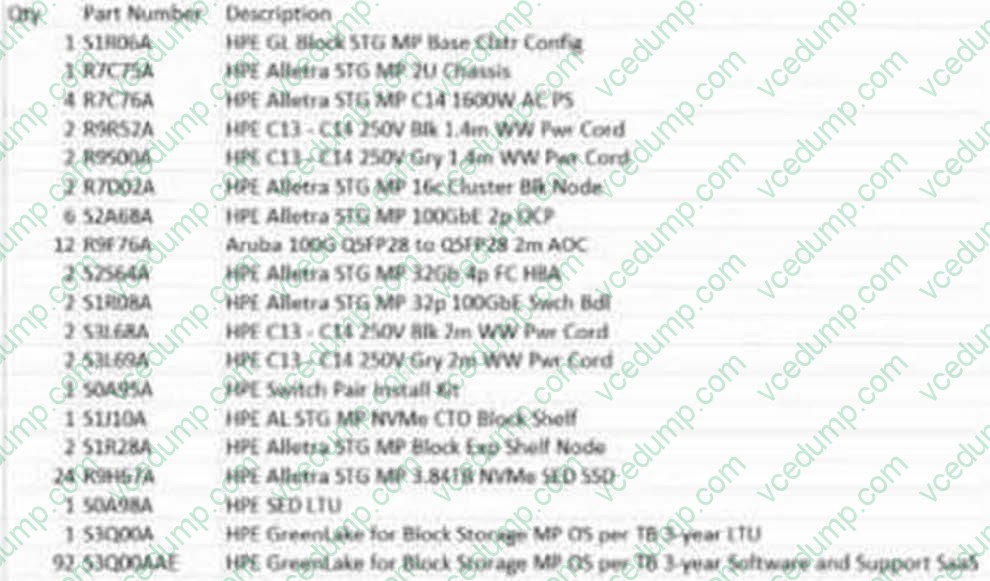
Your customer had an unexpected failure of their current storage array, causing them to lose some of their critical data. As a result, they are looking for a storage array with a guarantee of 100% data availability to prevent this failure and loss in the future.
They need 80TB raw and two new 25GbE top-of-rack switches to connect to their environment.
They expect 5% annual growth .
Which correction should be made to the configuration in the exhibit to meet the customer's requirements?
A. Change to 25G networking
B. Decrease to 20 ?3.84TB drives
C. HPE GreenLake financial model
D. Add 2?Aruba 8325 switches -
Question 19:
Your organization is implementing a new high-performance computing (HPC) cluster to support advanced scientific simul-ations. The cluster will consist of several hundred nodes that require rapid access to shared datasets. The storage is Vast/GL4F.
The application is very sensitive to latency and minimizing CPU overhead during data transfers is critical to achieving the desired performance levels.
Which access protocol should the organization implement to enhance NFS performance by reducing storage latency and increasing I/O operations?
A. NFS
B. NFS over RDMA
C. RoCE
D. iSER -
Question 20:
You are sizing an HPE Alletra Storage MP B10000 as shown in the graphic below.
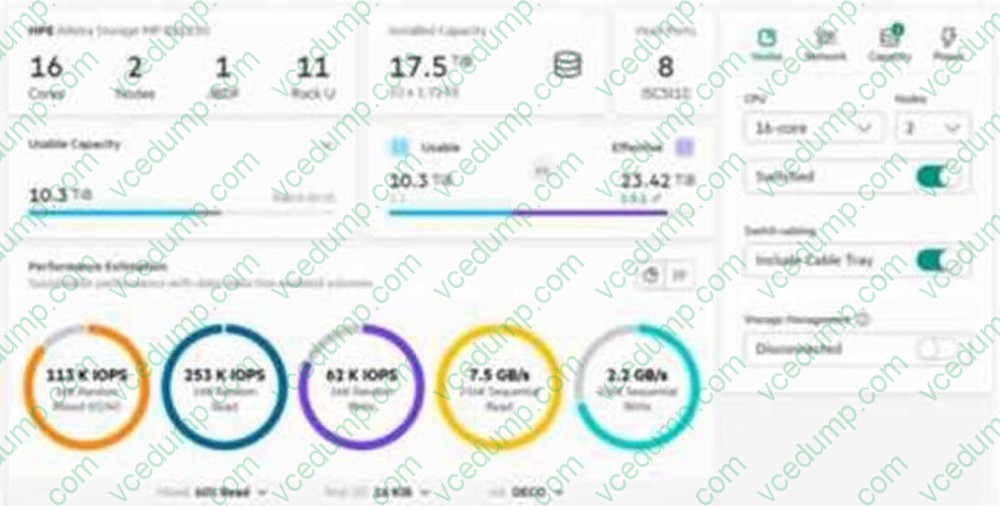
What change must be made to the current storage configuration to achieve maximum IOPS performance?
A. Additional network cards or HBAs need to be added for more throughput
B. Additional disks need to be added to the system
C. No change needed - the system is already operating at maximum performance
D. The controller must be upgraded to a 32-core model
Related Exams:
-
HP0-003
HP OpenView Service Desk 5.x -
HP0-045
Supporting the ESL E-Series Lobraries -
HP0-052
Planning and Design of HP 9000/HP Integrity Server Solutions -
HP0-053
Enterprise Integration and Management of HP ProLiant Servers -
HP0-054
Compaq/Oracle 8i I and P with Windows NT -
HP0-055
Implementing HP ProLiant Servers -
HP0-058
Configuration and Management of HP Integrity Mid-Range Servers -
HP0-063
LF PROFESSIONAL COLOR WORKFLOW MANAGEMENT -
HP0-064
HP BladeSystems C-Class Solutions 1 -
HP0-065
Planning and Designing ProLiant Solutions for the Enterprise
Tips on How to Prepare for the Exams
Nowadays, the certification exams become more and more important and required by more and more enterprises when applying for a job. But how to prepare for the exam effectively? How to prepare for the exam in a short time with less efforts? How to get a ideal result and how to find the most reliable resources? Here on Vcedump.com, you will find all the answers. Vcedump.com provide not only HP exam questions, answers and explanations but also complete assistance on your exam preparation and certification application. If you are confused on your HPE7-J02 exam preparations and HP certification application, do not hesitate to visit our Vcedump.com to find your solutions here.