HP HPE7-A07 Online Practice
Questions and Exam Preparation
HPE7-A07 Exam Details
Exam Code
:HPE7-A07
Exam Name
:Aruba Certified Campus Access Mobility Expert Written
Certification
:HP Certifications
Vendor
:HP
Total Questions
:70 Q&As
Last Updated
:Jul 03, 2026
HP HPE7-A07 Online Questions &
Answers
Question 1:
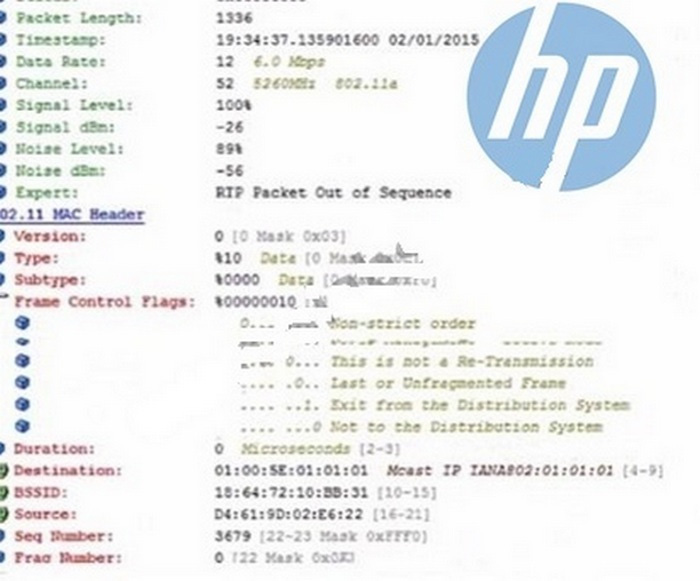
Exhibit.
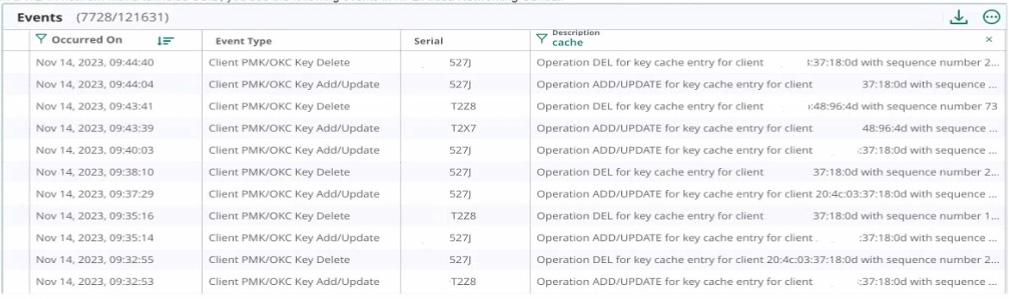
Which wireless connection phase has Just been completed?
A. MAC Authentication and 4-way handshake B. L3 authentication and encryption C. 802.11 enhanced open association D. L2 authentication and encryption
D. L2 authentication and encryption
Explanation/Reference:
The wireless connection phase that has just been completed is L2 authentication and encryption. This phase includes processes such as the Extensible Authentication Protocol (EAP) exchange, RADIUS requests and responses, and the 4way handshake which is characteristic of WPA2-AES encryption.
Question 2:
DragDrop
Match each Group Based Policy (GBP) rote description to its respective role ID.
Select and Place:
Explanation/Reference:
Question 3:
Exhibit.
An engineer has applied the above configuration to R1 and R2 However the routers OSPF adjacency never progresses past the "EXSTART-DR" slate as shown below.
Which configuration action on either router will allow R1 and R2 to progress past the "EXSTART/DR" state?
A. Change R1 and R2 to a network type of point-to-point. B. Remove the layer 3 MTU configuration. C. Ensure the OSPF process is not configured with passive-interface default. D. Change the IP address and mask applied to interface 1/1/1.
A. Change R1 and R2 to a network type of point-to-point.
Explanation/Reference:
In OSPF, the "EXSTART/DR" state indicates that the routers are trying to establish an adjacency but are unable to progress. This can happen if the OSPF network type is incorrectly configured for the type of connection between the routers. Given that R1 and R2 are connected via a point-to-point link (as suggested by the /31 subnet), setting the network type to point-to-point on both routers will remove the need for DR/BDR election, which is unnecessary on a point-to-point link, and allow OSPF to progress past the "EXSTART" state and form a full adjacency.
Question 4:
You configured a WPA3-SAE with the following MAC Authentication Role Mapping inCloud Authentication and Policy:
With further default settings assume a new Android phone is connected to the network. Which role will the client be assigned after connecting forthe first time?
A. byod B. client will be rejected network access C. lot-local D. unmatched-device
D. unmatched-device
Explanation/Reference:
The configuration shown in the third exhibit details a client role mapping that associates different client profile tags with specific client roles. When a new device, such as an Android phone, connects to the network, it will be profiled and assigned a role based on the mappings defined. If the device does not match any predefined profiles, it would be assigned the "unmatched-device" role. This is under the assumption that default settings are in place and the client does not match the criteria for any of the specific roles like "byod", "iot-internet", or "iot-local". Therefore, an Android phone connecting for the first time and not matching any specific profile tag would be assigned to the "unmatched-device" role.
Question 5:
What is me recommended configuration to ensure link aggregation is consistent in a campus topology using VSX with two aggregation switches and downlinks to access switches?
A. Use a custom LACP hash algorithm for improved load Balancing. B. Keep the MTU values at the default setting for GRE and VXLAN communications C. Use the command "vsx-sync mclag-interfaces" under the VSX context. D. Use the command "vsx-sync active-gateways" under the VSX context.
C. Use the command "vsx-sync mclag-interfaces" under the VSX context.
Explanation/Reference:
When configuring Virtual Switching Extension (VSX) in a campus topology for link aggregation across two aggregation switches, it is important to synchronize Multi-Chassis Link Aggregation Group (MC-LAG) interfaces. The command "vsxsync mclag-interfaces" ensures that the state and configuration of MC-LAG interfaces are synchronized between the two VSX-linked switches,providing consistent link aggregation and preventing any loops or mismatched configurations that might occur if the interfaces were not in sync.
Question 6:
Your customer added third-party USB dongles to the USB ports of their AOS 10 access points. The customer uses AP-615 and AP-635 Each AP is connected with a Cat 6A cable to a CX 6300F Class 4 PoE switch All APs are in the same group in HPE Aruba Networking Central and share the same configuration However, many of the dongles do not come up.
Which option will solve this issue?
A. Replace the Class a PoE switches with Class 6 PoE switches. B. Create two separate service profiles in the loT tab of the Central configuration settings. C. Perform a "poe disable" followed by a "poe enable" for the switch ports which connect to the APs so that the APs reboot. D. Move the AP-635 access points to a different group in Central to configure the dongles separately from the AP-615.
A. Replace the Class a PoE switches with Class 6 PoE switches.
Explanation/Reference:
USB dongles often require additional power, which may exceed the power delivery capabilities of Class 4 PoE switches. Aruba AP-615 and AP-635 are designed to work with USB dongles that require additional power for proper operation. Since the Cat 6A cable can support higher power levels, replacing the Class 4 PoE switches with Class 6 PoE switches, which can deliver higher power, should resolve the issue with the dongles not powering up.
Question 7:
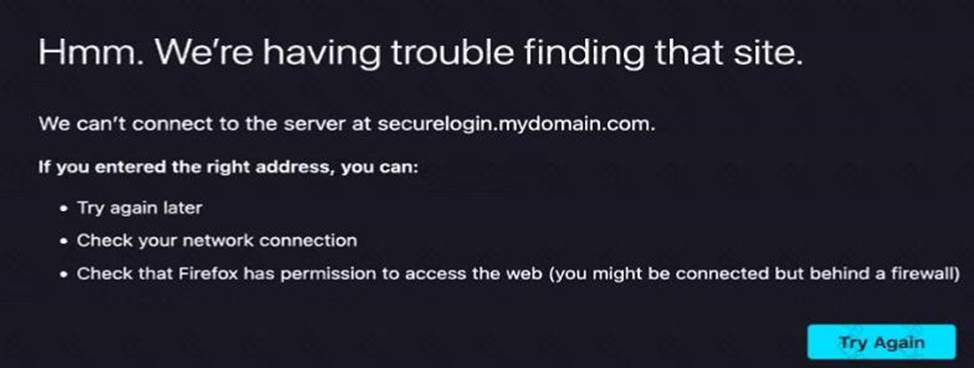
You configured" a bridgedmode SSID with WPA3-Enterprise and EAP-TLS security. When you connect an Active Directory joined client that has valid client certificates. ClearPass shows the following error.
What is needed to resolve this issue?
A. Enable authorization in your Authentication Method. B. Recreate the SSID m tunneled mode. C. Modify your ACX-AD authentication source to include the UPN in the search. D. Configure ClearPass to trust the client certificate.
C. Modify your ACX-AD authentication source to include the UPN in the search.
Explanation/Reference:
The error message "User not found" indicates that the authentication source, in this case, Active Directory (AD), is not able to locate the user account based on the current search parameters. This often occurs when the User Principal Name (UPN) that the client is using to authenticate is not included in the search parameters of the AD authentication source within ClearPass. By modifying the AD authentication source to include the UPN in the search, ClearPass will be able to correctly locate the user account and proceed with the authentication using the valid client certificates.
Question 8:
A client connecting to a tunneled open network is receiving the wrong VLAN Your customer has a gateway and has sent over a packet capture from a switch port mirror taken from the upstream switch with a packet capture from the IPsec tunnel and the GRE tunnel to help Identify the VLAN being sent from the controller to the AP.
Where will you see the VLAN assignment?
A. The GRE tunnel will include the VLAN lag assignment B. VLAN tag assignment win not he captured in any of the packet captures C. IPsec tunnel will include the VLAN tag assignment D. VLAN tag assignment win be included in the port mirror
D. VLAN tag assignment win be included in the port mirror
Explanation/Reference:
In a packet capture from an upstream switch port mirror, you would see the VLAN assignment. The port mirror captures the traffic as it is on the network, including any VLAN tags. GRE or IPsec tunnels encapsulate the original packet, including VLAN tags, but the VLAN information is not visible within the encapsulation headers.
Question 9:
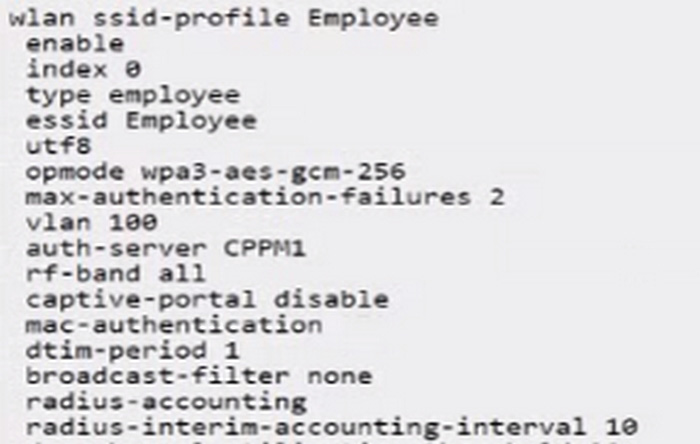
A customer is planning to add loT devices that connect wirelessly to the existing 802.1X SSlD. The customer will use ClearPass to authenticate the IoT devices by MAC address but other devices will still need to authenticate by only 802 1X Exhibit.
The customer provided the current configuration and reported their non-loT 802. IX devices are no longer able to connect. Which configuration change can be made to fix the issue?
B. Modify opmode wpa3-aes-gcm-256 to opmode wpa2-aes C. Add i2-autn-fairtnrougn to the WLAN configuration D. Remove mac-authentication from the WLAN configuration E. Modify max-authentication failures to 0.
C. Add i2-autn-fairtnrougn to the WLAN configuration
Explanation/Reference:
The existing configuration for the WLAN ssid-profile has enabled MAC authentication which, while suitable for IoT devices that may not support 802.1X, can interfere with the normal 802.1X authentication process for other devices. By removing the mac-authentication directive from the WLAN configuration, the non-IoT 802.1X devices should be able to connect without issues as the authentication process will not be disrupted by MAC authentication checks. This adjustment ensures that the WLAN ssid-profile is correctly aligned with the authentication requirements for both IoT and non-IoT devices within the network environment, conforming to the best practices for mixed-device WLAN configurations.
Question 10:
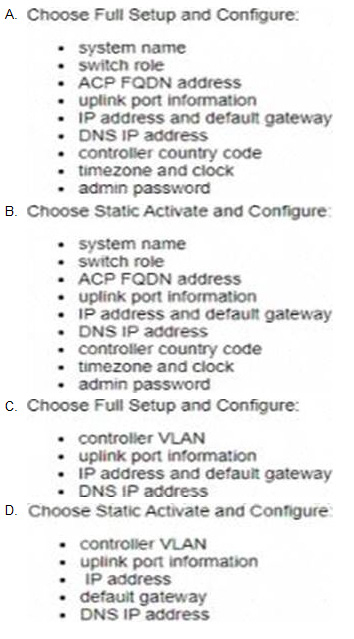
You want to configure an MTU of 9198 for a routed lag interface on a CX 6300 switch. Which configuration achieves this?
A. Option A B. Option B C. Option C D. Option D
A. Option A
Explanation/Reference:
In the context of ArubaOS-CX, particularly with the 6300 series switches, setting the MTU on a routed Link Aggregation Group (LAG) interface requires the interface lag id command in the configuration, specifying the LAG interface you're configuring. The ip mtu command is then used to set the desired MTU size for that LAG. Option A correctly shows this configuration process, where the MTU is set to 9198 for the LAG interface, in line with the requirements for routing larger frames, which could be necessary for certain applications or data flows that require jumbo frames.
The information related to the configuration of Aruba switches is consistent with the principles and guidelines found in the technical documentation for the ArubaOS-CX 6300 series switches, which emphasizes the importance of correct MTU settings for network performance and stability.
Nowadays, the certification exams become more and more important and required by more and more
enterprises when applying for a job. But how to prepare for the exam effectively? How to prepare
for the exam in a short time with less efforts? How to get a ideal result and how to find the
most reliable resources? Here on Vcedump.com, you will find all the answers.
Vcedump.com provide not only HP exam questions,
answers and explanations but also complete assistance on your exam preparation and certification
application. If you are confused on your HPE7-A07 exam preparations
and HP certification application, do not hesitate to visit our
Vcedump.com to find your solutions here.