HP0-Y51 Exam Details

  • Exam Code
    :HP0-Y51
  • Exam Name
    :Building HP SDN and FlexNetwork Solutions
  • Certification
    :HP Certifications
  • Vendor
    :HP
  • Total Questions
    :60 Q&As
  • Last Updated
    :Jul 12, 2026

HP HP0-Y51 Online Questions & Answers

  • Question 1:

    Which OpenFlow use case is an example of Network Functions Virtualization (NFV)?

    A. Use OpenFlow to deploy configurations using IMC VAN SDN Manager.
    B. Use OpenFlow to implement a router on an open-vswitch.
    C. Use OpenFlow to replace the need of an snmp-agent on the switch.
    D. Use OpenFlow to implement traffic prioritization on the edge.

  • Question 2:

    What correctly describes the role of OpenFlow in an SDN solution?

    A. OpenFlow regulates the communications among teamed SDN controllers, as well as between an SDN controller and a network infrastructure device
    B. OpenFlow integrates the SDN controller into a larger management suite such as that provided in an HP CloudSystern solution.
    C. OpenFlow is a communication protocol that an SDN controller can use to control devices at the network infrastructure layer.
    D. OpenFlow is the open standard technology that regulates SDN control plane and application plane communications.

  • Question 3:

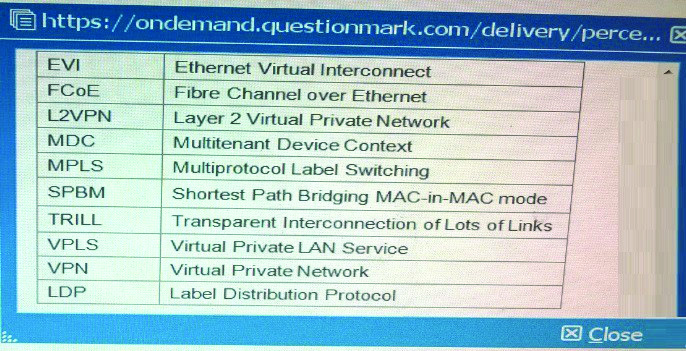
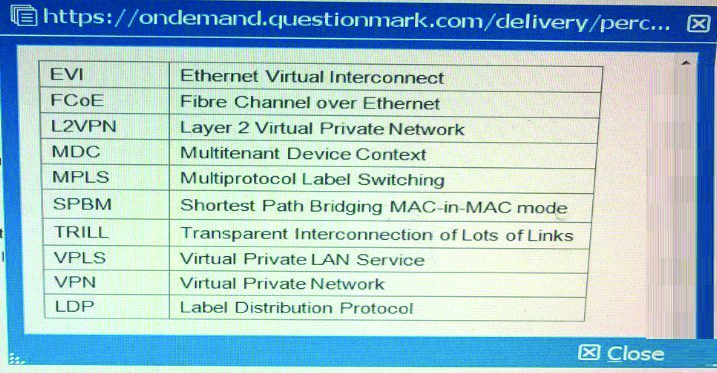
    Table of Acronyms

    Refer to the exhibit.

    The switch shown in the exhibit should from a TRILL region. For Switch 1 interface ten1/0/22, what is a valid port link-type and TRILL port type?

    A. port link type = access port in any VLAN TRILL port type = TRILL access port
    B. port link type = access port in any VLAN TRILL port type = TRILL trunk port
    C. port link type = trunk port that permits VLMs 10 and 20 TRILL- port type = TRILL access port
    D. port link type = hybrid port with untagged VLANs 10 and 20 TRILL port type = TRILL hybrid port

  • Question 4:

    A company has an HP BYOD solution with these requirements:

    Employees can connect their own devices to an Employees SSID, which enforces Wi-Fi Protected Access 2 (WPA2) with 802.1X.

    User Access Manager (UAM) is the RADIUS server for 802.1X authentication, and it enforces EAP-TLS.

    The employees will first connect to an open SSID, access a portal page, and download the proper certificates for completing 802.1X authentication.

    To meet these requirements, an administrator needs to deploy the correct certificate templates on UAM. What determine deploy?

    A. Whether the company uses Active Directory (AD) or Open LDAP
    B. Type of endpoint devices and the device operating systems (OS)
    C. Government regulations with which the company must comply
    D. Level of security that the company requires

  • Question 5:

    Table of Acronyms

    An HP Comware switch is configured with the MDC feature. It has three MDCs, which use the same CPU and are assigned these CPU weights:

    MDC 1 = 10

    MDC 2 = 4

    DC 3 = 2

    Currently:

    MDC 1 needs to use 25 percent of the CPU resources.

    MDC 2 needs to use 60 percent of the CPU resources.

    MDC 3 needs to use 60 percent of the CPU resources.

    Approximately what percentage of the CPU does each MDC receive while at the current CPU request rates?

    A. MDC 1 = 25 percent, MDC 2 = 50 percent, and MDC 3 = 25 percent
    B. MDC 1 = 63 percent, MDC 2 = 25 percent, and MDC 3 = 12 percent
    C. MDC 1 = 10 percent. MDC 2 = 4 percent, and MDC 3 = 2 percent
    D. MDC 1 = 25 percent. MDC 2 = 25 percent, and MDC 3 = 12 percent

  • Question 6:

    Refer to the exhibit.

    The exhibit shows the Fibre Channel (FQ zones that are members of zonesets on an HP Comware switch. How does this zoning affect the FC fabric operation?

    A. Host bus adapter (HBA) pWWNs in zoneset 1 belong to VSAN 1, which is currently active. HBA pWWNs in zoneset 2 belong to VSAN 2, which is inactive
    B. Server pWvVNs in zone 1 can discover targets pWWNs in zone 2. Server pWWNs in zone 3 can discover target pWWNs in zone 4.
    C. A sender pWWN in zone 1 can discover target pWWNs in zone 1. A server pWWN in zone 2 can discover target pWWNs in zone 2.
    D. The switch matches a host bus adapter (HBA) pWWN to entries in zone 1 to determine whether an HBA can connect to a port. If it does not find a match, it checks zone 2.

  • Question 7:

    Table of Acronyms

    An administrator has configured an HP Comware switch to support FCoE in Fibre Channel Forwarder (FCF) mode. A switch interface, ten1/0/1, connects to a sewer FC host bus adapter (HBA), The HBA should send storage traffic in VSAN 2, which is associated with VLAN 20.

    How should the administrator assign FC traffic for this HBA to VSAN 2?

    A. By binding a VFC interface to ten1/0/1 and specifying VSAN 2 as the VFC interface trunk VSAN
    B. By accessing the VLAN 20 configuration view and specifying ten1/0/1 as a member port of the VLAN
    C. By configuring ten1/0/1 as an F-mode FC port and specifying VSAN2 as the port access VSAN
    D. By accessing the VSAN 2 configuration view and adding ten1/0/1 as a trunk port

  • Question 8:

    An SDN application needs to create reactive flow table entries in response to specific packets. The flow_mod APIs will create the actual entries, but application must be configured with another API as part of this function. What is that API?

    A. A sequence packet listener (SPL) API that specifies the Director role and the match criteria for the packets
    B. A listener API that registers the application to listen for data paths
    C. A listener API that registers the application to listen for meters
    D. A sequence packet listener (SPL) API that specifies the Advisor role and the match criteria for the packets

  • Question 9:

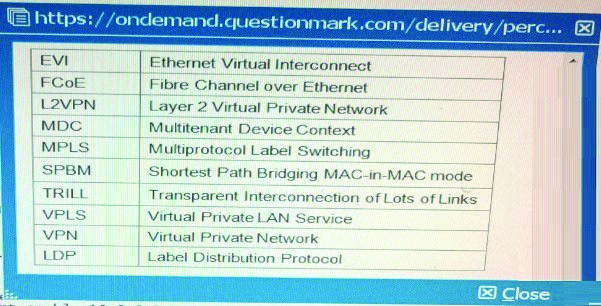
    Table of acronyms

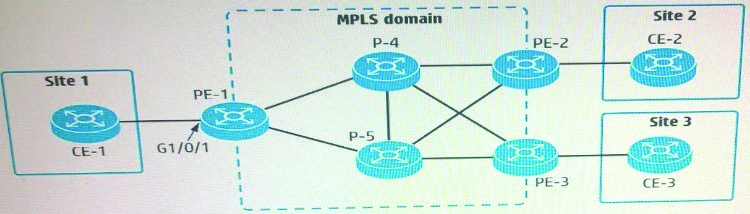
    Refer to the exhibit.

    An administrator is setting up an MPLS and L2VPN virtual circuit (VC) between customer Site 1 and Site 2. The administrator is creating a global cross-connect group, which uses LDP signaling, on PE-1. Which two elements are required to do this?

    A. An AC connection (specifies a service instance on g1/0/1) and a peer (PE-2)
    B. A peer (PE-2) and a VPN instance (associated with g1/0/1)
    C. A peer (PE-2) and a VLAN ID (access VLAN or. g1/0/1)
    D. An AC connection (specifies a service instance on g1/0/1) and a VPN instance (associated with g1/0/1)

  • Question 10:

    Table of Acronyms

    Refer to the exhibit.

    An administrator wants to establish a remote LDP session between PE-1 (loopback IP address 10.0 0.1) and PE-2 (loopback IP address; 10.0.0.2). What is required to do this?

    A. Both PE-1 and PE-2 have a VPN instance that is defined with the same route distinguisher (RD)
    B. Both PE-1 and PE-2 advertise the same label for their loopback IP address
    C. Both PE-1 and PE-2 use ordered mode for LDP.
    D. Both PE-1 and PE-2 advertise their loopback IP address with OSPF and with LDP.

Tips on How to Prepare for the Exams

Nowadays, the certification exams become more and more important and required by more and more enterprises when applying for a job. But how to prepare for the exam effectively? How to prepare for the exam in a short time with less efforts? How to get a ideal result and how to find the most reliable resources? Here on Vcedump.com, you will find all the answers. Vcedump.com provide not only HP exam questions, answers and explanations but also complete assistance on your exam preparation and certification application. If you are confused on your HP0-Y51 exam preparations and HP certification application, do not hesitate to visit our Vcedump.com to find your solutions here.