HESI Exam Details
-
Exam Code
:HESI -
Exam Name
:Health Educational Systems Inc (HESI) Exam -
Certification
:Health Educational Systems Certifications -
Vendor
:Health Educational Systems -
Total Questions
:620 Q&As -
Last Updated
:May 29, 2026
Health Educational Systems HESI Online Questions & Answers
-
Question 51:
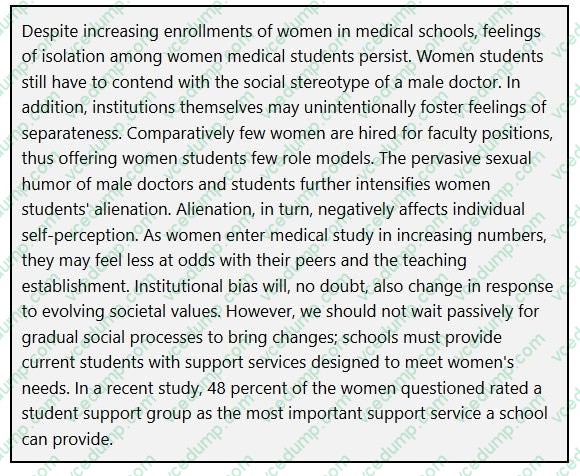
The author cites factual information in support of which of the following contentions?
A. Women students have more negative experiences in medical school than male students.
B. Medical schools are moving rapidly to eliminate the effects of sexual bias.
C. Many women are psychologically damaged by the feelings of alienation in medical school.
D. Many women medical students feel a need for officially sponsored support services. -
Question 52:
What is the name of NO2?
A. nitrogen oxide
B. nitrogen dioxide
C. nitrogen bioxide
D. nitrogen monoxide -
Question 53:
Which of these is the best definition of the word languid?
A. sluggish
B. depressed
C. warm
D. talkative -
Question 54:
What is the best definition of the word sinuous?
A. thin
B. supple
C. mischievous
D. slender -
Question 55:
Select the meaning of the underlined word in the sentence.
The girl hadn't eaten properly for weeks; her cheekbones were nearly concave in shape.
A. extended
B. extinguished
C. bowed inward
D. bulging -
Question 56:
Reading Material
(1)
The study, published today in Nature Microbiology, holds promise for a new treatment method against antibiotic-resistant bacteria (commonly known as superbugs). (2) The star-shaped structures are short chains of proteins called `peptide polymers', and were created by a team from the Melbourne School of Engineering.
(3)
The team included Professor Greg Qiao and PhD candidate Shu Lam, from the Department of Chemical and Biomolecular Engineering, as well as Associate Professor Neil O'Brien-Simpson and Professor Eric Reynolds from the Faculty of Medicine, Dentistry and Health Sciences and Bio21 Institute.
(4)
Professor Qiao said that currently the only treatment for infections caused by bacteria is antibiotics. (5) However, over time bacteria mutate to protect themselves against antibiotics, making treatment no longer effective. (6) These mutated bacteria are known as `superbugs'.
(7)
"It is estimated that the rise of superbugs will cause up to ten million deaths a year by 2050. (8) In addition, there have only been one or two new antibiotics developed in the last 30 years," he said.
(9)
Professor Qiao and his team have been working with peptide polymers in the past few years. (10) Recently, the team created a star-shaped peptide polymer that was extremely effective at killing Gram-negative bacteria - a major class of bacteria known to be highly prone to antibiotic resistance - while being non-toxic to the body.
(11)
In fact, tests undertaken on red blood cells showed that the star-shaped polymer dosage rate would need to be increased by a factor of greater than 100 to become toxic.
(12)
The star-shaped peptide polymer is also effective in killing superbugs when tested in animal models. (13) Furthermore, superbugs showed no signs of resistance against these peptide polymers.
(14)
The team discovered that their star-shaped peptide polymers can kill bacteria with multiple pathways, unlike most antibiotics which kill with a single pathway.
(15)
They believe that this accounts for the superior performance of the star-shaped peptide polymers over antibiotics. (16) One of these pathways includes `ripping apart' the bacteria cell wall.
(17)
While more research is needed, Professor Qiao and his team believe that their discovery is the beginning of unlocking a new treatment for antibiotic-resistant pathogens.
The term superbug refers to ____.
A. mutated bacteria that are larger in size than non-mutated bacteria
B. bacteria that help the body fight off infection
C. mutated bacteria that have developed a resistance to antibiotics
D. bacteria from insect bites that only affect humans -
Question 57:
What is 13.5 + 9.035?
A. 22.04
B. 22.85
C. 22.535
D. 22.085 -
Question 58:
Which of these is not a property of water?
A. density of liquid form is less than solid form
B. high boiling point compared to other hydrogen compounds
C. can absorb/release large quantities of heat without large temperature change
D. high surface tension -
Question 59:
The chemical 4[NH4Fe(SO4)2 × 12H] contains how many more hydrogen atoms than oxygen atoms?
A. 16 hydrogen atoms
B. There are more oxygen atoms than hydrogen atoms.
C. 32 hydrogen atoms
D. 64 hydrogen atoms -
Question 60:
Subtract: 8,674.5 - 998.9 =
A. 4,445.67
B. 7,675.6
C. 8,294.6
D. 3,349.5
Related Exams:
Tips on How to Prepare for the Exams
Nowadays, the certification exams become more and more important and required by more and more enterprises when applying for a job. But how to prepare for the exam effectively? How to prepare for the exam in a short time with less efforts? How to get a ideal result and how to find the most reliable resources? Here on Vcedump.com, you will find all the answers. Vcedump.com provide not only Health Educational Systems exam questions, answers and explanations but also complete assistance on your exam preparation and certification application. If you are confused on your HESI exam preparations and Health Educational Systems certification application, do not hesitate to visit our Vcedump.com to find your solutions here.