HESI Exam Details
-
Exam Code
:HESI -
Exam Name
:Health Educational Systems Inc (HESI) Exam -
Certification
:Health Educational Systems Certifications -
Vendor
:Health Educational Systems -
Total Questions
:620 Q&As -
Last Updated
:May 29, 2026
Health Educational Systems HESI Online Questions & Answers
-
Question 491:
What is the decimal equivalent of 3/8?
A. 0.625
B. 0.375
C. 0.875
D. 0.125 -
Question 492:
The autoimmune disease, multiple sclerosis is characterized by the degradation of what?
A. Proteins
B. Carbohydrates
C. Myelin Sheath
D. Dendrites
E. Phospholipids -
Question 493:
A person with AB- blood should not receive blood from which other blood type?
A. A
B. O
C. B
D. AB+ -
Question 494:
10 kilograms is equivalent to how many pounds?
A. 2.2
B. 22
C. 160
D. 4.54 -
Question 495:
What is the best definition of biopsy?
A. administer a written test
B. enter a conversation
C. remove for observation or study
D. conduct an interview -
Question 496:
Soon after the surgery, the patient found he had to suppress the urge to vomit. What does "suppress" mean in this context?
A. correct
B. exemplify
C. counter
D. antagonize -
Question 497:
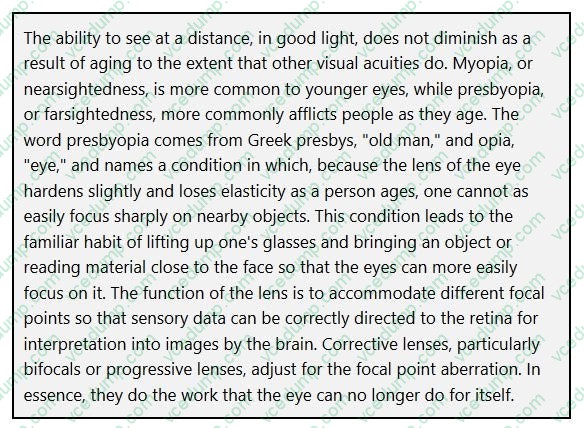
What was the author's primary purpose for writing this essay?
A. to define what presbyopia is
B. to describe how eyes age and the function of corrective lens
C. to compare and contrast nearsightedness with farsightedness
D. to review the anatomy of the human eye -
Question 498:
Reading Material
Smallpox is one of the deadliest and dangerous diseases affecting the human population across the world. The first recorded epidemic was in 1350 BC during the Egyptian-Hittite war, and it was quite prevalent in the late 1800's through a large part of the 1900's. Approximately five hundred million people were infected with the disease prior to its eradication in the 1970's, with the last case being in Somalia in 1977. Symptoms of infection included excessive bleeding, high fever, delirium, vomiting, and a raised pink rash. Most cases of smallpox ended in death and survivors were often seriously maimed by pock marks, blindness, or infertility. The pain and suffering remained for a lifetime after the disease was gone.
There is no known cure for smallpox, only preventative vaccinations. Because smallpox was wiped out in 1970s, the World Health Organization (W.H.O.) recommended that all countries stop vaccinating for the disease in 1980. This means that today, most young people are not vaccinated against the disease. Because the disease is considered eradicated, the issue of what to do with the remaining government-held vaccines has been an issue of debate. Should the stored vaccines be destroyed since the disease is no longer a concern, or do we keep them in storage for research or in case of an unexpected outbreak? Experts at the Center for Disease Control (C.D.C.) and the World Health Organization have spent an enormous amount of time researching this issue and have given much educated thought to the matter. Reportedly the W.H.O. wants to destroy all vaccines, however some scientists feel the destruction could do more harm than good.
The issue of bioterrorism adds another layer of complexity to the issue. In the case of smallpox, just a small amount of the virus released in the air could infect thousands of people in 6-24 hours. If such a disease were used as a weapon, we would obviously want the vaccine available for use. However, the fact that the vaccine still exists allows the use of smallpox for bioterrorism in the first place. If we could be sure all of the vaccine was destroyed, the decision may be a bit easier, but what if it the vaccine were only partially destroyed, and the remainder was used by an unfriendly nation?
In this world of global unrest and increasing technology, bioterrorism will come an increasing concern. The smallpox virus could be a serious threat to world health should any nation engage in the act if bioterrorism against an enemy. The question remains: do we run the risk of bioterrorism by continuing to store the medicine for several hundred smallpox vaccinations or do we destroy the vaccine and pray that there is no outbreak of the deadly virus? Because it is unknown at this time if researchers are able to re-create the vaccine, either solution may have permanent consequences.
According to the text, why is there an increasing concern over bioterrorism?
A. The speed at which the disease could spread is unknown.
B. There is a decreasing number of smallpox vaccinations.
C. Oil prices are rising.
D. There is a rise in global unrest and there are increasing advancements in technology. -
Question 499:
Which transition best completes this sentence correctly?
Sarah did not realize until after she arrived in New York that she had left her ball gown at home; ____, she was fortunate enough to find a shop that rented them by the evening.
A. because
B. while
C. however
D. after all -
Question 500:
What is the best definition of the word proximal?
A. far
B. up
C. away
D. central
Related Exams:
Tips on How to Prepare for the Exams
Nowadays, the certification exams become more and more important and required by more and more enterprises when applying for a job. But how to prepare for the exam effectively? How to prepare for the exam in a short time with less efforts? How to get a ideal result and how to find the most reliable resources? Here on Vcedump.com, you will find all the answers. Vcedump.com provide not only Health Educational Systems exam questions, answers and explanations but also complete assistance on your exam preparation and certification application. If you are confused on your HESI exam preparations and Health Educational Systems certification application, do not hesitate to visit our Vcedump.com to find your solutions here.