HESI Exam Details
-
Exam Code
:HESI -
Exam Name
:Health Educational Systems Inc (HESI) Exam -
Certification
:Health Educational Systems Certifications -
Vendor
:Health Educational Systems -
Total Questions
:620 Q&As -
Last Updated
:May 29, 2026
Health Educational Systems HESI Online Questions & Answers
-
Question 111:
Reading Material
Smallpox is one of the deadliest and dangerous diseases affecting the human population across the world. The first recorded epidemic was in 1350 BC during the Egyptian-Hittite war, and it was quite prevalent in the late 1800's through a large part of the 1900's. Approximately five hundred million people were infected with the disease prior to its eradication in the 1970's, with the last case being in Somalia in 1977. Symptoms of infection included excessive bleeding, high fever, delirium, vomiting, and a raised pink rash. Most cases of smallpox ended in death and survivors were often seriously maimed by pock marks, blindness, or infertility. The pain and suffering remained for a lifetime after the disease was gone.
There is no known cure for smallpox, only preventative vaccinations. Because smallpox was wiped out in 1970s, the World Health Organization (W.H.O.) recommended that all countries stop vaccinating for the disease in 1980. This means that today, most young people are not vaccinated against the disease. Because the disease is considered eradicated, the issue of what to do with the remaining government-held vaccines has been an issue of debate. Should the stored vaccines be destroyed since the disease is no longer a concern, or do we keep them in storage for research or in case of an unexpected outbreak? Experts at the Center for Disease Control (C.D.C.) and the World Health Organization have spent an enormous amount of time researching this issue and have given much educated thought to the matter. Reportedly the W.H.O. wants to destroy all vaccines, however some scientists feel the destruction could do more harm than good.
The issue of bioterrorism adds another layer of complexity to the issue. In the case of smallpox, just a small amount of the virus released in the air could infect thousands of people in 6-24 hours. If such a disease were used as a weapon, we would obviously want the vaccine available for use. However, the fact that the vaccine still exists allows the use of smallpox for bioterrorism in the first place. If we could be sure all of the vaccine was destroyed, the decision may be a bit easier, but what if it the vaccine were only partially destroyed, and the remainder was used by an unfriendly nation?
In this world of global unrest and increasing technology, bioterrorism will come an increasing concern. The smallpox virus could be a serious threat to world health should any nation engage in the act if bioterrorism against an enemy. The question remains: do we run the risk of bioterrorism by continuing to store the medicine for several hundred smallpox vaccinations or do we destroy the vaccine and pray that there is no outbreak of the deadly virus? Because it is unknown at this time if researchers are able to re-create the vaccine, either solution may have permanent consequences.
What is the author's purpose in writing this article about smallpox?
A. to persuade
B. to inform
C. to entertain
D. to analyze -
Question 112:
BF3 is also known as ____.
A. boron trifluoride
B. boron tetrafluoride
C. tri-boron monofluoride
D. boron monofluoride -
Question 113:
The stigma of a flower serves what purpose?
A. to fertilize
B. to manufacture pollen
C. to collect pollen
D. to bait pollinators -
Question 114:
Which of these is not a biotic factor?
A. rock
B. rose
C. child
D. worm -
Question 115:
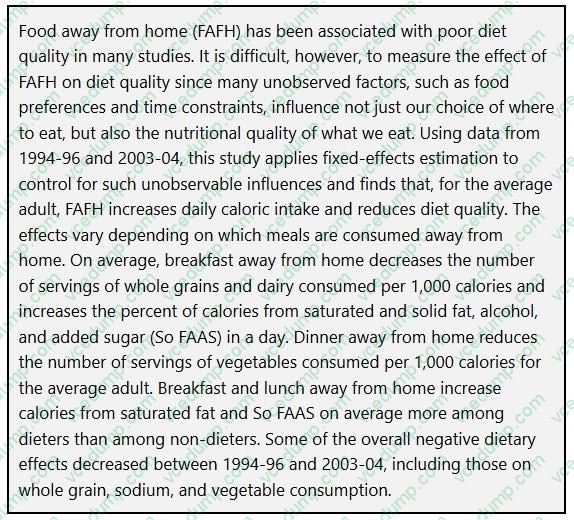
Which meal(s) eaten away from home have worse results for dieters than for non-dieters?
A. The article doesn't state which meal is the worse for non-dieters.
B. Dinner eaten away from home is worse because people consume fewer whole grains and vegetables.
C. Breakfast eaten away from home is worse because it increases the percent of calories from saturated and solid fat, alcohol, and added sugar (So FAAS) in a day.
D. Breakfast and lunch eaten away from home are worse because they increase the percent of calories from saturated fats. -
Question 116:
The liver is an organ responsible for detoxifying the body of many harmful substances. Therefore, you might expect the liver to contain a high amount of:
A. Rough endoplasmic reticulum.
B. Lysosomes.
C. Mitochondria.
D. Smooth endoplasmic reticulum. -
Question 117:
What is the main function of calcitonin?
A. Increasing the absorption of calcium in the heart.
B. Decreasing the calcium concentration in the blood.
C. Preventing the increase in calcium in the bone marrow.
D. Inhibiting the processing of calcium in the muscle cells.
E. None of the above -
Question 118:
What is the best description for the word defecate?
A. to have a bowel movement
B. to surrender to an opposing side
C. to conquer in battle
D. to strain -
Question 119:
Reading Material
A complete blood count (CBC) is one of the most useful and requested types of analysis in medical practice. A CBC searches for all the cells that exist in the blood, which are divided into three basic types: white blood cells (leukocytes),
platelets, and red blood cells (erythrocytes). All of these blood cells are produced in the bone marrow and correspond to a specific exam, integrated in the CBC: erythrogram, leukogram, and thrombogram.
The erythrogram studies red blood cells. Among other tests, it includes a red blood cell count, a hematocrit, and hemoglobin. When these levels are low, the patient may be suffering from anemia, which can be caused by anything from heavy
menstrual bleeding to Addison's disease. A diagnosis of polycythemia may be made if the number of red blood cells is increased.
The leukogram is the test that evaluates the number of white cells present in the blood, which should vary between 4,000 and 10,000 cells per cubic millimeter in most adults. High values of white blood cells are seen with infection or severe
emotional/physical stress, while AIDS and chemotherapy are two causes for low values.
The thrombogram is the analysis of platelets, the cells responsible for coagulation. The main function of platelets is to help stop bleeding by helping form a clot. They do this by secreting proteins from their surface that allow them to stick to
vessels and each other. Low values of platelets are seen with pregnancy or an enlarged spleen, whereas high values are seen with cancers or iron deficiency. According to the accompanying text, what are the names of the three basic blood cells?
A. leukocytes, platelets, and erythrocytes
B. red blood cells, erythrocytes, and platelets
C. white blood cells, leukocytes, and platelets
D. erythrograms, leukograms, and thrombograms -
Question 120:
Which of these is true of viruses?
A. They are larger than bacteria.
B. They are acellular.
C. Some are parasitic; some are not.
D. Their genetic material can be composed of DNA, RNA, or both.
Related Exams:
Tips on How to Prepare for the Exams
Nowadays, the certification exams become more and more important and required by more and more enterprises when applying for a job. But how to prepare for the exam effectively? How to prepare for the exam in a short time with less efforts? How to get a ideal result and how to find the most reliable resources? Here on Vcedump.com, you will find all the answers. Vcedump.com provide not only Health Educational Systems exam questions, answers and explanations but also complete assistance on your exam preparation and certification application. If you are confused on your HESI exam preparations and Health Educational Systems certification application, do not hesitate to visit our Vcedump.com to find your solutions here.