H12-261 Exam Details
-
Exam Code
:H12-261 -
Exam Name
:HCIE-Routing & Switching (Written) V3.0 -
Certification
:Huawei Certifications -
Vendor
:Huawei -
Total Questions
:494 Q&As -
Last Updated
:Oct 07, 2025
Huawei H12-261 Online Questions & Answers
-
Question 291:
IPv6 ISIS ring protocol deployment, the following method is correct
A. In the broadcast network, the first can be divided into IPv4 IPv6 DIS priority settings.
B. By default, the priority of the broadcast network interface is Level-1 Level-2 DIS 1 and
C. In the same broadcast network, if each router is supported, IPv4 IPv6 IPv4 IPv6 DIS and , and must be the same device
D. ISIS ISIS silent ISIS ISIS interface configuration, then this interface will not send packets, but will receive packets -
Question 292:
What is the relationship between CIR BC TC and ?
A. TC=CIR/BC
B. CIR=TC/BC
C. CIR=BE/TC
D. TC=BC/CIR -
Question 293:
Which of the following statements regarding the BFD one-arm-Echo function are true?
A. Local and remote discriminators must be configured for this function.
B. After this function is enabled, the destination and source IP addresses of BFD packets are the same.
C. This function is applicable when one device supports BFD and the other device does not.
D. The default destination IP address of a BFD packet is 224.0.0.184. -
Question 294:
Regarding routing BGP filtering, what are the errors described below?
A. Configure a routing policy for routes originating in the local area. The policy is effective before adding routes to the routing table.
B. Route-Policy node " " node Route-Policy's relationship is inter-filter or , that is, as long as it passes a filter, it can pass.
C. When the BGP BGP BGP pair is received, the routing policy is executed, and the unwanted routing routes are not added to the local.
D. Route-Policy node if-match " " In the same one, multiple attributes of different attributes are or *** -
Question 295:
IPSG DHCP-snooping can be configured to statically bind or bind to a table.
A. True
B. False -
Question 296:
HW has a Frame Relay network with two sites (a headquarters site and a remote site) connected by a single PVC. RIP version 2 is running in the network. A new remote site is added and HW has ordered a second PVC between this site and the headquarters site. All Frame Relay interface IP addresses are in a single subnet. The customer configured Frame Relay DLCI mappings and can successfully ping from the new remote to the headquarters site as well as to the other remote site. However, the new router does not have a route in its route table to the other remote site's LAN, and cannot ping the LAN interface or any hosts on that LAN. What is most likely causing the problem?
A. Triggered updates should be configured on the headquarters router, to directly forward routing updates between the two remote sites
B. The headquarters site router has split-horizon enabled on the frame-relay interface
C. Neighbor statements are not configured on the two remote sites, pointing to all other sites
D. The frame-relay IP to DLCI mappings are incorrectly configured
E. RIP cannot propagate routing updates over a partial mesh frame-relay configuration, so another routing protocol should be selected -
Question 297:
After the BGP down connection is successful, what are the possible reasons?
A. Open report, defeat, loss
B. Routing update The mandatory attribute in the text is lost.
C. After the BGP holdtime keepalive connection is established, the message is not received within the quotient of the quotient.
D. Received error BGP message -
Question 298:
Which of the following statements regarding the basic MPLS forwarding process is false?
A. When an IP packet enters an MPLS domain, the device checks whether the tunnel ID corresponding to the destination IP address of the packet is 0x0. If so, the MPLS forwarding process starts.
B. By default, the egress node supporting PHP allocates the label with the value of 3 to the penultimate hop.
C. A transit node replaces a label on the top of the label stack in an MPLS packet with the label assigned by the next hop.
D. When an IP packet enters an MPLS domain, the MPLS edge device inserts a new label between the Layer 2 header and the IP header of the packet. -
Question 299:
If the router only needs to forward IPv6, IPv4 packets, then there is no need to configure any of these and address protocols on the router.
A. True
B. False -
Question 300:
Router HW1 and Router HW2 are connected to network A and B Network B respectively. Referring to the figure, if you want to set up an IPsec VPN tunnel between HW1 and HW2, which of the following ACL rules needs to be configured on HW1 to transmit the traffic across network A and B pass through the encrypted VPN tunnel?
A. rule permit ip source 10.1.2.0 0.0.0.255 destination 10.1.1.0 0.0.0.255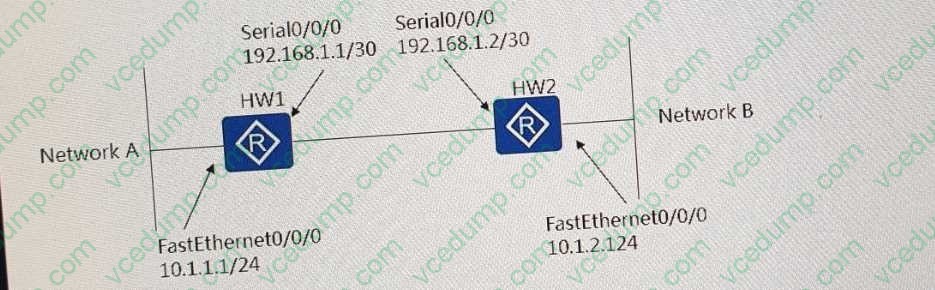
B. rule permit ip source 10.1.1.0 0.0.0.255 destination 10.1.2.0 0.0.0.255
C. rule permit ip source 10.1.1.0 0.0.0.255 destination 192.168.1.2 0
D. rule permit ip source 192.168.1.1 0 destination 10.1.2.0 0.0.0.255
E. rule permit ip source 192.168.1.1 0 destination 192.168.1.2 0
Related Exams:
-
H11-821
HCNP-UC-HIPT (Implementing Huawei IP Telephony Solutions) -
H11-828
HCNP-UC(Fast Track)(Unified Communication (Fast Track)) -
H11-851
HCIA-Video Conference V3.0 -
H11-861
HCIP-Video Conference V2.0 -
H11-868
HCNP- VC(Fast Track)-(Video Conference (Fast Track)) -
H12-111
HCIA-IoT V3.0 -
H12-224
HCIP-Routing & Switching (Fast Track) V2.0 -
H12-311
HCIA-WLAN V3.0 -
H12-351
HCIE-WLAN (Written) V1.0 -
H12-411
HCIA-Data Center Facility V2.0
Tips on How to Prepare for the Exams
Nowadays, the certification exams become more and more important and required by more and more enterprises when applying for a job. But how to prepare for the exam effectively? How to prepare for the exam in a short time with less efforts? How to get a ideal result and how to find the most reliable resources? Here on Vcedump.com, you will find all the answers. Vcedump.com provide not only Huawei exam questions, answers and explanations but also complete assistance on your exam preparation and certification application. If you are confused on your H12-261 exam preparations and Huawei certification application, do not hesitate to visit our Vcedump.com to find your solutions here.