H12-222 Exam Details
-
Exam Code
:H12-222 -
Exam Name
:HCIP-Routing & Switching-IENP V2.5 -
Certification
:Huawei Certifications -
Vendor
:Huawei -
Total Questions
:287 Q&As -
Last Updated
:Jan 17, 2024
Huawei H12-222 Online Questions & Answers
-
Question 101:
Which of the following statements regarding the ingress node in MPLS forwarding process are correct? (Multiple Choice)
A. After receiving a data packet, the ingress node searches for tunnel ID in the ILM table first.
B. The ingress node finds the NHLFE entry matching the tunnel ID in the ILM table to associate LFIB and NHLFE entries.
C. The ingress node checks the NHLFE entry to obtain the outbound interface, next hop, outgoing label, and label operation type.
D. The label operation type is Push.
E. The ingress node adds the obtained label to the IP packet, processes EXP by QoS policy, processes the TTL, and forwards the encapsulated MPLS packet to the next hop. -
Question 102:
Which of the following statements regarding the IntServ model is false?
A. RSVP is used to transmit signaling of QoS requests, notifying the router of QoS requirements of the application.
B. It provides guaranteed bandwidth and delay to meet requirements of the application.
C. It can provide a load control service, to ensure that even in the case of network overload, can provide services similar to the network which is not overloaded, that is, in the case of network congestion, this model ensures that packets of some applications can be processed with the low delay.
D. In this model, the network maintains the status of each flow (IP addresses and port numbers of source and destination ends), and based on this state packets are classified, policed, queued, and scheduled, meeting application requirements. -
Question 103:

The following figure shows the configuration. Which of the following statements are false? (Multiple Choice)
A. The mpls Isr-id command configures the LSR ID. This command is the prerequisite for other MPLS commands. By default, this command is not configured.
B. The mpls command can be run in the system view and interface view to enable MPLS. You can configure a LSR ID after MPLS is enabled.
C. After MPLS is enabled globally, you do not need to enable MPLS in the interface view again.
D. The last command configures LSRA as the ingress LSR and creates a static LSP. -
Question 104:
Which of the following command is used to configure remote port mirroring on a Huawei router to send the packets mirrored on the remote mirrored port to the monitoring device through the Layer 3 IP network?
A. mirror-sever destination-ip 10.1.0.1 source-ip 192.168.1.1
B. monitor-sever destination-ip 10.1.0.1 source-ip 192.168.1.1
C. observe-sever destination-ip 10.1.0.1 source-ip 192.168.1.1
D. sever destination-ip 10.1.0.1 source-ip 192.168.1.1 -
Question 105:
Fast detection technology can rapidly detect communication faults between neighboring devices as soon as possible so that the system can take measures immediately to ensure that services are not interrupted.
A. TRUE
B. FALSE -
Question 106:
BFD (bidirectional forwarding detection) is a fast detection technology but is complex, It needs to be supported by special devices.
A. TRUE
B. FALSE -
Question 107:
MPLS supports multi-layer labels and connection-oriented on the forwarding plane, therefore it is widely used. So Which of the following is not the cause for MPLS deployment?
A. Wide recognition by vendors
B. Traffic engineering capabilities
C. Simplifying route query on software-based routers
D. Using VPN services -
Question 108:
On the network shown in the following figure, a MPLS LSP is configured and a local LDP session is established between SWA and SWB. Which of the following statements is true?
A. The configuration is correct.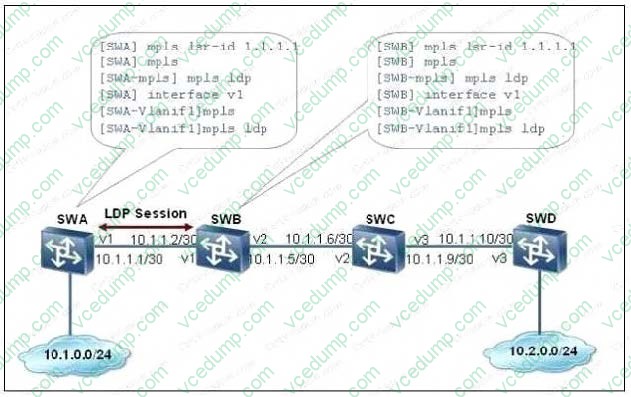
B. The MPLS LSR IDs of the two devices must be different.
C. MPLS does not need to be enabled globally.
D. MPLS does not need to be enabled on interfaces. -
Question 109:
On the DiffServ network, what is the main purpose of defining the service type of the EF classification?
A. Preferentially guarantee the services that require short delay, low packet loss, low jitter, and assured bandwidth.
B. Provide channels for packet forwarding.
C. Ensure bandwidth for specific traffic.
D. Ensure that packets are forwarded with the minimum delay. -
Question 110:
MPLS uses LDP to provide different label distribution modes. Which of the following statements regarding LDP label distribution control modes are false? (Multiple Choice)
A. LDP label distribution can be controlled in ordered mode.
B. In ordered mode, when an LSR is the origin of a route, it can send label mapping messages to the upstream router initiatively and does not need to wait for label mapping messages from the next hop LSR.
C. LDP label distribution cannot be controlled in independent mode.
D. In independent mode, an LSR cannot send label mapping messages to the upstream router before it receives label mapping messages from the next hop LSR.
Related Exams:
-
H11-821
HCNP-UC-HIPT (Implementing Huawei IP Telephony Solutions) -
H11-828
HCNP-UC(Fast Track)(Unified Communication (Fast Track)) -
H11-851
HCIA-Video Conference V3.0 -
H11-861
HCIP-Video Conference V2.0 -
H11-868
HCNP- VC(Fast Track)-(Video Conference (Fast Track)) -
H12-111
HCIA-IoT V3.0 -
H12-224
HCIP-Routing & Switching (Fast Track) V2.0 -
H12-311
HCIA-WLAN V3.0 -
H12-351
HCIE-WLAN (Written) V1.0 -
H12-411
HCIA-Data Center Facility V2.0
Tips on How to Prepare for the Exams
Nowadays, the certification exams become more and more important and required by more and more enterprises when applying for a job. But how to prepare for the exam effectively? How to prepare for the exam in a short time with less efforts? How to get a ideal result and how to find the most reliable resources? Here on Vcedump.com, you will find all the answers. Vcedump.com provide not only Huawei exam questions, answers and explanations but also complete assistance on your exam preparation and certification application. If you are confused on your H12-222 exam preparations and Huawei certification application, do not hesitate to visit our Vcedump.com to find your solutions here.