GMAT Exam Details
-
Exam Code
:GMAT -
Exam Name
:Graduate Management Admission Test (2022) -
Certification
:Admission Tests Certifications -
Vendor
:Admission Tests -
Total Questions
:429 Q&As -
Last Updated
:Jul 13, 2026
Admission Tests GMAT Online Questions & Answers
-
Question 101:
A certain investment of $2.000 earns interest at a fixed annual rate, with interest paid monthly to the investor. If the monthly interest payment is $10, what is the annual interest rate?
A. 3.6%
B. 4.8%
C. 5%
D. 5.5%
E. 6% -
Question 102:
A. Statement (1) ALONE is sufficient, but statement (2) atone is not sufficient.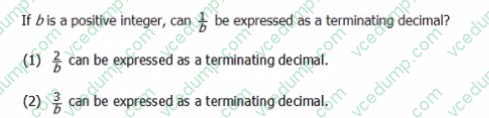
B. Statement (2) ALONE is sufficient, but statement (1) atone is not sufficient
C. BOTH statements TOGETHER are sufficient, but NEITHER statement ALONE is sufficient.
D. EACH statement ALONE is sufficient.
E. Statements (1) and (2) TOGETHER are NOT sufficient. -
Question 103:
A. Statement (1) ALONE is sufficient, but statement (2) alone is not sufficient.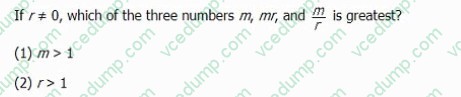
B. Statement (2) ALONE is sufficient, but statement (1) alone is not sufficient.
C. BOTH statements TOGETHER are sufficient, but NEITHER statement ALONE is sufficient.
D. EACH statement ALONE is sufficient
E. Statements (1) and (2) TOGETHER are NOT sufficient. -
Question 104:
It can most reasonably be inferred from the passage that multinational companies
A. are more likely to be financially successful in emerging nations if they aty themselves with local businesses that are using environmental sustainability Initiatives to drive growth
B. are less prone to the problems associated with the halo effect than are companies based only in one nation.
C. are increasingly likely to buy out emerging-nation companies that have successfully developed and Implemented environmental sustainability initiatives
D. are usually able to implement large-scale environmental sustainability Initiatives only after they have achieved a certain level of profitability.
E. tend to develop environmental sustainability initiatives that differ significantly from those that have been successfully and more easily implemented by smaller companies In the emerging world -
Question 105:
Coal Exporter: Environmentalists oppose allowing coal trains to pass a national park because they believe coal dust blowing off the trains could cause significant environmental damage. This belief is mistaken. Exporters have Incentives to prevent a low In the total weight of coal cargo during transport Consequently, they spray it with an environmentally safe sealant proven to reduce coal dust loss.
Which of the following most accurately describes how the two sentences in boldface function in the coal exporter's reasoning?
A. The first sentence functions as support for the only conclusion of the reasoning; the second sentence states that conclusion.
B. The first sentence functions as support for the only conclusion of the reasoning; the second sentence describes a supposed result of the circumstance that the first sentence describes.
C. The first sentence functions as support for an intermediate conclusion; the second sentence functions as support for the assertion made by the first sentence.
D. The first sentence states an intermediate conclusion; the second sentence states the main conclusion of the reasoning.
E. The first sentence describes a situation that the reasoning seeks to causally explain; the second sentence provides a possible explanation. -
Question 106:
A. Statement (1) ALONE is sufficient, but statement (2) alone is not sufficient.
B. Statement (2) ALONE is sufficient, but statement (1) alone is not sufficient.
C. BOTH statements TOGETHER are sufficient, but NEITHER statement ALONE is sufficient.
D. EACH statement ALONE is sufficient.
E. Statements (1) and (2) TOGETHER are NOT sufficient. -
Question 107:
Because of the positive correlation across animal species between body size and home range size, researchers suspected that body size of female mallards (a species of duck) may influence their home range size. The researchers also reasoned that younger females may be forced into less suitable habitats by older females competing with them for optimal areas, with the younger females compensating by having larger home ranges. However, their research supported neither suspicion. The failure to detect variation of range size according to body size may be due to other, undetermined mallard attributes (for example, body condition) that may have been a significant factor affecting home range size. The fact that most yearling females can breed may help to explain why the expected age effect was not confirmed, since home range size may be affected by breeding capability.
The researchers did find, however, that home range size of females was Inversely related to the percentage of the study area composed of seasonal or semipermanent wetlands. This may have been because of reduced competition for breeding space within the species when more of the wetlands were present. They also found home range size to decrease somewhat as the percentage of wood-shrub habitat increased, suggesting that reduction in visual contact among mallard pairs may reduce interaction and thus reduce competition among breeding pairs.
The author's purpose in making the statement that most yearling female mallards are able to breed is most likely in order to
A. explain the lack of corroboration from the study for the prediction that younger females may have larger home ranges than older females
B. help confirm that home range size is affected by breeding ability
C. support the point that younger females do not tend to have larger home ranges than older females
D. explain a finding that younger females tend to have smaller home ranges than older females
E. help explain why yearling female mallards apparently have home ranges of the same size as those of older female mallards -
Question 108:
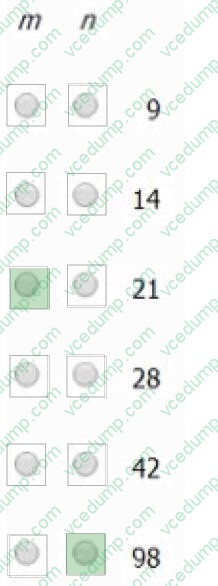
HOTSPOT
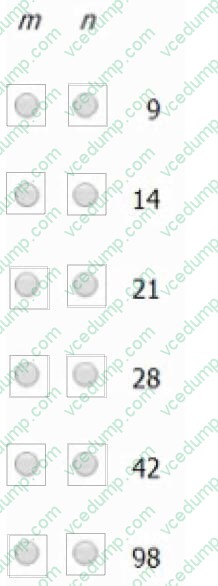
Suppose that m and n are two positive integers such that m< n, their least common multiple is 294, and their greatest common divisor is 7. In the table, select a value for m and a value for n that are jointly consistent with the given information. Make only two selections, one in each column.
Hot Area:
-
Question 109:
Sorenson and Audia would most likely agree with which of the following statements about the intrinsic advantages mentioned in the highlighted text?
A. Geographic concentration of production is, in many cases, maintained I* the economic benefits provided by these advantages.
B. The expectation that these advantages should lead to lower failure rates is supported by organizational ecology studies.
C. These advantages are insufficient as an explanation for geographic concentration of production.
D. These advantages are often related not to a particular location but to the colocation of structurally equivalent organizations Itself.
E. The benefits of these advantages are outweighed by intense competition from organizations outside local population boundaries. -
Question 110:
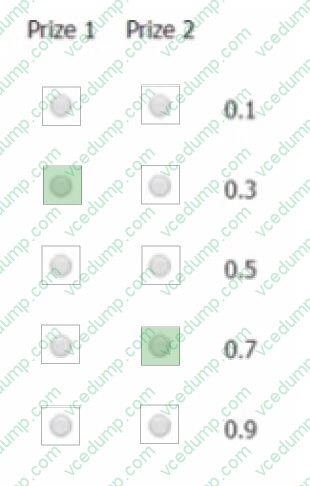
HOTSPOT
At a carnival game, a winning player spins a wheel that always lands on either Prize 1 or Prize 2 to determine which of the two prizes he or she wins. The probability that the prize wheel indicates Prize 2 Is double the probability that It indicates Prize 1. If a player does not want the prize that the prize wheel first indicates, then he or she may spin the wheel again. In such cases, the player must accept whichever prize the prize wheel indicates on the second spin.
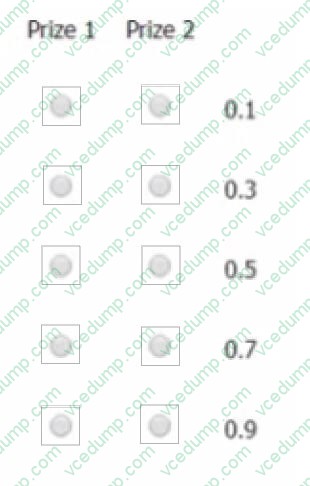
Select for Prize I the number nearest to the probability that a winning player who wants Prize 1 will receive Prize 1 after one or two spins of the prize wheel, and select for Prize ^the number nearest to the probability that a winning player who wants Prize 2 will receive Prize 2 after one or two spins of the prize wheel. Make only two selections, one in each column.
Hot Area:
Related Exams:
Tips on How to Prepare for the Exams
Nowadays, the certification exams become more and more important and required by more and more enterprises when applying for a job. But how to prepare for the exam effectively? How to prepare for the exam in a short time with less efforts? How to get a ideal result and how to find the most reliable resources? Here on Vcedump.com, you will find all the answers. Vcedump.com provide not only Admission Tests exam questions, answers and explanations but also complete assistance on your exam preparation and certification application. If you are confused on your GMAT exam preparations and Admission Tests certification application, do not hesitate to visit our Vcedump.com to find your solutions here.