Admission Tests GMAT Online Practice
Questions and Exam Preparation
GMAT Exam Details
Exam Code
:GMAT
Exam Name
:Graduate Management Admission Test (2022)
Certification
:Admission Tests Certifications
Vendor
:Admission Tests
Total Questions
:429 Q&As
Last Updated
:Jan 12, 2026
Admission Tests GMAT Online Questions &
Answers
Question 1:
Which of the following is most strongly supported by the findings of the Harms study?
A. Right-handed people shown a seating plan tend to choose seats on the right side of the seating diagram whether it shows the front seats at the top or the bottom. B. The seating choices of those attending a movie, regardless of the genre, have little impact on how well the movie is understood. C. The seats preferred by most left-handed people attending a movie are on the opposite side of the theater from those preferred by most right-handed people. D. Well-made documentaries contain significantly more visuospatial content than emotional content. E. In theaters full to capacity and with left-right symmetry in their seating diagram, not a audience members get to sit on the side of the theater they most favor.
E. In theaters full to capacity and with left-right symmetry in their seating diagram, not a audience members get to sit on the side of the theater they most favor. explanation:
Explanation/Reference:
Despite overall physiological bilateral symmetry, many species exhibit lateralized biases, i.e., preferences for right- or left-oriented behavior. When approaching prey, for example, some predator species favor their right eye; some prey species respond more quickly when their left eye detects a predator. Similar behavioral asymmetries occur in humans. Most notable is right- and lefthandedness; less notable is the tendency to turn right when entering a room. Paul Farnsworth found that more successful students tended to choose seats near the front, a little to the right. He arqued that external factors such as teacher location might have affected this lateral bias. But it is now known that processing differences between the two brain hemispheres can also contribute to behavioral asymmetries. George Karev found that when presented with a movie theater seating diagram, right-handed people were more likely than left-handed people to choose a seat on the right, facing front. But he hypothesized that, since the right hemisphere processes visuospatial and emotional information, the people who chose right- side seats did so because that would put the screen in their left visual field, optimizing information flow to the right hemisphere. Although the right hemisphere is thought to be dominant in processing emotion, some evidence suggests that the left hemisphere plays a role. The valence model proposes that the left and right hemispheres process positive and negative emotion respectively, while the approach-withdrawal model posits that the left hemisphere processes emotion expressed in approach behavior and the right hemisphere processes emotion expressed in withdrawal behavior. Victoria Harms and colleagues suggested that since a paper seating plan was used in the theater-seating studies by Karev and others, the exhibited preference might be due simply to handedness: people choose the same side of the paper as their favored hand. Consequently, the Harms research was designed to study choices in an actual movie theater. Also, hoping to distinguish between various explanations, they studied seating choices for comedies (presumed to contain positive emotional content), dramas (presumed to contain negative emotional content), and documentaries (presumed to have balanced emotional content). They found significant--though not universal-- preference for seats on the right, facing front, regardless of movie genre and of handedness.

Question 2:
The passage suggests that one reason that the "conditions of captivity" (see bolded text) were significant was that
A. food and water were readily available to all members of a group B. researchers were unable to observe animals from an unobtrusive distance C. climatic conditions seldom matched those of the animals' natural habitat D. animals were unable to distance themselves from each other physically E. animals lacked opportunities to interact with members of other species
D. animals were unable to distance themselves from each other physically explanation:
Explanation/Reference:
Members of many primate species approach an opponent shortly after conflict and initiate behaviors such as embracing, grooming, or huddling--a phenomenon researchers call postconflict reconciliation. Existing research, however, suffers from several shortcomings. The variability between groups of the same species is rarely addressed; the majority of studies investigate only a small fraction of the pairings that exist in a given group; and almost all reports are restricted to animals in captivity. In an attempt to address some of these shortcomings, Sommer et al. recently conducted a study of postconflict reconciliation in wild Hanuman langurs, a species of colobine monkey. They observed rates of postconflict reconciliation much lower than would be expected based on previous research, and found that over 80 percent of all pairings exhibited no postconflict affinity whatsoever. The rarity of friendly postconflict reunion in wild langurs draws attention to the possibility that conflicts are modulated through avoidance. The option of temporarily avoiding contact with opponents is not easily available to captive primates, and certainly not to the extent present in the wild. Still, studies of postconflict behavior of primates in captivity remain valuable: above all, they demonstrate the flexibility of nonhuman primates in various environments. It is likely, however, that the reported frequency of reconciliation among primates is artificially inflated by the conditions of captivity.
Question 3:
It is known from cave paintings and other evidence that the hunting people occupying the Bax Cave area in Country X tens of thousands of years ago repeatedly set fire to the surrounding area. Archaeologists hypothesize that because the fires caused later plant growth on the land, the hunters set the fires in order to attract herbivorous prey species. Such actions, they claim, are evidence for the mental capacity to delay gratification for weeks, months, or even years.
Which of the following would it be most useful to determine in evaluating the archaeologists' claim?
A. Whether the Bax Cave area is susceptible to fires caused by lightning strikes B. Whether remains can be found of hunting tools from tens of thousands of years ago in or near the Bax Cave C. Whether people occupying the Bax Cave tens of thousands of years ago consumed plants adapted to fire ecologies D. Whether in the immediate aftermath of fires in the Bax Cave area, animals sought by hunters came to seek prey driven out of dens or other shelters E. Whether the mental capacity to delay gratification for weeks, months, or even years was exhibited by contemporaries of the people occupying the Bax Cave tens of thousands of years ago
C. Whether people occupying the Bax Cave tens of thousands of years ago consumed plants adapted to fire ecologies
Question 4:
Scientists recently found traces of down on the fossil of a dinosaur, which they describe as typical of the kind that eventually, in birds, develops into feathers.
A. recently found traces of down on the fossil of a dinosaur, which they describe as typical of the kind that eventually, in birds, develops B. recently found traces of down on the fossil of a dinosaur, describing It as typical of the kind in birds that eventually develop C. recently found traces of down on the fossil of a dinosaur and describe it to be typical of the kind that, in birds, eventually develops D. describe the recently found traces of down on the fossil of a dinosaur to be typical of the kind in birds that eventually develop E. describe the traces of down found recently on the fossil of a dinosaur as typical of the kind that, in birds, eventually develops
A. recently found traces of down on the fossil of a dinosaur, which they describe as typical of the kind that eventually, in birds, develops
Question 5:
Which of the following is a research shortcoming mentioned in the passage that is not addressed in the information provided about Sommer's study?
A. lnadequate attention to the variability in postconflict behavior between groups of the same species B. Inadequate attention to the differences between various forms of postconflict behavior C. Inadequate attention to differences between species of colobine monkeys in postconflict behavior D. The restriction of most research to primates in captivity E. The study of primate groups in which only a small number of pairings took place
A. lnadequate attention to the variability in postconflict behavior between groups of the same species explanation:
Explanation/Reference:
Members of many primate species approach an opponent shortly after conflict and initiate behaviors such as embracing, grooming, or huddling--a phenomenon researchers call postconflict reconciliation. Existing research, however, suffers from several shortcomings. The variability between groups of the same species is rarely addressed; the majority of studies investigate only a small fraction of the pairings that exist in a given group; and almost all reports are restricted to animals in captivity. In an attempt to address some of these shortcomings, Sommer et al. recently conducted a study of postconflict reconciliation in wild Hanuman langurs, a species of colobine monkey. They observed rates of postconflict reconciliation much lower than would be expected based on previous research, and found that over 80 percent of all pairings exhibited no postconflict affinity whatsoever. The rarity of friendly postconflict reunion in wild langurs draws attention to the possibility that conflicts are modulated through avoidance. The option of temporarily avoiding contact with opponents is not easily available to captive primates, and certainly not to the extent present in the wild. Still, studies of postconflict behavior of primates in captivity remain valuable: above all, they demonstrate the flexibility of nonhuman primates in various environments. It is likely, however, that the reported frequency of reconciliation among primates is artificially inflated by the conditions of captivity.
Question 6:
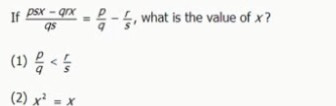
A. Statement (1) ALONE is sufficient, but statement (2) alone is not sufficient. B. Statement (2) ALONE is sufficient, but statement (1) alone is not sufficient. C. BOTH statements TOGETHER are sufficient, but NEITHER statement ALONE is sufficient. D. EACH statement ALONE is sufficient E. Statements (1) and (2) TOGETHER are NOT sufficient.
C. BOTH statements TOGETHER are sufficient, but NEITHER statement ALONE is sufficient.
Question 7:
Amy, Brianne, and Cedric will each choose exactly 1 container, Container X or Container Y, and then randomly pick 1 marble, without replacement, from mat container. Container X has 3 red marbles and 10 white marbles, while Container Y has 2 red marbles and 8 white marbles. If Amy and Brianne each pick 1 marble before Cedric picks 1 marble, which of these containers should Cedric choose to maximize the probability that the 1 marble he picks will be a red marble?
A. Statement (1) ALONE is sufficient, but statement (2) alone is not sufficient. B. Statement (2) ALONE is sufficient, but statement (1) alone is not sufficient. C. BOTH statements TOGETHER are sufficient, but NEITHER statement ALONE is sufficient. D. EACH statement ALONE is sufficient. E. Statements (1) and (2) TOGETHER ate NOT sufficient.
B. Statement (2) ALONE is sufficient, but statement (1) alone is not sufficient.
Question 8:
Shaneice drove nonstop from City X to City Y in exactly 5 hours. Shaneice drove the first 200 kilometers from City X to City Y in how many minutes?
(1)
Shaneice averaged 80 kilometers per hour during the first 3 hours of driving from City X to City Y.
(2)
Shaneice averaged 90 kilometers per hour during the last 2 hours of driving from City X to City Y.
A. Statement (1) ALONE is sufficient, but statement (2) alone is not sufficient. B. Statement (2) ALONE is sufficient, but statement (1) alone is not sufficient. C. BOTH statements TOGETHER are sufficient, but NEITHER statement ALONE is sufficient. D. EACH statement ALONE is sufficient. E. Statements (1) and (2) TOGETHER are NOT sufficient.
E. Statements (1) and (2) TOGETHER are NOT sufficient.
Question 9:
A certain company's yearly revenue was 20% less in 2005 than in 2004 and 10% greater in 2006 than in 2005. If the company's yearly revenue in 2007 was equal to its yearly revenue In 2004, which of the following is closest to the percent increase in the company's yearly revenue from 2006 to 2007 ?
A. 5% B. 10% C. 12% D. 14% E. 15%
D. 14%
Question 10:
At his high school, Marlon is the only member of the track team who is also a member of the tennis team. His weight of 68.5 kilograms is the median weight of the 9 members of the track team and is also the median weight of the 7 members of the tennis team. If the total weight of the members of both teams is 960 kilograms, then the median weight of the members of both teams is how many kilograms greater than the average (arithmetic mean) weight of the members of both teams?
Nowadays, the certification exams become more and more important and required by more and more
enterprises when applying for a job. But how to prepare for the exam effectively? How to prepare
for the exam in a short time with less efforts? How to get a ideal result and how to find the
most reliable resources? Here on Vcedump.com, you will find all the answers.
Vcedump.com provide not only Admission Tests exam questions,
answers and explanations but also complete assistance on your exam preparation and certification
application. If you are confused on your GMAT exam preparations
and Admission Tests certification application, do not hesitate to visit our
Vcedump.com to find your solutions here.