FCSS_SASE_AD-25 Exam Details
-
Exam Code
:FCSS_SASE_AD-25 -
Exam Name
:FCSS - FortiSASE 25 Administrator -
Certification
:Fortinet Certifications -
Vendor
:Fortinet -
Total Questions
:51 Q&As -
Last Updated
:May 31, 2026
Fortinet FCSS_SASE_AD-25 Online Questions & Answers
-
Question 11:
A customer wants to upgrade their legacy on-premises proxy to a cloud-based proxy for a hybrid network. Which two FortiSASE features would help the customer achieve this outcome? (Choose two.)
A. secure web gateway (SWG)
B. zero trust network access (ZTNA)
C. sandbox cloud
D. inline-CASB -
Question 12:
Your organization is currently using FortiSASE for its cybersecurity. They have recently hired a contractor who will work from the HQ office and who needs temporary internet access in order to set up a web-based point of sale (POS) system. What is the recommended way to provide internet access to the contractor?
A. Use zero trust network access (ZTNA) and tag the client as an unmanaged endpoint.
B. Use the self-registration portal on FortiSASE to grant internet access.
C. Use a tunnel policy with a contractors user group as the source on FortiSASE to provide internet access.
D. Use a proxy auto-configuration (PAC) file and provide secure web gateway (SWG) service as an explicit web proxy. -
Question 13:
Refer to the exhibits.
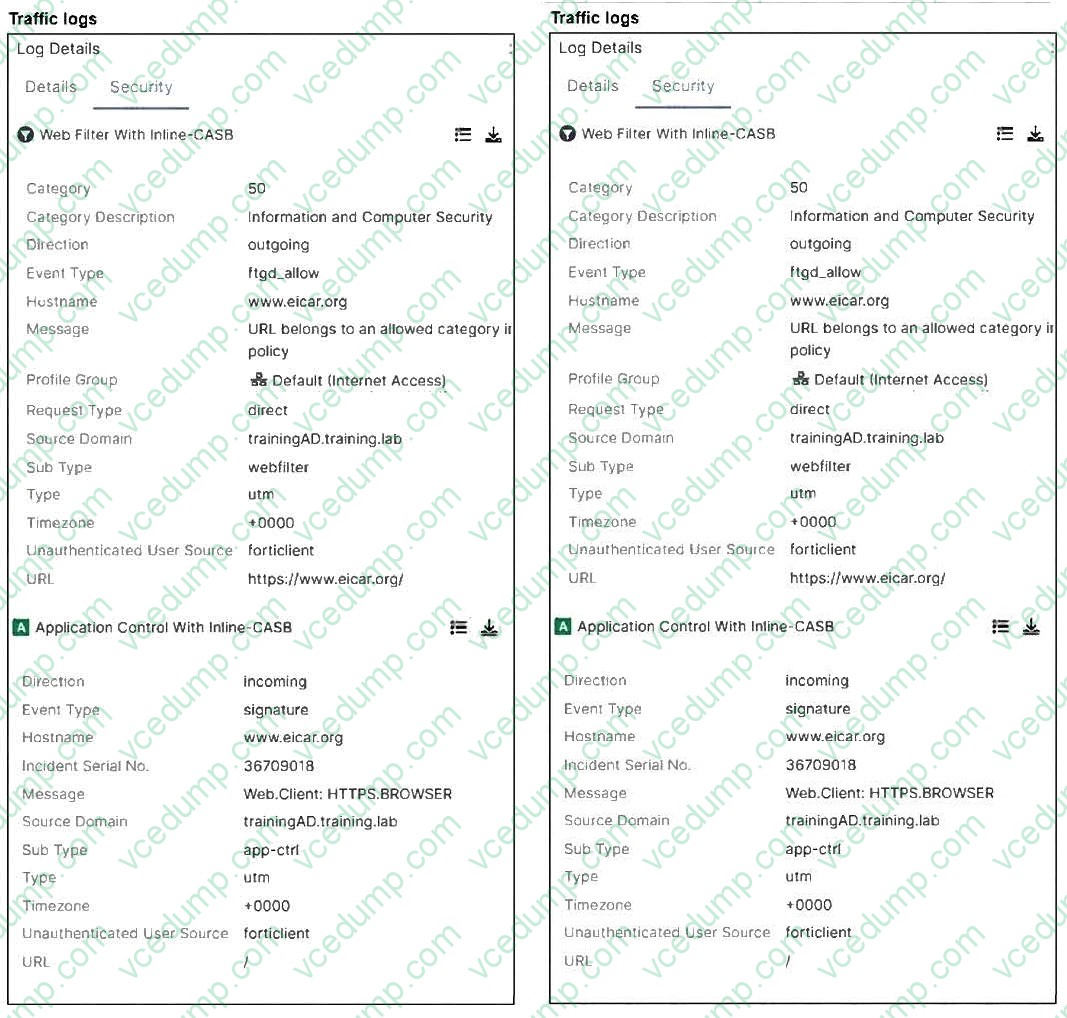
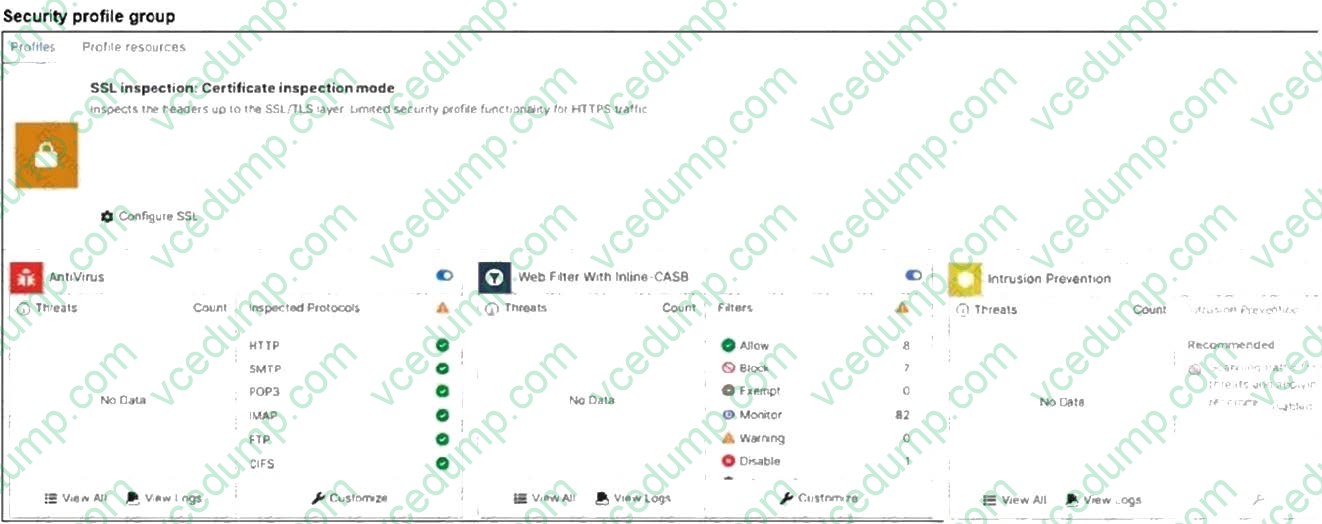
A FortiSASE administrator has configured an antivirus profile in the security profile group and applied it to the internet access policy. Remote users are still able to download theeicar.com-zipfile fromhttps://eicar.org.
Which configuration on FortiSASE is allowing users to perform the download?
A- Web filter is allowing the URL.
A. Deep inspection is not enabled.
B. Application control is exempting all the browser traffic.
C. Intrusion prevention is disabled. -
Question 14:
How does FortiSASE hide user information when viewing and analyzing logs?
A. By tokenization in log data
B. By masking log data
C. By compressing log data
D. By hashing log data -
Question 15:
For monitoring potentially unwanted applications on endpoints, which information is available on the FortiSASE software installations page?
A. the vendor of the software
B. the endpoint the software is installed on
C. the license status of the software
D. the usage frequency of the software -
Question 16:
An organization must block user attempts to log in to non-company resources while using Microsoft Office 365 to prevent users from accessing unapproved cloud resources. Which FortiSASE feature can you implement to meet this requirement?
A. application control with inline-CASB
B. data loss prevention (DLP) with Microsoft Purview Information Protection (MPIP)
C. web filter with inline-CASB
D. DNS filter with domain filter -
Question 17:
Refer to the exhibit.
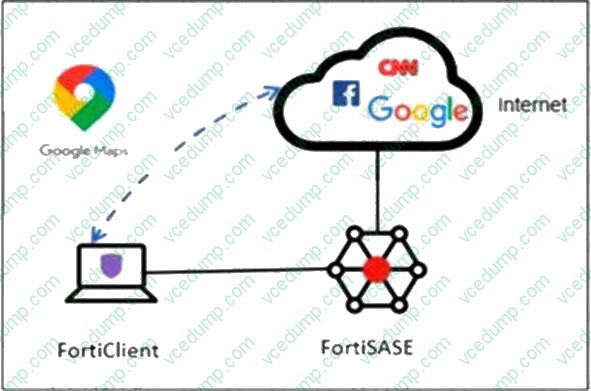
An organization must inspect all the endpoint internet traffic on FortiSASE, and exclude Google Maps traffic from the FortiSASE VPN tunnel and redirect it to the endpoint physical interface.
Which configuration must you apply to achieve this requirement?
A. Configure a steering bypass tunnel firewall policy using Google Maps FQDN to exclude and redirect the traffic.
B. Add the Google Maps URL in the zero trust network access (ZTNA) TCP access proxy forwarding rule.
C. Add the Google Maps URL as a steering bypass destination in the endpoint profile.
D. Exempt Google Maps in URL filtering in the web filter profile. -
Question 18:
Which information does FortiSASE use to bring network lockdown into effect on an endpoint?
A. Zero-day malware detection on endpoint
B. The number of critical vulnerabilities detected on the endpoint
C. The security posture of the endpoint based on ZTNA tags
D. The connection status of the tunnel to FortiSASE -
Question 19:
Which secure internet access (SIA) use case minimizes individual endpoint configuration?
A. Agentless remote user internet access
B. Site-based remote user internet access
C. SIA using ZTNA
D. SIA for FortiClient agent remote users -
Question 20:
A customer wants to ensure secure access for private applications for their users by replacing their VPN. Which two SASE technologies can you use to accomplish this task? (Choose two.)
A. zero trust network access (ZTNA)
B. secure SD-WAN
C. secure web gateway (SWG) and cloud access security broker (CASB)
D. SD-WAN on-ramp
Related Exams:
-
EMEA-ADVANCED-SUPPORT
Fortinet EMEA Advanced Support -
FCP_FAC_AD-6.5
FCP - FortiAuthenticator 6.5 Administrator -
FCP_FAZ_AD-7.4
FCP - FortiAnalyzer 7.4 Administrator -
FCP_FAZ_AN-7.4
FCP - FortiAnalyzer 7.4 Analyst -
FCP_FAZ_AN-7.6
Fortinet NSE 5 - FortiAnalyzer 7.6 Analyst -
FCP_FCT_AD-7.2
FCP - Forti Client EMS 7.2 Administrator -
FCP_FCT_AD-7.4
Fortinet NSE 6 - FortiClient EMS 7.4 Administrator -
FCP_FGT_AD-7.4
FCP - FortiGate 7.4 Administrator -
FCP_FGT_AD-7.6
FortiGate 7.6 Administrator FCP_FGT_AD-7.6 -
FCP_FMG_AD-7.4
FCP - FortiManager 7.4 Administrator
Tips on How to Prepare for the Exams
Nowadays, the certification exams become more and more important and required by more and more enterprises when applying for a job. But how to prepare for the exam effectively? How to prepare for the exam in a short time with less efforts? How to get a ideal result and how to find the most reliable resources? Here on Vcedump.com, you will find all the answers. Vcedump.com provide not only Fortinet exam questions, answers and explanations but also complete assistance on your exam preparation and certification application. If you are confused on your FCSS_SASE_AD-25 exam preparations and Fortinet certification application, do not hesitate to visit our Vcedump.com to find your solutions here.