FCSS_LED_AR-7.6 Exam Details
-
Exam Code
:FCSS_LED_AR-7.6 -
Exam Name
:Fortinet NSE 6 - LAN Edge 7.6 Architect -
Certification
:Fortinet Certifications -
Vendor
:Fortinet -
Total Questions
:48 Q&As -
Last Updated
:Jul 14, 2026
Fortinet FCSS_LED_AR-7.6 Online Questions & Answers
-
Question 41:
Refer to the exhibit.
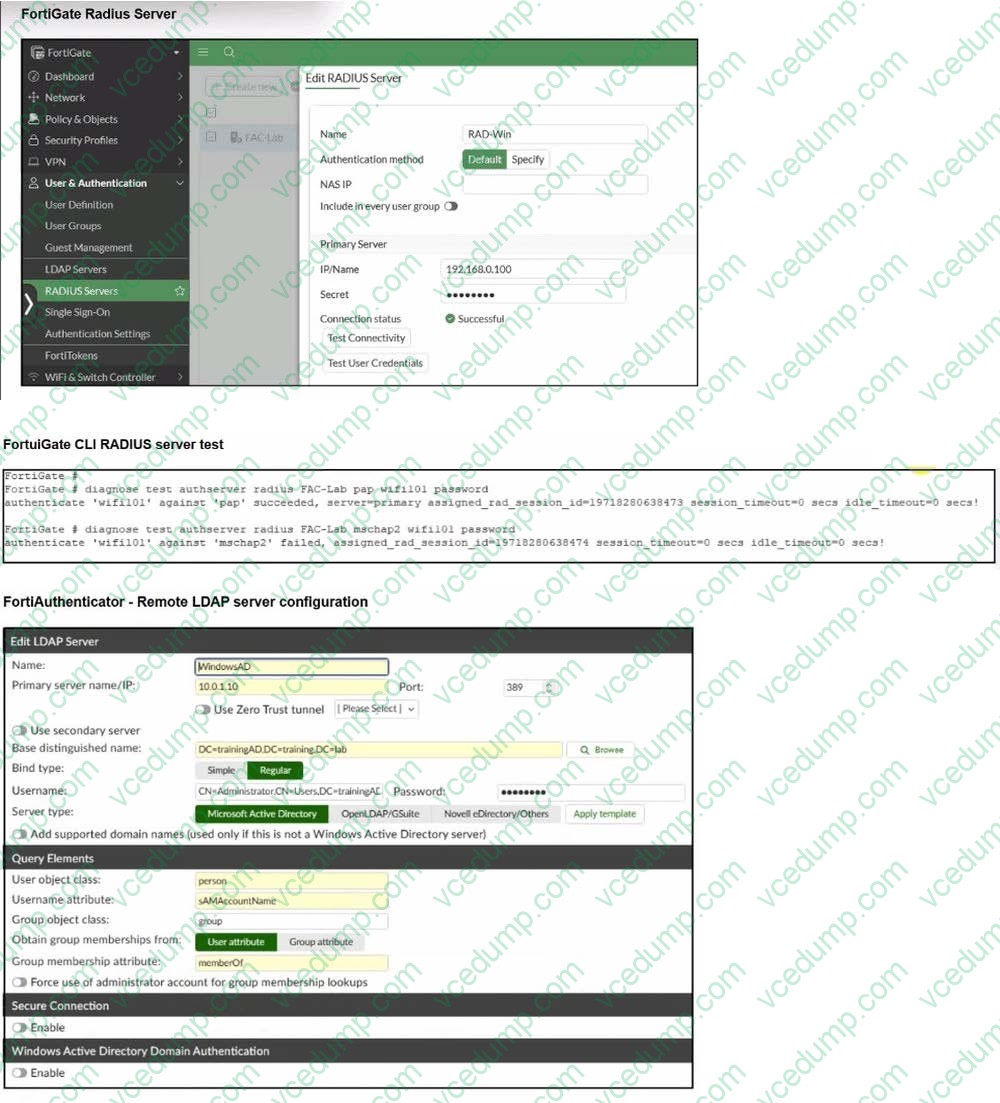
A RADIUS server has been successfully configured on FortiGate, which sends RADIUS authentication requests to FortiAuthenticator. FortiAuthenticator, in turn, relays the authentication using LDAP to a Windows Active Directory server.
It was reported that wireless users are unable to authenticate successfully.
The FortiGate configuration confirms that it can connect to the RADIUS server without issues.
While testing authentication on FortiGate using the command diagnose test authserver radius, it was observed that authentication succeeds with PAP but fails with MSCHAPv2.
Additionally, the Remote LDAP Server configuration on FortiAuthenticator was reviewed.
Which configuration change might resolve this issue?
A. Change the RADIUS authentication protocol to CHAP
B. Enable Windows Active Directory Domain Authentication.
C. Manually add user credentials to the FortiAuthenticator local database
D. Use RADIUS attributes under the FortiGate configuration. -
Question 42:
A FortiGate wireless deployment uses VLAN pooling with vlan-pooling wtp-group. VLAN 201 is mapped to WTP group "Lobby", and VLAN 202 is mapped to WTP group "Office". The administrator configures the Wi-Fi zone table so that VLAN 202 has an IP subnet and DHCP, but VLAN 201 is left without an IP configuration. What is the expected client behavior for devices connecting to APs in the "Lobby" WTP group?
A. Clients will load-balance between VLAN 201 and 202 automatically
B. Clients will receive an IP address from VLAN 202 because it is the only VLAN with DHCP
C. Clients will fail to obtain an IP address because their WTP group maps them to VLAN 201
D. Clients will be placed into the FortiGate default VLAN until DHCP is available -
Question 43:
In each user certificate, you can define the subject field, expiration date. User Principal Name (UPN), URL for CRL download, and the OCSP URL. How does the detailed configuration of these attributes impact the certificate?
A. It makes the certificate easier to revoke manually because it reduces the need for automatic checks.
B. It limits the validity of the certificate to specific devices and applications, reducing its general usability.
C. It enables precise identification of the user and ensures timely certificate revocation checks.
D. It makes the certificate compatible with a wide range of applications and services by ensuring universal validity -
Question 44:
Refer to the exhibits.
\
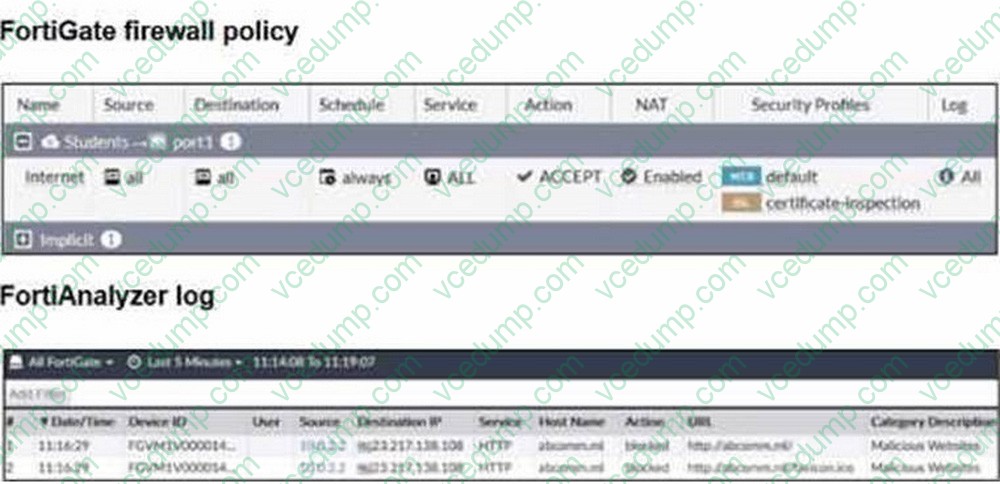
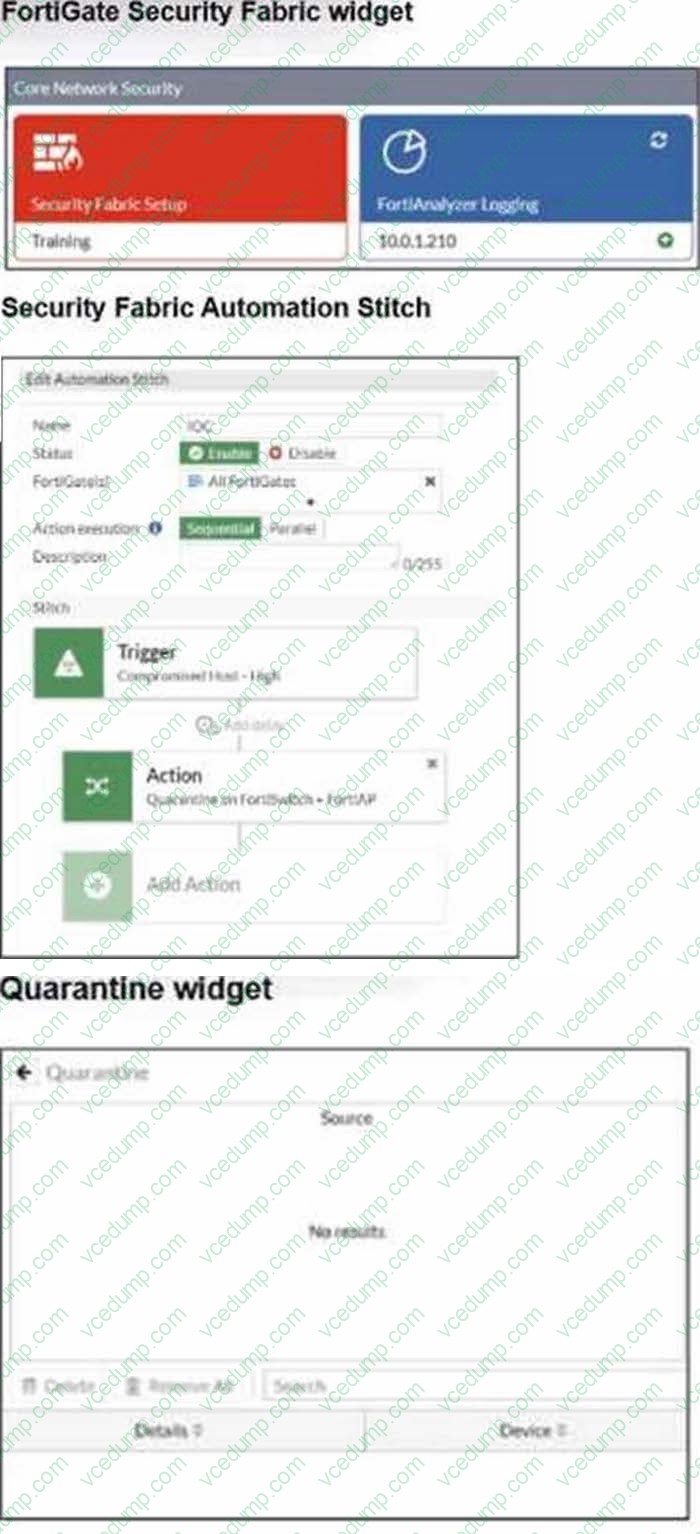
Examine the FortiGate configuration, FortiAnalyzer logs, and FortiGate widget shown in the exhibits.
Security Fabhc quarantine automation has been configured to isolate compromised devices automatically. FortiAnalyzer has been added to the Security Fabric, and an automation stitch has been configured to quarantine compromised devices.
To test the setup, a device with the IP address 10.0.2.1 that is connected through a managed FortiSwitch attempts to access a malicious website. The logs on FortiAnalyzer confirm that the event was recorded, but the device does not appear in the FortiGate quarantine widget.
Which two reasons could explain why FortiGate is not quarantining the device? (Choose two.)
A. The IOC action should include only the FortiSwitch in the quarantine.
B. The SSL inspection should be set to deep-Inspection
C. The malicious website is not recognized as an indicator of compromise (IOC) by FortiAnalyzer.
D. The threat detection services license is missing or invalid under FortiAnalyzer. -
Question 45:
Which VLAN is used by FortiGate to place devices that fail to match any configured NAC policies? CRSPAN
A. NAC
B. segment
C. Quarantine
D. Onboarding -
Question 46:
Refer to the exhibit.
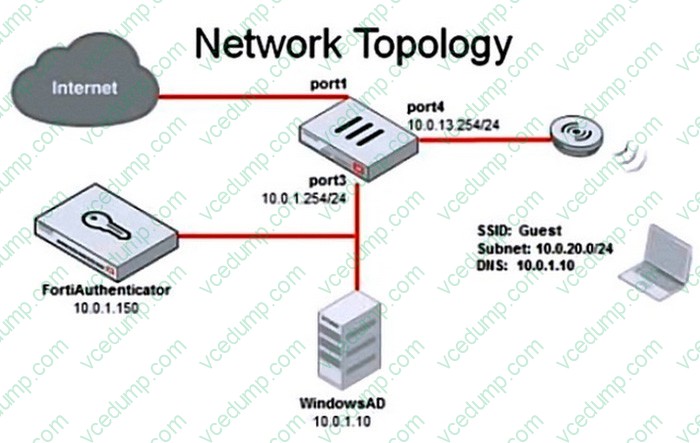
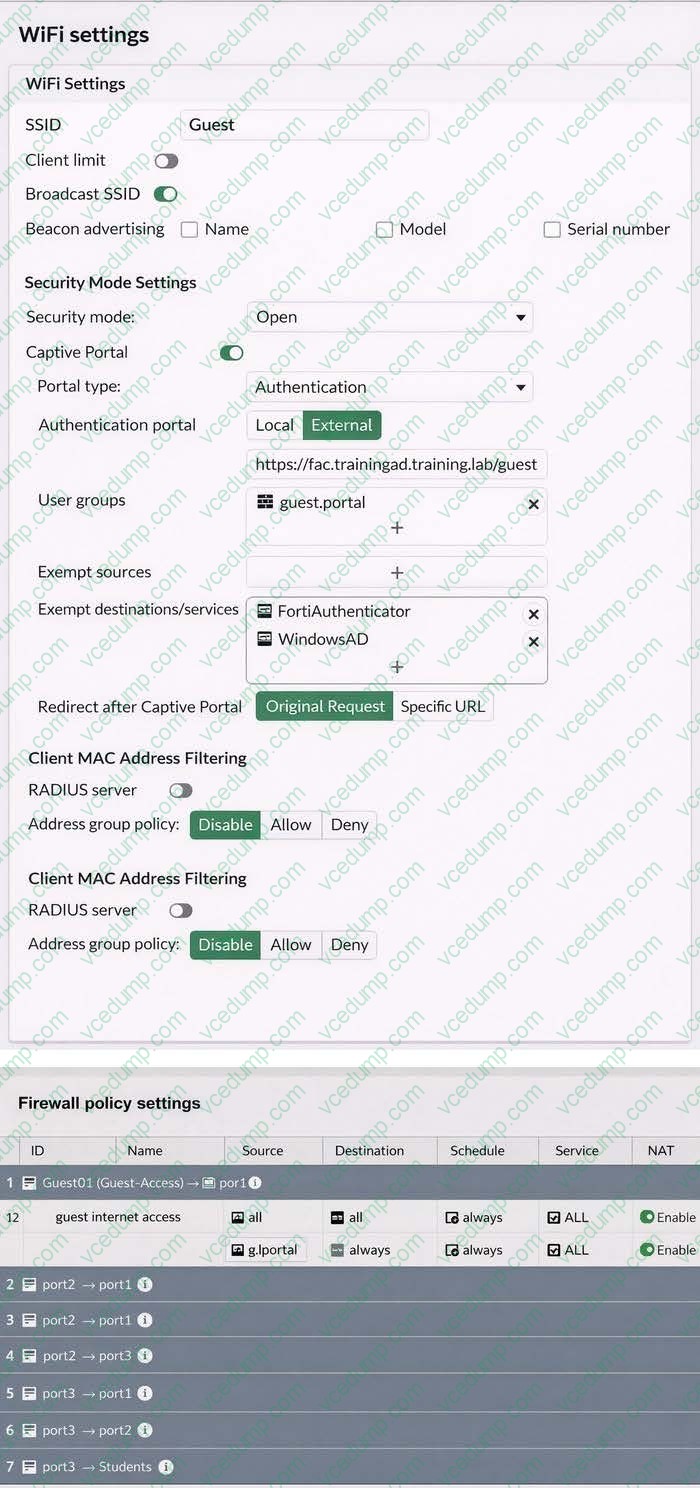
Review the exhibits to analyze the network topology, SSID settings, and firewall policies.
FortiGate is configured to use an external captive portal for authentication to grant access to a wireless network. During testing, it was found that users attempting to connect to the SSID cannot access the captive portal login page.
What configuration change should be made to resolve this issue to allow users to access the captive portal?
A. Change the SSID security mode to WPA2-Enterprise for authentication.
B. Disable HTTPS redirection for the captive portal authentication page.
C. Exclude FortiAuthenticator and Windows AD address objects from filtering.
D. A firewall policy allowing Guest SSID traffic to reach FortiAuthenticator and Windows AD. -
Question 47:
How can FortiAIOps help optimize network performance in an SD-Branch deployment with FortiGate, FortiSwitch, and FortiAP?
A. It disables low-performing APs and switches automatically.
B. It uses Al-driven analytics to identify network issues and provide optimization recommendations.
C. It removes the need for SD-WAN configuration by automating all routing decisions.
D. It predicts and resolves all network issues without any human intervention. -
Question 48:
A conference center wireless network provides guest access through a captive portal, allowing unregistered users to self-register and connect to the network. The IT team has been tasked with updating the existing configuration to enforce captive portal authentication over a secure HTTPS connection. Which two steps should the administrator take to implement this change? (Choose two.)
A. Enable HTTP redirect in the user authentication settings.
B. Create a new SSID with the HTTPS captive portal URL.
C. Disable HTTP administrative access on the guest SSID to enforce HTTPS connection.
D. Update the captive portal URL to use HTTPS on FortiGate and FortiAuthenticator.
Related Exams:
-
EMEA-ADVANCED-SUPPORT
Fortinet EMEA Advanced Support -
FCP_FAC_AD-6.5
FCP - FortiAuthenticator 6.5 Administrator -
FCP_FAZ_AD-7.4
FCP - FortiAnalyzer 7.4 Administrator -
FCP_FAZ_AN-7.4
FCP - FortiAnalyzer 7.4 Analyst -
FCP_FAZ_AN-7.6
Fortinet NSE 5 - FortiAnalyzer 7.6 Analyst -
FCP_FCT_AD-7.2
FCP - Forti Client EMS 7.2 Administrator -
FCP_FCT_AD-7.4
Fortinet NSE 6 - FortiClient EMS 7.4 Administrator -
FCP_FGT_AD-7.4
FCP - FortiGate 7.4 Administrator -
FCP_FGT_AD-7.6
FortiGate 7.6 Administrator FCP_FGT_AD-7.6 -
FCP_FMG_AD-7.4
FCP - FortiManager 7.4 Administrator
Tips on How to Prepare for the Exams
Nowadays, the certification exams become more and more important and required by more and more enterprises when applying for a job. But how to prepare for the exam effectively? How to prepare for the exam in a short time with less efforts? How to get a ideal result and how to find the most reliable resources? Here on Vcedump.com, you will find all the answers. Vcedump.com provide not only Fortinet exam questions, answers and explanations but also complete assistance on your exam preparation and certification application. If you are confused on your FCSS_LED_AR-7.6 exam preparations and Fortinet certification application, do not hesitate to visit our Vcedump.com to find your solutions here.