
F5CAB2 Real Exam Questions

BIG-IP Administration Data Plane Concepts (F5CAB2)

86 questions available · Page 1 of 9

Updated Exam DumpsVerified AnswersPass Guarantee

Get Complete Exam Dumps
Question 1 Single choice

Which statement is true concerning cookie persistence?

  1. A

    Cookie persistence allows persistence independent of IP addresses.

  2. B

    Cookie persistence allows persistence even if the data are encrypted from client to pool member.

  3. C

    Cookie persistence uses a cookie that stores the virtual server, pool name, and member IP address in clear text.

  4. D

    If a client's browser accepts cookies, cookie persistence will always cause a cookie to be written to the client's file system.

Show answer and explanation

Correct answer: A

Explanation

Cookie persistence identifies the selected member through information carried in an HTTP cookie, so it does not depend on the client's source IP remaining constant. That allows the persistence relationship to survive an IP address change. End-to-end encryption can prevent HTTP inspection, and cookie handling does not guarantee a file-system write.
Question 2 Single choice

A BIG-IP Administrator is conducting maintenance on one BIG-IP appliance in an HA Pair.

Why should the BIG-IP Administrator put the appliance into FORCED-OFFLINE state?

  1. A

    To terminate connections to the management IP and decrease persistent connections

  2. B

    To allow new connections to Virtual Servers and ensure the appliance becomes active

  3. C

    To preserve existing connections to Virtual Servers and reduce the CPU load

  4. D

    To terminate existing connections to Virtual Servers and prevent the appliance from becoming active

Show answer and explanation

Correct answer: D

Explanation

Forced Offline removes the appliance from traffic service for maintenance and prevents it from becoming active. Unlike a state intended to drain or preserve established application flows, this state terminates existing virtual-server connections. It therefore provides both required effects: clearing current traffic and keeping the unit out of the active role.

Question 3 Single choice

Port lockdown on a self IP permits no inbound services. An available virtual server on the same VLAN listens on TCP 443 at a different destination address. How does port lockdown affect client traffic to that virtual server?

  1. A

    It blocks TCP 443 traffic to both address types.

  2. B

    It makes the self IP unavailable for Layer 3 routing.

  3. C

    It restricts direct self-IP services, not virtual-server matching.

  4. D

    It limits pool members to the same permitted ports.

Show answer and explanation

Correct answer: C

Explanation

Port lockdown governs services addressed directly to the self IP, such as management or other locally hosted services. The client instead targets a different destination owned by the virtual server. That traffic can still match the virtual server on TCP 443 because restricting direct self-IP services does not disable virtual-server matching.

Question 4 Single choice

A trunk is an untagged member of the native VLAN and a tagged member of the app VLAN with tag 100. The trunk receives a frame with no VLAN tag. To which BIG-IP VLAN does the frame belong?

  1. A

    The app VLAN, because it is carried by the trunk

  2. B

    Both VLANs, because both use the same logical trunk

  3. C

    Neither VLAN, because trunks accept only tagged frames

  4. D

    The native VLAN, because that membership handles untagged frames

Show answer and explanation

Correct answer: D

Explanation

VLAN classification follows the tagging mode of the trunk's memberships. An incoming frame without a VLAN tag belongs to the VLAN configured as untagged on that trunk, which is the native VLAN here. The app VLAN membership expects tag 100, so an untagged frame is not classified into the app VLAN merely because both memberships share the trunk.

Question 5 Single choice

What type of virtual server should be used to block responses for one IP in a subnet with a virtual server? (Choose one answer)

  1. A

    Drop

  2. B

    Block

  3. C

    Reject

  4. D

    Standard

Show answer and explanation

Correct answer: C

Explanation

A Reject virtual server can be defined for the individual IP that must not receive responses. Its more specific destination match handles that address instead of the broader subnet virtual server, and rejection actively refuses matching traffic. A Standard virtual server would process the flow normally rather than enforce the required refusal.

Question 6 Single choice

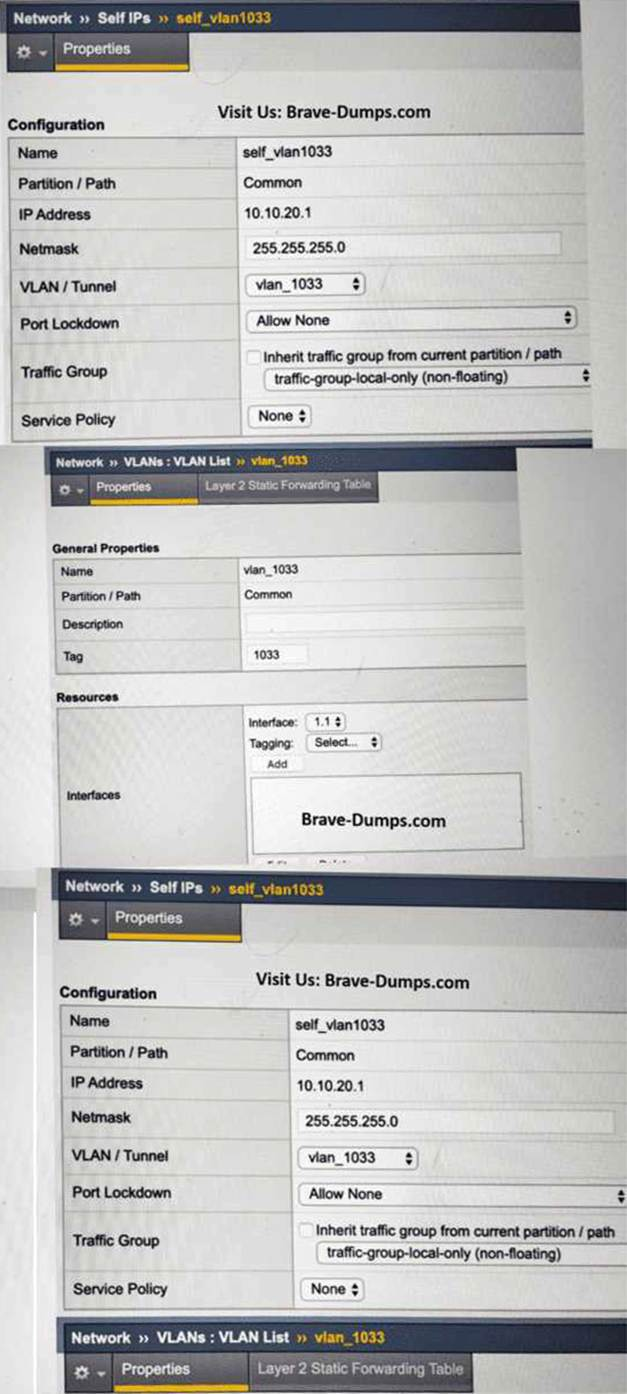
Refer to the exhibit.

The network team creates a new VLAN on the switches. The BIG-IP Administrator creates a new VLAN and a Self IP on the BIG-IP device, but theservers on the new VLAN are NOT reachablefrom the BIG-IP device.

Which action should the BIG-IP Administrator take to resolve this issue? (Choose one answer)

  1. A

    Set Port Lockdown of the Self IP toAllow All

  2. B

    ChangeAuto Last Hopto enabled

  3. C

    Assign aphysical interfaceto the new VLAN

  4. D

    Create aFloating Self IP address

Show answer and explanation

Correct answer: C

Explanation

The Self IP gives BIG-IP a Layer 3 address on the new VLAN, but the VLAN still needs a Layer 2 attachment to the network. Assigning a physical interface to the new VLAN supplies that path to the switch and servers. Port Lockdown controls services accepted at the Self IP; it does not create missing VLAN connectivity.

Question 7 Single choice

An application is configured so that the same pool member must be used for an entire session, as well as for HTTP and FTP traffic. A user reports that a session has terminated, and the user must restart the session. The BIG-IP Administrator determines that the active BIG-IP device failed over to the standby BIG-IP device.

Which configuration settings should the BIG-IP Administrator verify to ensure proper behavior when BIG-IP failover occurs?

  1. A

    Cookie persistence and session timeout

  2. B

    Stateful failover and network failover detection

  3. C

    syn-cookie insertion threshold and connection low-water mark

  4. D

    Persistence mirroring and Match Across Services

Show answer and explanation

Correct answer: D

Explanation

Persistence mirroring transfers persistence records to the standby unit so that a failover does not erase the session-to-member mapping. Match Across Services extends that mapping across different services, allowing the HTTP and FTP flows in the same session to remain associated with the same pool member after the peer becomes active.

Question 8 Single choice

An organization needs to deploy an HTTP application on a BIG-IP system. The requirements specify hardware acceleration to enhance performance, while HTTP optimization features are not required.

What type of virtual server and associated protocol profile should be used to meet these requirements? (Choose one answer)

  1. A

    Type: Stateless Protocol Profile: fastL4

  2. B

    Type: Standard Protocol Profile: tcp-wan-optimized

  3. C

    Type: Performance (Layer 4) Protocol Profile: fastL4

  4. D

    Type: Performance (HTTP) Protocol Profile: fasthttp

Show answer and explanation

Correct answer: C

Explanation

The requirement is accelerated Layer 4 processing without HTTP optimization. A Performance (Layer 4) virtual server with the fastL4 protocol profile handles traffic at the transport layer and fits that performance goal. A Performance (HTTP) server would introduce HTTP-specific processing that the application does not require.

Question 9 Single choice

Which object relationship correctly describes processing for a pool-based application flow?

  1. A

    The virtual server supplies service endpoints, the pool applies profiles, and the member defines the listener.

  2. B

    A profile chooses an eligible node, the virtual server monitors its port, and the pool accepts the client flow.

  3. C

    The pool accepts the listener match, the node balances traffic, and a profile combines an address with a port.

  4. D

    The virtual server accepts the listener match, profiles handle the protocol, and the pool supplies service endpoints.

Show answer and explanation

Correct answer: D

Explanation

Each object has a distinct role in the flow. The virtual server provides the listener that accepts matching client traffic, attached profiles handle the required protocol processing, and the pool supplies the service endpoints from which an eligible member can be chosen. Profiles do not select nodes, and pools do not define the client listener.

Question 10 Single choice

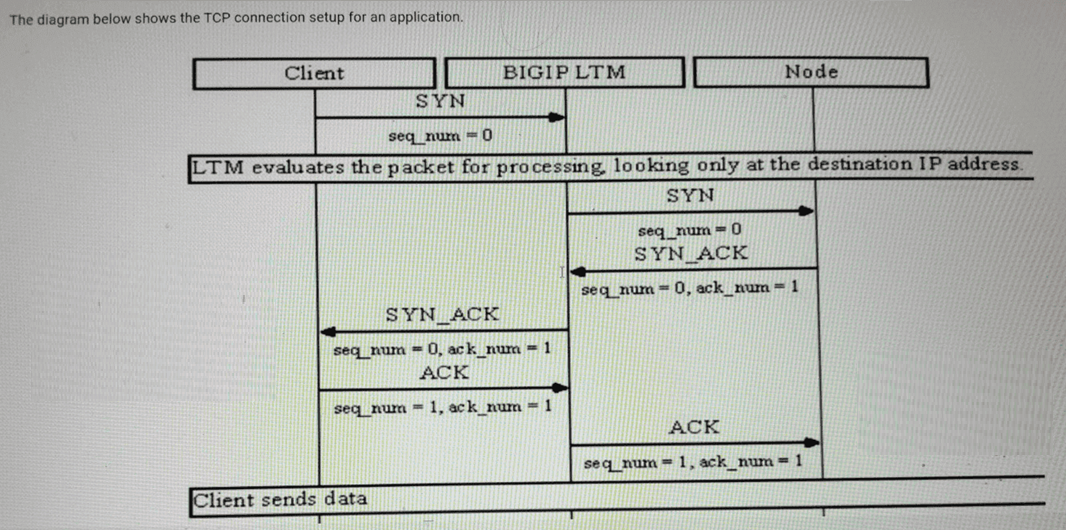
The diagram below shows the TCP connection setup for an application.

Which of the following virtual server types applies? (Choose one answer)

  1. A

    Standard virtual server

  2. B

    Forwarding IP virtual server

  3. C

    Stateless virtual server

Show answer and explanation

Correct answer: A

Explanation

The BIG-IP system terminates the client-side TCP handshake and establishes a separate TCP connection to the node. This full-proxy behavior creates independent client-side and server-side connection state, which is characteristic of a Standard virtual server. A forwarding or stateless virtual server would not perform the two distinct proxied handshakes depicted here.