
E20-880 Real Exam Questions

VNX Solutions Expert Exam for Technology Architects

240 questions available · Page 1 of 24

Updated Exam DumpsVerified AnswersPass Guarantee

Get Complete Exam Dumps
Question 1 Single choice

A company has two data centers. They run multiple Exchange servers in each data center in a virtualized environment. The Exchange Admin would like the storage for each Exchange server to be configured to provide the most flexibility for migrating virtual machines between physical servers. VSS tools for

100% Real Q&As | 100% Real Pass

application consistency compatibility needs to be maintained.

How should the storage for the Exchange virtual machine be allocated to the hypervisor?

  1. A

    Place the Exchange databases and logs on RDMs. Place the boot device for the VM on a VMFS volume.

  2. B

    Place the virtual machine files and exchange data files on a single VHD to allow maximum portability and failover.

  3. C

    Configure the DAG to save and restore its state when taken offline or moved.

  4. D

    Place the virtual machine files, database, and log each in a separate VMFS.

Show answer and explanation

Correct answer: A

Question 2 Single choice

Your customer has a single threaded legacy application with a sequential write workload. They are currently performing a storage technology refresh. They ask you to architect a solution using VNX systems configured with NL-SAS, SAS and Flash drives.

Which drive and RAID protection should they use for the legacy application?

  1. A

    SAS drives; RAID 5 protection

  2. B

    Flash drives; RAID 5 protection

  3. C

    SAS drives; RAID 6 protection

  4. D

    NL-SAS drives; RAID 6 protection

Show answer and explanation

Correct answer: A
Question 3 Single choice

Your customer is experiencing performance degradation when deleting VNX Snapshots.

What technique would you recommend to avoid the defragmentation process that is occurring?

  1. A

    Avoid deleting the last Snapshot on the Thick LUN

  2. B

    Implement RecoverPoint CLR

  3. C

    Implement SnapSure checkpoints

  4. D

    Implement Replication Manager to automate your local protection

Show answer and explanation

Correct answer: A
Question 4 Single choice

As a result of suffering a catastrophic failure, your customer has requested a DR solution. The solution must introduce a higher level of availability for their Exchange 2010 system. You have recommended a strategy that involves Replication Manager with native DAG.

In what state(s) of the database would the replication occur?

  1. A

    Either active or passive

  2. B

    Active only

  3. C

    Passive only

  4. D

    Neither active nor passive

Show answer and explanation

Correct answer: A

Question 5 Single choice

An application generates 1000 random 16 KiB IOPS with a R/W ratio of 4:1. An asynchronous mirror is started on the application LUN. The update cycle is configured to be 20 minutes, and updates take 6 minutes to complete. Assume that the data rate is constant.

What is the minimum space that should be configured for the Reserved LUN Pool on the secondary VNX?

  1. A

    1,125 MiB

  2. B

    4,500 MiB

  3. C

    5,625 MiB

  4. D

    9,000 MiB

Show answer and explanation

Correct answer: B

Question 6 Single choice

You are working with a customer to design a VNX for Block solution for their SQL database. They currently have a CX4-480. In the past they have co-located their database and log files. In the new VNX design, the database will be placed in a FAST VP enabled pool. The transaction logs will be placed on a traditional RAID Group. Your customer needs help determining the number of IOPS they need to satisfy the needs of their transaction logs.

You know the following:

Transaction period: 8 hours (business day)
Throughput during transaction period: 240 GB

How many IOPS will the transaction log volume require?

  1. A

    273

  2. B

    546

  3. C

    1092

  4. D

    1419

Show answer and explanation

Correct answer: C

Question 7 Single choice

Refer to the exhibit.

100% Real Q&As | 100% Real Pass

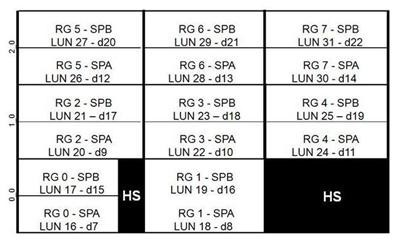
A customer has three SAS DAEs configured with eight 4+1 RAID 5 Groups (RG) and six Hot Spares as shown in the exhibit. All RGs are unused except for RG 0, which contains the Control LUNs. All LUNs except for those in RG 0 are the same size.

Which dvols will be selected for file system creation using Automatic Volume Management System-defined pools?

  1. A

    dvols 11, 13, 20, and 22

  2. B

    dvols 9, 12, 14, and 18

  3. C

    dvols 7, 11, 17, and 25

  4. D

    dvols 9, 10, 11, and 12

Show answer and explanation

Correct answer: A

Question 8 Single choice

Refer to the exhibit.

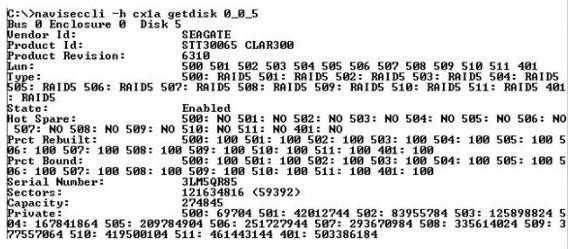
A customer is seeking insight about the data access profile on LUN 500, and has provided you the output shown in the exhibit. The Average Seek Distance (GB) parameter from Unisphere Analyzer shows a high value relative to the size of the disks that make up the RAID Group on which LUN 500 resides.

What can you determine about the data access profile of LUN 500?

  1. A

    It is indeterminate

  2. B

    It is random

  3. C

    It is sequential

    100% Real Q&As | 100% Real Pass

  4. D

    It is highly variable

Show answer and explanation

Correct answer: A

Question 9 Single choice

A customer creates a multi-tiered pool with the following configuration: Five 200 GB FAST VP optimized Flash drives configured as 4+1 RAID 5 Five 600 GB 15 krpm SAS drives
configured as 4+1 RAID 5 Twenty-four 2 TB NL-SAS drives configured as 6+2 RAID 6

The customer's workload consists of 8 kB random I/Os with a R/W ratio of 2:1.

How many host IOPs can the pool support?

  1. A

    3,337 writes/s and 6,673 reads/s

  2. B

    28,060 IOPs

  3. C

    20,560 IOPs

  4. D

    3,697 writes/s and 7,393 reads/s

Show answer and explanation

Correct answer: A

Question 10 Single choice

A customer is using a virtualized environment with a large number of NFS datastores presented from a VNX system. They are experiencing more than expected network traffic on their datastore networks.

According to EMC best practices, what recommendation should you make to your customer?

  1. A

    Adjust NFS.ReadBufferSize and NFS.SendBufferSize to 64.

  2. B

    Ensure that all VMware file systems are thin provisioned to improve NFS write I/O.

  3. C

    Enable NFS write cache for all NFS datastores.

  4. D

    Make sure that the NFS and VMKernel traffic is consolidated onto the same virtual switches.

Show answer and explanation

Correct answer: A