E20-807 Exam Details
-
Exam Code
:E20-807 -
Exam Name
:Expert - VMAX All Flash and VMAX3 -
Certification
:EMC Certifications -
Vendor
:EMC -
Total Questions
:72 Q&As -
Last Updated
:Jul 14, 2026
EMC E20-807 Online Questions & Answers
-
Question 31:
XtremIO is part of a company's FAST.X environment with a VMAX All Flash array and will remain as part of the configuration. The VMAX All Flash array is configured for SRDF as well. In addition, a large VMware environment is hosted on the XtremIO, however, the VMware datastore devices are not virtualized to the VMAX All Flash array.
If the company wants to have remote replication for the VMware devices, how can this be accomplished?
A. Virtualize the VMware datastore devices using incorporation and add to the SRDF configuration
B. Connect an additional VMAX3 or VMAX All Flash array to the XtremIO array and enable SRDF
C. Virtualize the VMware datastore devices using encapsulation and add to the SRDF configuration
D. Enable SRDF on the XtremIO array and add the VMware datastore devices to the configuration -
Question 32:
Performance analysis on VMAX3 FE ports have shown that a large number of QFULL responses were returned to their best performing hosts. However, other hosts suffered from high response times. What needs to be configured in order to lower the high response times?
A. Decrease the queue depth of the poor performing hosts
B. Increase the queue depth for all hosts
C. Set similar queue depths for all hosts D. Increase the queue depth of the best performing hosts -
Question 33:
Which Dell EMC VMAX3 point-in-time replication technology allows snapshots to be created without requiring a target volume?
A. TimeFinder SnapVX
B. ProtectPoint
C. SRDF/Asynchronous
D. Open Replicator -
Question 34:
FAST.X needs to be configured on a VMAX3 array to access LUNs on an XtremIO X-Brick. In addition, existing data on the LUNs has to be preserved and made available for host access. How can this be accomplished?
A. By externally provisioning the LUNs
B. By incorporating the LUNs
C. By zoning the host HBAs to the VMAX3 array FE ports
D. By zoning the host HBAs to the VMAX3 array DX ports -
Question 35:
An existing single engine VMAX3 with two FC ports configured for remote replication will be adding FAST.X to a CloudArray. Currently the array is configured with 32 FC ports which are all in use. Which steps are required to support a minimum connectivity to the CloudArray?
A. Identify a port on each director to be used for the DX emulation Remove replication from any devices on the selected ports Delete any volumes presented to those ports
B. Identify two ports on each director to be used for the DX emulation. Stop all remote replication Delete any volumes presented to those ports.
C. Identify two ports on a single director to be used for the DX emulation Remove any masking entries related to the director ports
D. Identify two ports on each director to be used for the DX emulation Remove any masking entries to the director ports. -
Question 36:
Refer to the Exhibit.
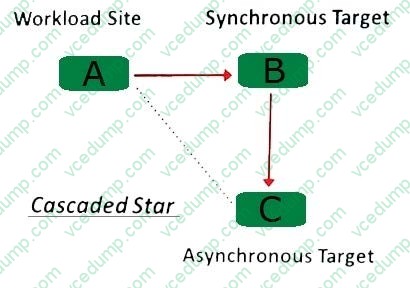
SRDF/Star has been deployed on VMAX3 arrays. Star protection has been enabled. Where are the active and inactive SDDF sessions located during normal operations?
A. Site A. Two active sessions Site B. One inactive session
B. Site A. Two active sessions Site C. One inactive session
C. Site B. Two inactive sessions Site C. Two inactive session
D. Site B. Two active sessions Site C. One inactive session -
Question 37:
A Non-Disruptive (NDM) session is active between a VMAX3 array and a VMAX All Flash array. What happens during the NDM Cutover operation?
A. I/O paths to both arrays are active
B. Paths to the VMAX3 are made inactive
C. Host discovers additional paths to the arrays
D. Application's storage configuration is replicated -
Question 38:
What is a requirement for Non-Disruptive Migration (NDM) to a VMAX All Flash or VMAX3 array?
A. Application host connected through FC to both arrays
B. Application host connected through FC to only the source array
C. Individual NDM licenses on both arrays
D. eManagement running on both arrays -
Question 39:
What is a key difference between SRDF/Metro and SRDF/S?
A. SRDF/Metro: R1 devise is host accessible, R2 is red-only SRDF/S: R1 is host accessible, R2 is write disabled
B. SRDF/Metro: R1 and R2 devices are host accessible at the same time SRDF/S: R1 devices are host accessible, R2 devices are write disabled
C. SRDF/Metro: R2 can be larger than R1 SRDF/S R2 cannot be larger than R1
D. SRDF/Metro: Requires a third array for any witness functionality SRDF/S: Does not require a third array -
Question 40:
To determine Service Level Objective compliance on a VMAX3, where is the I/O response time measured?
A. Frontend Directors
B. Host Bus Adapters
C. SAN Switches
D. Backend Directors
Related Exams:
-
D-CIS-FN-01
Dell Cloud Infrastructure and Services Foundations v2 -
D-ECS-DY-23
Dell ECS Deploy 2023 -
D-GAI-F-01
Dell GenAI Foundations Achievement -
D-ISM-FN-01
Dell Information Storage and Management Foundations v2 -
D-MSS-DS-23
Dell Midrange Storage Solutions Design 2023 -
D-OME-OE-A-24
Dell OpenManage Operate Achievement -
D-PCR-DY-01
Dell PowerProtect Cyber Recovery Deploy v2 -
D-PDD-DY-23
Dell PowerProtect DD Deploy 2023 -
D-PE-OE-23
Dell PowerEdge Operate 2023 -
D-PEXE-IN-A-00
Dell PowerEdge XE9680 and XE8640 Install
Tips on How to Prepare for the Exams
Nowadays, the certification exams become more and more important and required by more and more enterprises when applying for a job. But how to prepare for the exam effectively? How to prepare for the exam in a short time with less efforts? How to get a ideal result and how to find the most reliable resources? Here on Vcedump.com, you will find all the answers. Vcedump.com provide not only EMC exam questions, answers and explanations but also complete assistance on your exam preparation and certification application. If you are confused on your E20-807 exam preparations and EMC certification application, do not hesitate to visit our Vcedump.com to find your solutions here.