
E20-507 Real Exam Questions

VMAX3 Solutions Specialist Exam for Storage Administrators

154 questions available · Page 1 of 16

Updated Exam DumpsVerified AnswersPass Guarantee

Get Complete Exam Dumps
Question 1 Single choice

Storage has been provisioned from a VMAX3 using a Masking View with a single Storage Group associated with the Bronze SLO.

How can new storage be provisioned to this host using the Gold SLO while maintaining the original volumes in the Bronze SLO?

  1. A

    Convert the existing Storage Group to cascaded, create a new child Storage Group for the new devices, and apply the Gold SLO.

  2. B

    Apply the Gold SLO directly to the new volumes.

  3. C

    Add a cascaded Storage Group to the original Storage Group and apply the Gold SLO.

  4. D

    A new Masking View and Storage Group is required for the devices managed by the Gold SLO.

Show answer and explanation

Correct answer: A
Question 2 Single choice

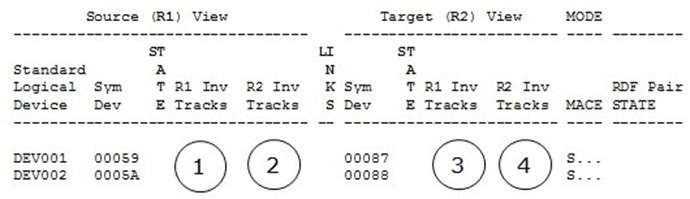
Refer to the Exhibit.

Production work has been resumed on the R2 devices after an SRDF Failover operation.

Where will the changes made to the R2 device be reflected in an SRDF Query?

  1. A

    1

  2. B

    2

  3. C

    3

  4. D

    4

Show answer and explanation

Correct answer: A

Question 3 Single choice

In a VMAX3 environment, what is used to make SRDF/A resilient to temporary increases in write workloads or intermittent link loss?

  1. A

    Storage Resource Pool

  2. B

    Delta Set Extension Pool

  3. C

    SAV Pool

  4. D

    Reserved LUN Pool

Show answer and explanation

Correct answer: A

Question 4 Single choice

How many linked targets, per source, are allowed when using TimeFinder SnapVX?

  1. A

    128

  2. B

    256

  3. C

    512

  4. D

    1024

Show answer and explanation

Correct answer: D

Explanation

To access a point-in time-copy, create a link from the snapshot data to a host mapped target device.
SnapVX supports up to 1,024 linked targets per source device. Links can be a permanent copy on a target device, or a temporary copy that no longer retains the point-in-time copy of the data once the link is removed.
References:
http://ireland.emc.com/collateral/TechnicalDocument/docu68926.pdf

Question 5 Single choice

A storage administrator has set the I/O limit on a VMAX3 Storage Group to 1000 IO/Sec. The I/O distribution has been set to the default mode. One of the directors in the associated two-director Port Group has failed.

What will the I/O limit be on the director that is still online?

  1. A

    500 IO/Sec

  2. B

    750 IO/Sec

  3. C

    1000 IO/Sec

  4. D

    2000 IO/Sec

Show answer and explanation

Correct answer: A

Question 6 Single choice

If a Gatekeeper is listed in both the gkselect and the gkavoid files, what will happen during the selection of Gatekeepers?

  1. A

    gkavoid entry is used

  2. B

    gkselect entry is used

  3. C

    Neither entry is used

  4. D

    Either entry could be used

Show answer and explanation

Correct answer: A

Question 7 Single choice

What is the granularity of FAST data movement requests in a VMAX3 array?

  1. A

    1 Extent Group

  2. B

    1 Extent Group Set

  3. C

    12 Extents

  4. D

    42 Extent Groups

Show answer and explanation

Correct answer: A

Explanation

References:
http://uk.emc.com/collateral/technical-documentation/docu55786-vmax3-service-level-pro-fully-
automated-storage.pdf

Question 8 Single choice

At which level does Non-Disruptive Migration work?

  1. A

    Port Group

  2. B

    Disk Group

  3. C

    Storage Group

  4. D

    Initiator Group

Show answer and explanation

Correct answer: C

Explanation

Reference
https://www.emc.com/collateral/technical-documentation/h15464-vmax-non-disruptive-
migration.pdf (P.7)

Question 9 Single choice

A VMAX3 system administrator needs to create a SRDF relationship for a planned data migration.

Which replication mode of SRDF is recommended for the initial bulk data transfer?

  1. A

    Adaptive Copy Disk

  2. B

    Synchronous

  3. C

    Asynchronous

  4. D

    Adaptive Copy Write Pending

Show answer and explanation

Correct answer: A

Explanation

SRDF/Synchronous (SRDF/S), SRDF/Asynchronous (SRDF/A), and SRDF Adaptive Copy are the basic operation modes of SRDF. The first two are valid for Oracle database protection and maintain dependent write-order consistency. The third is useful for bulk data transfers or in combination with more complex SRDF solutions such as SRDF/Automated Replication (SRDF/AR)

Question 10 Single choice

What is the default port number to access the EMC vApp Manager for Solutions Enabler?

  1. A

    2707

  2. B

    5480

  3. C

    8080

  4. D

    8443

Show answer and explanation

Correct answer: B