E20-335 Real Exam Questions

Symmetrix Solutions Specialist Exam for Implementation Engineers

164 questions available · Page 1 of 17

Updated Exam DumpsVerified AnswersPass Guarantee

Get Complete Exam Dumps
Question 1 Single choice

What is the maximum number of pools allowed in a FAST VP tier?

  1. A

    1

  2. B

    2

  3. C

    3

  4. D

    4

Show answer and explanation

Correct answer: D

Explanation

Explanation:

For FAST VP, the storage tier is called a VP tier. When defined, VP tiers contain between one and four thin storage pools. Each thin pool must contain data devices of the same RAID protection type, and be configured on the same drive technology. In the case of Fibre Channel and SATA drives, the rotational speed of the drives must also match. However, thin pools containing data devices configured on rotating drives of different sizes and speeds may be combined in a single
VP tier.
SCM
Question 2 Single choice

Which feature allows the contents of a BCV to remain unchanged during and after operation?
Even while the BCV and the standard is synchronized?

  1. A

    Protected restore

  2. B

    Full establish

  3. C

    Symmir restore

  4. D

    Incremental restore

Show answer and explanation

Correct answer: A

Explanation

Explanation:
Might be symmir restore. Use your own discretion.

Question 3 Single choice

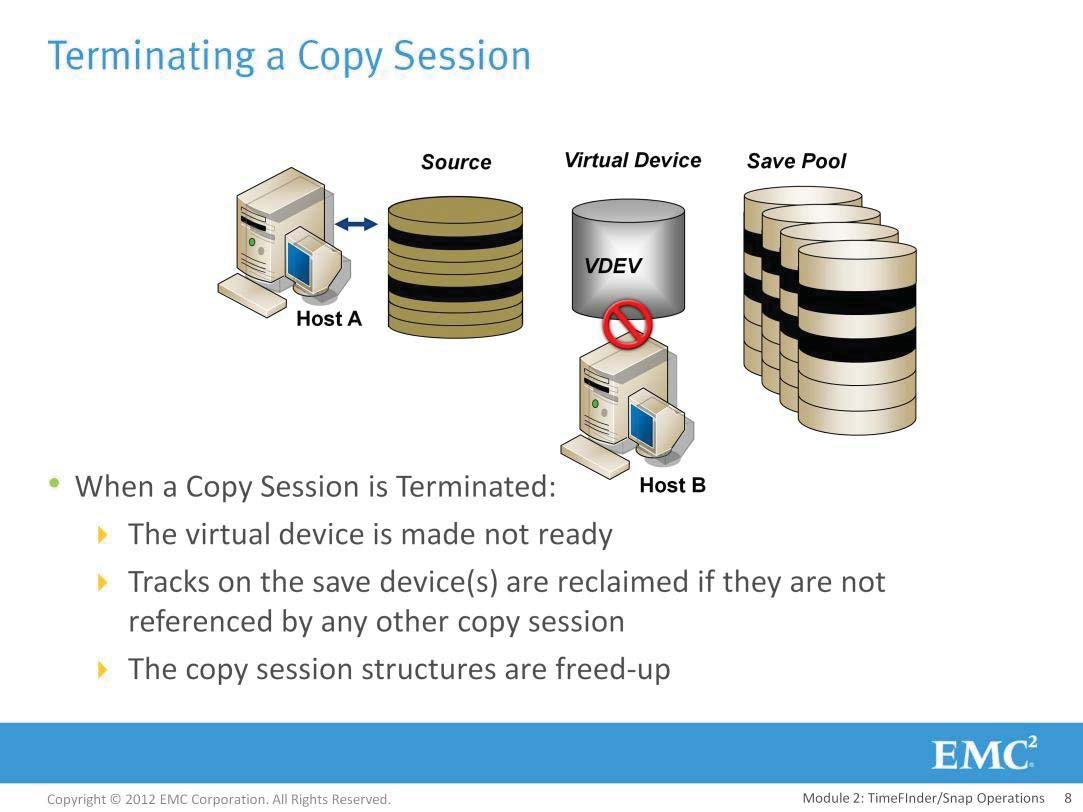
What happens when a TimeFinder/Snap session is terminated?

  1. A

    The virtual device is made Read-Only Tracks on the Save Device(s) are reclaimed if not referenced by another session

  2. B

    The virtual device is made Not Ready Tracks on the Save Device(s) are reclaimed if not referenced by another session The copy session structures are freed-up

  3. C

    The virtual device is made Not Ready
    The copy session structures are written to the virtual device Tracks on the Save Device(s) are reclaimed if not referenced by another session

  4. D

    The virtual device is removed Tracks on the Save Device(s) are reclaimed if not referenced by another session

Show answer and explanation

Correct answer: B

Explanation

Explanation:

As sessions are terminated, the space in the Save Area is released and available for re-use by other snap sessions.
BCM

Question 4 Single choice

Open Replicator will be used to move data from a Symmetrix V-Max array to a CLARiiON array. The CLARiiON has NOT been discovered by the host on which the Open Replicator commands are issued.

Which information has to be specified in the Open Replicator device file?

  1. A

    The CLARiiON Array ID and LUN ID

  2. B

    The WWN of the CLARiiON LUN

  3. C

    The CLARiiON Array ID and WWN of the CLARiiON LUN

  4. D

    The WWN and LUN ID of the CLARiiON LUN

Show answer and explanation

Correct answer: B

Question 5 Single choice

On a Symmetrix VMAX array, which local replication technology is used by SRDF/AR single hop?

  1. A

    Native TimeFinder/Clone

  2. B

    TimeFinder/Clone Emulation

  3. C

    TimeFinder/Snap

  4. D

    Native TimeFinder/Mirror

Show answer and explanation

Correct answer: B

Explanation

Explanation:
At Enginuity 5773 and below, SRDF/AR uses native TimeFinder/Mirror functionality. Starting with Enginuity 5874, all TimeFinder/Mirror operations are converted automatically to TimeFinder/Clone operations, as TimeFinder/Mirror feature is no longer available. SRDF/AR uses the symmir command set to obtain local and remote point-in-time copies of the data. With Enginuity 5874 and above these symmir commands are transparently converted to equivalent TimeFinder/Clone operations.
BCM

Question 6 Single choice

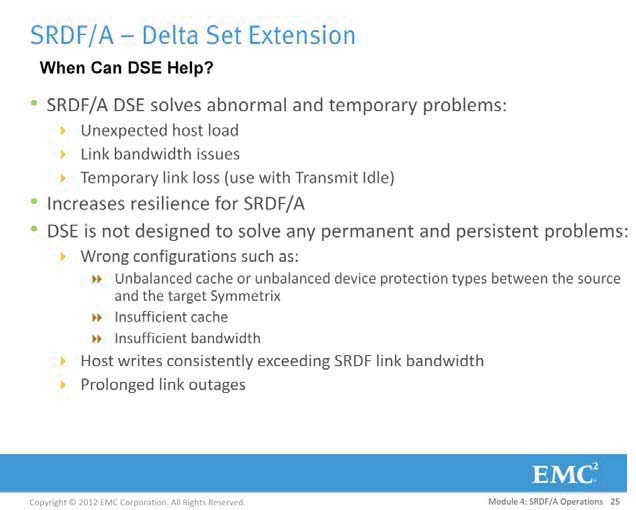
How does Delta Set Extension help in an SRDF/A deployment?

  1. A

    Reduces RPO

  2. B

    Reduces the amount of required cache

  3. C

    Improves response time

  4. D

    Absorbs bursts of host writes

Show answer and explanation

Correct answer: D

Explanation

SRDF/A DSE should be used with the Transmit Idle feature. Thus, SRDF/A can ride through a temporary link loss. Once the DSE threshold is reached, data is paged out to the DSE Pools. When space in the DSE pool is also exhausted, SRDF/A session will be dropped and will become inactive.

Question 7 Single choice

In symmetric V-max series array running Enginuity 5874, which device is used as a pass-through device for Auto provisioning?

  1. A

    VDEV

  2. B

    VCM

  3. C

    ACLX

  4. D

    SFS

Show answer and explanation

Correct answer: C

Question 8 Single choice

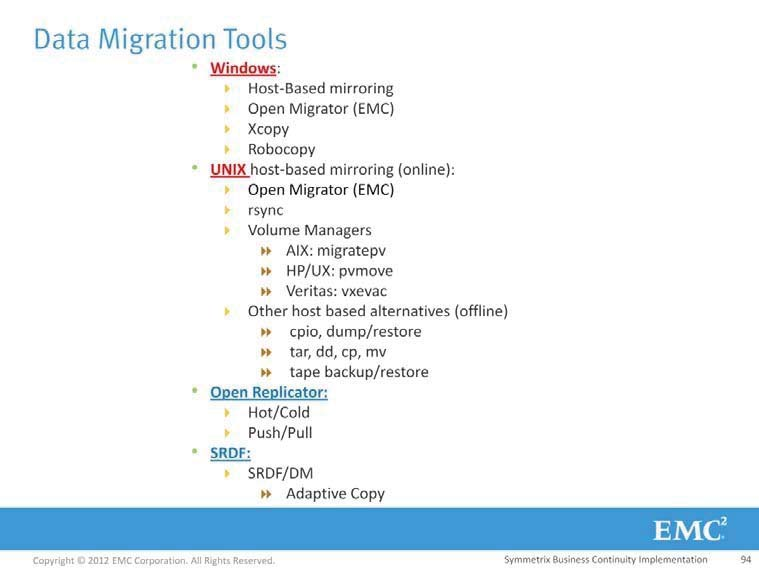
Which UNIX utility or tool would you use to perform an HP-UX host-based data migration?

  1. A

    migratepv

  2. B

    pvmove

  3. C

    vxmigrate

  4. D

    vxevac

Show answer and explanation

Correct answer: B

Explanation

Explanation:

A combination of the environment and customer objectives determines the tool used to perform the migration.

This slide lists some of the tools available. It is not a complete list, and new tools and options are constantly being made available.

Question 9 Single choice

What is the result of performing a TimeFinder/Mirror consistent split operation against a device group?

  1. A

    All BCV devices in the group are consistent point-in-time copies.

  2. B

    All standard devices in the group are consistent point-in-time copies.

  3. C

    BCV devices are write-disabled and ready for synchronization with standard devices.

  4. D

    All standard devices are write-disabled and ready for synchronization with BCV devices.

Show answer and explanation

Correct answer: A

Explanation

Explanation:

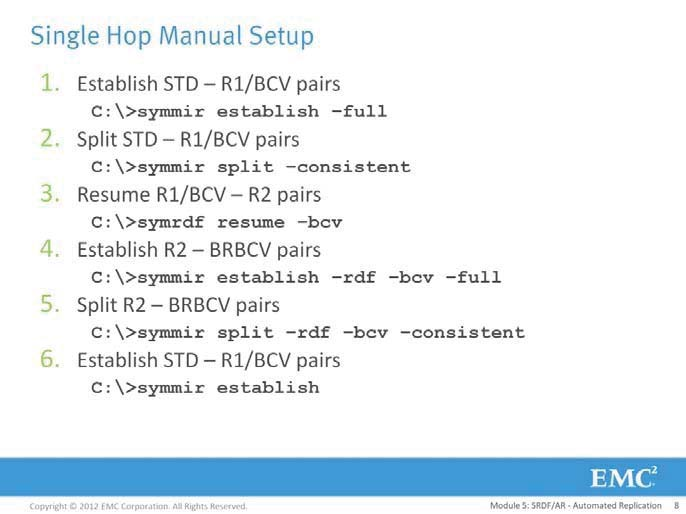
There are six steps to prepare the state of all the mirrors involved in SRDF/AR Single Hop prior to running the symreplicate command. To begin a replication session in the single-hop configuration, the mirrors must be in the following states:

- The local STD/BCV pairs must be fully synchronized
- The RDF pairs must be in a suspended state
- The remote BCV pairs must be in a split state

Note: The user must wait and check for full synchronization before proceeding to the next step and issuing the next command. In step (1), if it is the first time that the STD devices are paired with these R1/BCV devices, a full establish operation is required. The establish operation in step (1) automatically suspends the RDF links between the R1/BCV R2 device pairs. After verifying that the STD R1/BCV pairs are in a synchronized state, they can be split in step (2). The RDF link between R1/BCV R2 device pairs is resumed in step (3). After R1/BCV R2 device pairs are synchronized, the R2 BCV device pairs can be established in step (4). Again as this is the first time these devices are paired, a full establish operation has to be performed. After synchronization of R2 BRBCV pairs, they can be split in step (5). Finally the STD BCV device pairs can now be incrementally established in step (6).

Question 10 Single choice

Which of these protection types offers the best protection?

  1. A

    RAID 6

  2. B

    RAID 5 (7+1)

  3. C

    RAID 1

  4. D

    RAID 5 (3+1)

Show answer and explanation

Correct answer: A

Explanation

Explanation:

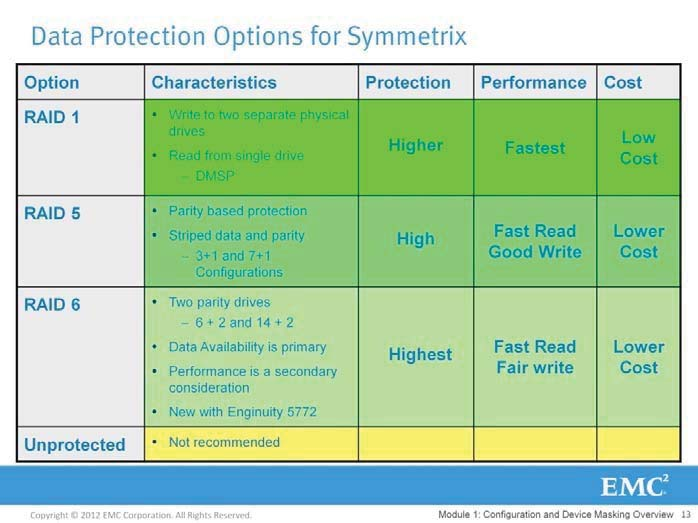
RAID 5 is based on the industry standard algorithm and can be configured with three data and one parity, or seven data and one parity. While the latter will provide more capacity per $, there is a greater performance impact when in degraded mode where a drive has failed and all surviving drives must be read in order to rebuild the missing data.

RAID 6 is focused on availability. With the new larger capacity disk drives, rebuild times may take multiple days increasing the exposure to a second disk failure.

Random read performance is similar across all protection types, assuming you are comparing the same number of drives. The major difference is write performance. With mirrored devices for every host write there are two writes on the backend. With RAID 5, each host write results in two reads and two writes. For RAID 6, each host write results in three reads and three writes. Other data protection schemes include remote replication using SRDF.
SCM