E20-326 Exam Details
-
Exam Code
:E20-326 -
Exam Name
:Symmetrix Solutions Design Exam for Technology Architects Exam -
Certification
:EMC Certifications -
Vendor
:EMC -
Total Questions
:235 Q&As -
Last Updated
:Jul 07, 2026
EMC E20-326 Online Questions & Answers
-
Question 131:
An existing TimeFinder customer migrated from a DMX-3 running Enginuity 5771 to a new VMAX array. A colleague advised them TimeFinder/Clone performance would improve on the VMAX due to changes to the Copy on First Write
(COFW) mechanism. The customer asks you to explain how the COFW mechanism changed on the VMAX.
What do you advise the customer?
A. Uses asynchronous copy on first write (ACOFW), which has no COFW penalty.
B. Uses synchronous copy on first write (COFW), which has no COFW penalty.
C. Uses asynchronous copy on first write (ACOFW), which holds protected writes in cache.
D. Uses synchronous copy on first write (COFW), which completes protected writes in cache. -
Question 132:
Refer to the exhibit.
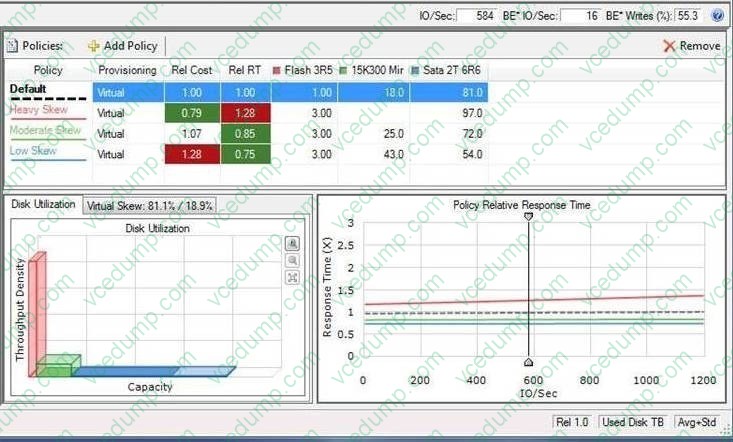
You are considering potential configurations of a new storage system. You need to make decisions that consider different cost-benefit ratios. Which policy applied to the workload provides the minimum expenditure?
A. Heavy Skew
B. Moderate Skew
C. Low Skew
D. Default Skew -
Question 133:
A customer asked you to design a storage solution for their new call center application. This is a new EMC customer and they do not have any existing storage infrastructure. Before you begin to design a solution, you request that the customer collect some host-based performance metrics. When and how should the customer collect performance metrics?
A. During peak workloads in small intervals
B. During peak workloads in large intervals
C. During normal workloads in small intervals
D. During normal workloads in large intervals -
Question 134:
What is a Capacity Available for Active Replication (CAAR) consideration when using TimeFinder on a Symmetrix VMAX?
A. TimeFinder VP Snap requires 2X protection slots for source and 1X protection slots for up to 16 targets
B. TimeFinder/Snap requires protection slots for both source and target
C. TimeFinder/Snap source requires 2X the protection slots of the target
D. TimeFinder VP Snap requires 2X protection slots for both source and target for up to 32 targets -
Question 135:
You are designing an SRDF/S solution. The workload profile is:

Total I/Os per second = 10000
Write % = 25
Read block size = 8 KB
Write block size = 8 KB
Network bandwidth can be purchased in increments of single T3 (45 Mb/s) links. Data compression is not in use. How many T3s links would you recommend?
A. 6
B. 2
C. 4
D. 8 -
Question 136:
What is considered to be a thin unfriendly environment?
A. an environment that makes use of filesystems that append data instead of re-using free space.
B. an environment that contains databases that make use of the auto-extend capability.
C. an environment that is used for media and document repositories.
D. an environment that is used by Test Development and Quality Assurance. -
Question 137:
A company plans to deploy Symmetrix VMAX arrays in their VMware vSphere environment. The ESXi hosts will be connected to the VMAX arrays over a FC SAN. Which VMAX FA port flag is optional?
A. SCSI Support
B. SPC-2
C. Unique worldwide name (UWN)
D. Common Serial Number (C) -
Question 138:
When designing SRDF/A, what is the recommended configuration for the DSE pool?
A. RAID-5 devices spread out over few disks
B. RAID-1 devices on dedicated disks
C. RAID-6 devices on dedicated disks
D. RAID-1 devices spread out over many disks -
Question 139:
A customer plans to aggregate a number of CLARiiONs to a Symmetrix VMAX with FAST VP. Which data collection requirements are recommended for a Tier Advisor analysis?
A. Minimum 5 hour NAR and trace data collection with both NAR and trace data collected at 2 minute intervals.
B. Trace data for 30 minutes each hour of NAR capture.Minimum 8 hour NAR data collection at 10 minute intervals for coarse data analysis.
C. Trace data at 1 minute intervals for detailed peak data capture.Maximum 24 hour NAR and trace capture at default 10 minute intervals to enable peak analysis on a daily basis.
D. Minimum 5 day NAR with default data collection interval of 10 minutes.Partial trace data for 30 minutes each hour of NAR capture. -
Question 140:
What is the maximum number of wavelengths that can be multiplexed on a single optical fiber over CWDM?
A. 8
B. 16
C. 32
D. 160
Related Exams:
-
D-CIS-FN-01
Dell Cloud Infrastructure and Services Foundations v2 -
D-ECS-DY-23
Dell ECS Deploy 2023 -
D-GAI-F-01
Dell GenAI Foundations Achievement -
D-ISM-FN-01
Dell Information Storage and Management Foundations v2 -
D-MSS-DS-23
Dell Midrange Storage Solutions Design 2023 -
D-OME-OE-A-24
Dell OpenManage Operate Achievement -
D-PCR-DY-01
Dell PowerProtect Cyber Recovery Deploy v2 -
D-PDD-DY-23
Dell PowerProtect DD Deploy 2023 -
D-PE-OE-23
Dell PowerEdge Operate 2023 -
D-PEXE-IN-A-00
Dell PowerEdge XE9680 and XE8640 Install
Tips on How to Prepare for the Exams
Nowadays, the certification exams become more and more important and required by more and more enterprises when applying for a job. But how to prepare for the exam effectively? How to prepare for the exam in a short time with less efforts? How to get a ideal result and how to find the most reliable resources? Here on Vcedump.com, you will find all the answers. Vcedump.com provide not only EMC exam questions, answers and explanations but also complete assistance on your exam preparation and certification application. If you are confused on your E20-326 exam preparations and EMC certification application, do not hesitate to visit our Vcedump.com to find your solutions here.