
E20-326 Real Exam Questions

Symmetrix Solutions Design Exam for Technology Architects Exam

235 questions available · Page 1 of 24

Updated Exam DumpsVerified AnswersPass Guarantee

Get Complete Exam Dumps
Question 1 Single choice

Prior to creating the Symmetrix VMAX architecture for Microsoft SQL, you are given a Perfmon Log view containing data for the database LUN. The file contains read and write IOPS collected over the past week, at 3-minute intervals.

Which method should be used to determine the correct IOPS target for calculating the appropriate number of RAID corrected spindles?

  1. A

    90th percentile

  2. B

    75th percentile

  3. C

    Overall Peak

  4. D

    Overall Average

Show answer and explanation

Correct answer: A
Question 2 Single choice

What is the maximum data change rate for which you would recommend TimeFinder/Snap over TimeFinder/Clone as a local replication solution?

  1. A

    10%

  2. B

    50%

  3. C

    70%

  4. D

    30%

Show answer and explanation

Correct answer: D

Question 3 Single choice

A customer plans to migrate existing AIX and Windows hosts as well as Mainframe z/OS LPARs to a new VMAX array. Performance data is needed to design the VMAX volumes configuration layout.

Which host performance data do you request from the customer?

  1. A

    STP, SAR, WRKDSKSTS

  2. B

    SAR, Perfmon, WRKDSKSTS

  3. C

    IOSTAT, Perfmon, SMF/CMF

  4. D

    IOSTAT, SAR, SMF/CMF

Show answer and explanation

Correct answer: C

Question 4 Single choice

A customer has purchased a new VMAX and is in the process of setting up Open Replicator for a migration.

What is a consideration for device pairing for the migration?

  1. A

    New devices must be of the same RAID type.

  2. B

    New Device must be the same size or smaller.

  3. C

    New Device must be of the same Meta Configuration.

  4. D

    New device must be the same size or larger.

Show answer and explanation

Correct answer: D

Question 5 Single choice

You are designing a new VMAX implementation. All applications will share physical drives and participate in SRDF/S replication.

The customer has two high I/O applications used for OLTP and a several low I/O applications used for testing. The customer wants to ensure the high I/O applications take precedence over the low I/O applications on the VMAX array.

What do you recommend?

  1. A

    Implement Symmetrix Priority Controls.

  2. B

    Configure striped metavolumes.

  3. C

    Implement SRDF Consistency Groups.

  4. D

    Configure concatenated metavolumes.

Show answer and explanation

Correct answer: A

Question 6 Single choice

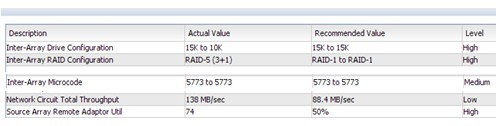
Refer to the exhibit.

You have used BCSD to model an SRDF/A solution.
Based on the SRDF/A risk analysis shown what are your recommendations?

  1. A

    Ensure that the SRDF devices on the source and target arrays use the same protection and reside on disks with the same RPM. Provide more remote adapters.

  2. B

    Provide more bandwidth. Upgrade both arrays to Symmetrix VMAX.

  3. C

    Ensure that the SRDF devices on the source and target arrays use the same protection and reside on disks with the same RPM. Upgrade both arrays to Symmetrix VMAX.

  4. D

    Provide more bandwidth and more remote adapters. Upgrade both arrays to Symmetrix VMAX.

Show answer and explanation

Correct answer: A

Question 7 Single choice

What determines the maximum cache requirements when modeling an SRDF/A Delta Set Extension configuration?

  1. A

    Transmit Idle time for the peak workload

  2. B

    Peak Cycle time for the peak workload

  3. C

    Sum of the data changed for N and N+1 cycles without modification

  4. D

    Sum of the data changed for N and N+1 cycles, modified by the Write Load Adjustment factor

Show answer and explanation

Correct answer: A

Question 8 Single choice

An SRDF/S design analysis was performed with BCSD. The Volume Exception tab in BCSD has identified several volumes.

What is a reason for this issue?

  1. A

    Acceptable volume write limits have been exceeded

  2. B

    Inadequate bandwidth

  3. C

    Acceptable write pending limits have been exceeded

  4. D

    Unknown limits have been exceeded, further investigation is required

Show answer and explanation

Correct answer: A

Question 9 Single choice

A customer is using virtual provisioning on a Symmetrix VMAX which is being shared for Production and non-production workloads.

What can be used to separate the different workloads?

  1. A

    Dynamic Cache Partitioning

  2. B

    Symmetrix Priority Controls

  3. C

    Write Pending Limit

  4. D

    FAST VP

Show answer and explanation

Correct answer: A

Question 10 Single choice

A proposed SRDF/S solution was modeled with BCSD using host-based data. - The BCSD model assumed two engine VMAX arrays with SRDF Fibre ports. - The RA Utilization chart shows a maximum utilization of 45%. The "Volume Exceptions" table lists five devices.

What should you recommend?

  1. A

    Change the application layout

  2. B

    Add more remote adapters

  3. C

    Use three engine VMAX arrays

  4. D

    Turn on software compression on the remote adapters

Show answer and explanation

Correct answer: A