A customer is configuring loopback replication on their VNX. They are confused by the size and number of bitmaps and blockmaps to allow.
How many blockmaps are there per file system?
Show answer and explanation
Correct answer: A
E20-324 Real Exam Questions
233 questions available · Page 1 of 24
Updated Exam DumpsVerified AnswersPass Guarantee
A customer is configuring loopback replication on their VNX. They are confused by the size and number of bitmaps and blockmaps to allow.
How many blockmaps are there per file system?
Correct answer: A
Your customer has just purchased ten 1TB NL-SAS drives for their VNX array. This additional capacity will be used to archive their large image repository.
Which configuration will provide the most efficient use of capacity while still following best practices?
Correct answer: C
An administrator allocated two LUNs on a VNX for the Exchange 2010 mailstore and logs. The Exchange 2010 server is a VM under vSphere 5.1.
How should those LUNs be presented to the virtual machine?
Correct answer: A
The CTO (Chief Technology Officer) of mid-sized company decided to virtualize their storage environment.
From the interview, you learn that the company has strict performance requirements that must be met to create a successful solution.
How should the performance requirements for the customer be determined?
Correct answer: A
Refer to the exhibit.
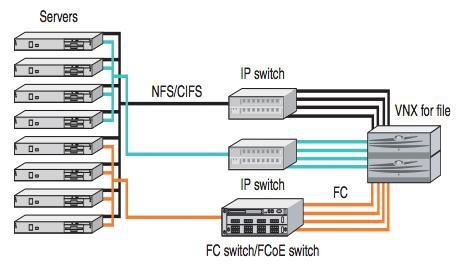
What type of VNX configuration is illustrated with this topology?
Correct answer: A
A customer has two data centers located 500 kilometers apart and uses VNX arrays exclusively for block data storage in both of them. Each data center is monitored and managed by Unisphere. The customer wants to deploy an integrated replication methodology to protect his most critical data.
Which product will meet the customer's requirements?
Correct answer: A
A customer has two data centers located 500 kilometers apart and uses VNX arrays in each data center for both block and file storage. Each data center is monitored and managed by Unisphere. The customer wants to deploy an integrated replication methodology to protect all of his data.
Which product will meet the customer's requirements?
Correct answer: A
Why is it important to consider the backup and restore environment when designing a VNX solution?
Correct answer: A
A customer configured performance monitoring and alerting for their VNX storage array. Periodically they are getting alerts on write latency greater than 15 ms. The VNX is configured with a pool of SAS drives and thin LUNs supporting a database application. NAR data, for a given period which includes one of the alerts,
is examined. Flash drives are installed in the VNX; however, they are not currently used.
Examining the configuration and data shows the following:
-- Host Type = Linux
-- Multi-pathing = Native
-- Failover Mode = 1
-- Data LUNs = SP A
-- Log LUNs = SP B
-- LUN Queue Length = 1.9
-- ABQL = 7.5
How can the performance issue be resolved?
Correct answer: A
A customer is experiencing a performance issue with a specific VNX file system. Analyzer showed that the utilization of several RAID Groups was in the red. The problematic file system, however, was mapped only to one of those RAID Groups, while other RAID Groups served file systems without known issues.
How would you explain utilization metric to this customer?
Correct answer: A