Databricks DATABRICKS-CERTIFIED-DATA-ENGINEER-ASSOCIATE Online Practice Questions and Exam Preparation
DATABRICKS-CERTIFIED-DATA-ENGINEER-ASSOCIATE Exam Details
-
Exam Code
:DATABRICKS-CERTIFIED-DATA-ENGINEER-ASSOCIATE -
Exam Name
:Databricks Certified Data Engineer Associate -
Certification
:Databricks Certifications -
Vendor
:Databricks -
Total Questions
:196 Q&As -
Last Updated
:Jul 11, 2026
Databricks DATABRICKS-CERTIFIED-DATA-ENGINEER-ASSOCIATE Online Questions & Answers
-
Question 151:
A data engineer needs to grant all privileges on the table sales to the group analytics_team. Which SQL command should be used?
A. GRANT FULL TO analytics_team ON TABLE sales;
B. GRANT ALL PRIVILEGES ON TABLE sales TO analytics_team;
C. GRANT ADMIN ON TABLE sales TO analytics_team;
D. GRANT USAGE ON TABLE sales TO analytics_team;
E. GRANT CREATE ON TABLE sales TO analytics_team;B. GRANT ALL PRIVILEGES ON TABLE sales TO analytics_team;Explanation
The GRANT ALL PRIVILEGES ON TABLE
TO
syntax is used in Databricks SQL for full access control. Question 152:
A data engineer wants to create a data entity from a couple of tables. The data entity must be used by other data engineers in other sessions. It also must be saved to a physical location. Which of the following data entities should the data engineer create?
A. Database
B. Function
C. View
D. Temporary view
E. TableE. TableExplanation
A table is a data entity that is stored in a physical location and can be accessed by other data engineers in other sessions. A table can be created from one or more tables using the CREATE TABLE or CREATE TABLE AS SELECT commands. A table can also be registered from an existing DataFrame using the spark.catalog.createTable method. A table can be queried using SQL or DataFrame APIs. A table can also be updated, deleted, or appended using the MERGE INTO command or the DeltaTable API.
References: Create a table Create a table from a query result Register a table from a DataFrame [Query a table] [Update, delete, or merge into a table]
Question 153:
A data engineer needs to apply custom logic to string column city in table stores for a specific use case. In order to apply this custom logic at scale, the data engineer wants to create a SQL user-defined function (UDF).
Which of the following code blocks creates this SQL UDF?
A. Option A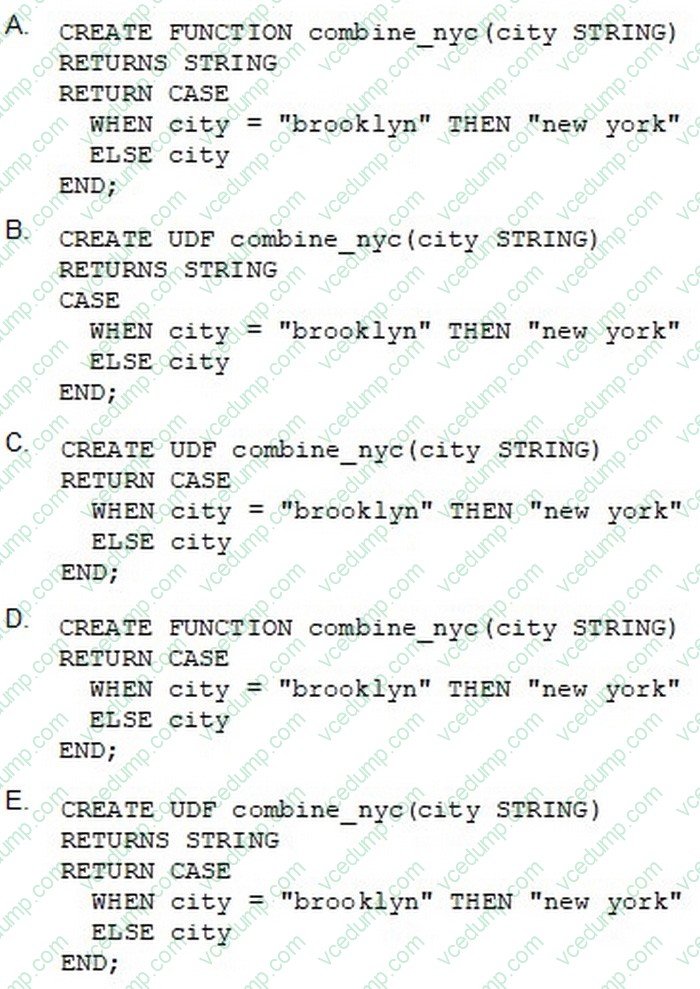
B. Option B
C. Option C
D. Option D
E. Option EA. Option AExplanation
https://www.databricks.com/blog/2021/10/20/introducing-sql-user-defined- functions.html
Question 154:
A data engineer that is new to using Python needs to create a Python function to add two integers together and return the sum?
Which of the following code blocks can the data engineer use to complete this task?
A. Option A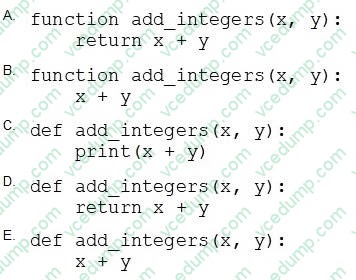
B. Option B
C. Option C
D. Option D
E. Option ED. Option DExplanation
https://www.w3schools.com/python/python_functions.asp https://www.geeksforgeeks.org/python-functions/
Question 155:
Which two components function in the DB platform architecture's control plane? (Choose two.)
A. Virtual Machines
B. Compute Orchestration
C. Serverless Compute
D. Compute
E. Unity CatalogB. Compute Orchestration
E. Unity CatalogExplanation
Question 156:
A Delta Live Table pipeline includes two datasets defined using STREAMING LIVE TABLE. Three datasets are defined against Delta Lake table sources using LIVE TABLE.
The table is configured to run in Development mode using the Continuous Pipeline Mode.
Assuming previously unprocessed data exists and all definitions are valid, what is the expected outcome after clicking Start to update the pipeline?
A. All datasets will be updated once and the pipeline will shut down. The compute resources will be terminated.
B. All datasets will be updated at set intervals until the pipeline is shut down. The compute resources will persist until the pipeline is shut down.
C. All datasets will be updated once and the pipeline will persist without any processing. The compute resources will persist but go unused.
D. All datasets will be updated once and the pipeline will shut down. The compute resources will persist to allow for additional testing.
E. All datasets will be updated at set intervals until the pipeline is shut down. The compute resources will persist to allow for additional testing.B. All datasets will be updated at set intervals until the pipeline is shut down. The compute resources will persist until the pipeline is shut down.Explanation
The Continuous Pipeline Mode for Delta Live Tables allows the pipeline to run continuously and process data as it arrives. This mode is suitable for streaming ingest and CDC workloads that require low-latency updates. The Development mode for Delta Live Tables allows the pipeline to run on a dedicated cluster that is not shared with other pipelines. This mode is useful for testing and debugging the pipeline logic before deploying it to production. Therefore, the correct answer is B, because the pipeline will run continuously on a dedicated cluster until it is manually stopped, and the compute resources will be released only after the pipeline is shut down.
References: Databricks Documentation - Configure pipeline settings for Delta Live Tables, Databricks Documentation - Continuous vs. triggered pipeline execution, Databricks Documentation - Development vs. production mode.
Question 157:
Identify a scenario to use an external table.
A Data Engineer needs to create a parquet bronze table and wants to ensure that it gets stored in a specific path in an external location.
Which table can be created in this scenario?
A. An external table where the location is pointing to specific path in external location.
B. An external table where the schema has managed location pointing to specific path in external location.
C. A managed table where the catalog has managed location pointing to specific path in external location.
D. A managed table where the location is pointing to specific path in external location.A. An external table where the location is pointing to specific path in external location.Explanation
Question 158:
What happens when the VACUUM command is run with retention set to 0?
A. It has no effect
B. All files are preserved
C. It deletes all unreferenced files immediately
D. It invalidates the Delta table
E. It optimizes file sizesC. It deletes all unreferenced files immediatelyExplanation
VACUUM RETAIN 0 HOURS aggressively removes all obsolete files, which may break time travel.
Question 159:
A data engineer has a Job with multiple tasks that runs nightly. Each of the tasks runs slowly because the clusters take a long time to start.
Which of the following actions can the data engineer perform to improve the start up time for the clusters used for the Job?
A. They can use endpoints available in Databricks SQL
B. They can use jobs clusters instead of all-purpose clusters
C. They can configure the clusters to be single-node
D. They can use clusters that are from a cluster pool
E. They can configure the clusters to autoscale for larger data sizesD. They can use clusters that are from a cluster poolExplanation
The best action that the data engineer can perform to improve the start up time for the clusters used for the Job is to use clusters that are from a cluster pool. A cluster pool is a set of idle clusters that can be used by jobs or interactive sessions. By using a cluster pool, the data engineer can avoid the cluster creation time and reduce the latency of the tasks. Cluster pools also offer cost savings and resource efficiency, as they can be shared by multiple users and jobs. Option A is not relevant, as endpoints available in Databricks SQL are used for creating and managing SQL analytics workloads, not for improving cluster start up time. Option B is not correct, as jobs clusters and all-purpose clusters have similar start up times. Jobs clusters are clusters that are dedicated to run a single job and are terminated when the job is completed. All-purpose clusters are clusters that can be used for multiple purposes, such as interactive sessions, notebooks, or multiple jobs. Both types of clusters can benefit from using a cluster pool. Option C is not advisable, as configuring the clusters to be single-node will reduce the parallelism and performance of the tasks. Single-node clusters are clusters that have only one worker node and are typically used for testing or development purposes. They are not suitable for running production jobs that require high scalability and fault tolerance. Option E is not helpful, as configuring the clusters to autoscale for larger data sizes will not affect the start up time of the clusters. Autoscaling is a feature that allows clusters to dynamically adjust the number of worker nodes based on the workload. It can help optimize the resource utilization and cost efficiency of the clusters, but it does not speed up the cluster creation process.
References: Cluster Pools Jobs Clusters [Databricks Data Engineer Professional Exam Guide]
Question 160:
A data engineer needs to process SQL queries on a large dataset with fluctuating workloads. The workload requires automatic scaling based on the volume of queries, without the need to manage or provision infrastructure. The solution should be cost-efficient and charge only for the compute resources used during query execution.
Which compute option should the data engineer use?
A. Databricks SQL Analytics
B. Databricks Runtime for ML
C. Databricks Jobs
D. Serverless SQL WarehouseD. Serverless SQL WarehouseExplanation
A Serverless SQL Warehouse automatically scales to handle fluctuating workloads, requires no infrastructure management, and charges only for the compute used during query execution, making it cost- efficient for large datasets.
Related Exams:
-
DATABRICKS-CERTIFIED-ASSOCIATE-DEVELOPER-FOR-APACHE-SPARK
Databricks Certified Associate Developer for Apache Spark 3.0 -
DATABRICKS-CERTIFIED-ASSOCIATE-DEVELOPER-FOR-APACHE-SPARK-35
Databricks Certified Associate Developer for Apache Spark 3.5 - Python -
DATABRICKS-CERTIFIED-DATA-ANALYST-ASSOCIATE
Databricks Certified Data Analyst Associate -
DATABRICKS-CERTIFIED-DATA-ENGINEER-ASSOCIATE
Databricks Certified Data Engineer Associate -
DATABRICKS-CERTIFIED-GENERATIVE-AI-ENGINEER-ASSOCIATE
Databricks Certified Generative AI Engineer Associate -
DATABRICKS-CERTIFIED-PROFESSIONAL-DATA-ENGINEER
Databricks Certified Data Engineer Professional -
DATABRICKS-CERTIFIED-PROFESSIONAL-DATA-SCIENTIST
Databricks Certified Professional Data Scientist -
DATABRICKS-MACHINE-LEARNING-ASSOCIATE
Databricks Certified Machine Learning Associate -
DATABRICKS-MACHINE-LEARNING-PROFESSIONAL
Databricks Certified Machine Learning Professional
Tips on How to Prepare for the Exams
Nowadays, the certification exams become more and more important and required by more and more enterprises when applying for a job. But how to prepare for the exam effectively? How to prepare for the exam in a short time with less efforts? How to get a ideal result and how to find the most reliable resources? Here on Vcedump.com, you will find all the answers. Vcedump.com provide not only Databricks exam questions, answers and explanations but also complete assistance on your exam preparation and certification application. If you are confused on your DATABRICKS-CERTIFIED-DATA-ENGINEER-ASSOCIATE exam preparations and Databricks certification application, do not hesitate to visit our Vcedump.com to find your solutions here.