CSSLP Real Exam Questions

Certified Secure Software Lifecycle Professional (CSSLP)

354 questions available · Page 1 of 36

Updated Exam DumpsVerified AnswersPass Guarantee

Get Complete Exam Dumps
Question 1 Single choice

Which of the following is an example of over-the-air (OTA) provisioning in digital rights management?

  1. A

    Use of shared secrets to initiate or rebuild trust.

  2. B

    Use of software to meet the deployment goals.

  3. C

    Use of concealment to avoid tampering attacks.

  4. D

    Use of device properties for unique identification.

Show answer and explanation

Correct answer: A

Explanation

Over-the- air provisioning is a mechanism to deploy MIDlet suites over a network. It is a method of distributing MIDlet suites. MIDlet suite providers install their MIDlet suites on Web servers and provide a hypertext link for downloading. A user can use this link to download the MIDlet suite either through the Internet microbrowser or through WAP on his device. Over-the-air provisioning is required for end-to-end encryption or other security purposes in order to deliver copyrighted software to a mobile device. For example, use of shared secrets to initiate or rebuild trust. Answer: D and C are incorrect. The use of device properties for unique identification and the use of concealment to avoid tampering attacks are the security challenges in digital rights management (DRM). Answer: B is incorrect. The use of software and hardware to meet the deployment goals is a distracter.

Question 2 Multiple choice

Which of the following methods does the Java Servlet Specification v2.4 define in the HttpServletRequest interface that control programmatic security? Each correct answer represents a complete solution. Choose all that apply.

  1. A

    getCallerIdentity()

  2. B

    isUserInRole()

  3. C

    getUserPrincipal()

  4. D

    getRemoteUser()

Show answer and explanation

Correct answers: B, C, D

Explanation

The various methods of the HttpServletRequest interface are as follows: getRemoteUser(): It returns the user name that is used for the client authentication. The value of the getRemoteUser() method returns null if no user is authenticated. isUserInRole(): It determines whether the remote user is granted a specified user role. The value of the isUserInRole() method returns true if the remote user is granted the specified user role; otherwise it returns false. getUserPrincipal(): It determines
the principle name of the current user and returns the java.security.Principal object. The java.security.Principal object contains the remote user name. The value of the getUserPrincipal() method returns null if no user is authenticated. Answer: A is incorrect. It is not defined in the HttpServletRequest interface. The getCallerIdentity() method is used to obtain the java.security.Identity of the caller.

Question 3 Multiple choice

What are the subordinate tasks of the Initiate and Plan IA C&A phase of the DIACAP process? Each correct answer represents a complete solution. Choose all that apply.

  1. A

    Initiate IA implementation plan

  2. B

    Develop DIACAP strategy

  3. C

    Assign IA controls.

  4. D

    Assemble DIACAP team

  5. E

    Register system with DoD Component IA Program.

  6. F

    Conduct validation activity.

Show answer and explanation

Correct answers: A, B, C, D, E

Explanation

The Department of Defense Information Assurance Certification and Accreditation Process (DIACAP) is a process defined by the United States Department of Defense (DoD) for managing risk.
The subordinate tasks of the Initiate and Plan IA C&A phase are as follows: Register system with DoD Component IA Program. Assign IA controls. Assemble DIACAP team. Develop DIACAP strategy. Initiate IA implementation plan. Answer: F is incorrect. Validation activities are conducted in the second phase of the DIACAP process, i.e., Implement and Validate Assigned IA

Question 4 Single choice

FITSAF stands for Federal Information Technology Security Assessment Framework. It is a methodology for assessing the security of information systems.

Which of the following FITSAF levels shows that the procedures and controls have been implemented?

  1. A

    Level 2

  2. B

    Level 3

  3. C

    Level 5

  4. D

    Level 1

  5. E

    Level 4

Show answer and explanation

Correct answer: B

Explanation

The following are the five levels of FITSAF based on SEI's Capability Maturity Model (CMM): Level 1: The first level reflects that an asset has documented a security policy. Level 2: The second level shows that the asset has documented procedures and controls to implement the policy. Level 3: The third level indicates that these procedures and controls have been implemented. Level 4: The fourth level shows that the procedures and controls are tested and reviewed. Level 5: The fifth level is the final level and shows that the asset has procedures and controls fully integrated into a comprehensive program.

Question 5 Single choice

Maria has been recently appointed as a Network Administrator in Gentech Inc. She has been tasked to perform network security testing to find out the vulnerabilities and shortcomings of the present network infrastructure.

Which of the following testing approaches will she apply to accomplish this task?

  1. A

    Gray-box testing

  2. B

    White-box testing

  3. C

    Black-box testing

  4. D

    Unit testing

Show answer and explanation

Correct answer: C

Explanation

Maria is new for this organization and she does not have any idea regarding the present infrastructure.
Therefore, black box testing is best suited for her. Blackbox testing is a technique in which the testing team has no knowledge about the infrastructure of the organization. The testers must first determine the location and extent of the systems before commencing their analysis. This testing technique is costly and time consuming. Answer: B is incorrect. White box testing, also known as Clear box or Glass box testing, takes into account the internal mechanism of a system or application. The connotations of "Clear box" and "Glass box" indicate that a tester has full visibility of the internal workings of the system. It uses knowledge of the internal structure of an application. It is applicable at the unit, integration, and system levels of the software testing process. It consists of the following testing methods: Control flow-based testing Create a graph from source code. Describe the flow of control through the control flow graph. Design test cases to cover certain elements of the graph. Data flow-based testing Test connections between variable definitions. Check variation of the control flow graph. Set DEF (n) contains variables that are defined at node n. Set USE (n) are variables that are read. Answer: A is incorrect. Graybox testing is a combination of whitebox testing and blackbox testing. In graybox testing, the test engineer is equipped with the knowledge of system and designs test cases or test data based on system knowledge. The security tester typically performs graybox testing to find vulnerabilities in software and network system. Answer: D is incorrect. Unit testing is a type of testing in which each independent unit of an application is tested separately. During unit testing, a developer takes the smallest unit of an application, isolates it from the rest of the application code, and tests it to determine whether it works as expected. Unit testing is performed before integrating these independent units into modules. The most common approach to unit testing requires drivers and stubs to be written. Drivers and stubs are programs. A driver simulates a calling unit, and a stub simulates a called unit.

Question 6 Multiple choice

Which of the following are the responsibilities of the owner with regard to data in an information classification program? Each correct answer represents a complete solution. Choose three.

  1. A

    Reviewing the classification assignments at regular time intervals and making changes as the business needs change.

  2. B

    Running regular backups and routinely testing the validity of the backup data.

  3. C

    Delegating the responsibility of the data protection duties to a custodian.

  4. D

    Determining what level of classification the information requires.

Show answer and explanation

Correct answers: A, C, D

Explanation

The following are the responsibilities of the owner with regard to data in an information classification program: Determining what level of classification the information requires. Reviewing the classification assignments at regular time intervals and making changes as the business needs change. Delegating the responsibility of the data protection duties to a custodian. An information owner can be an executive or a manager of an organization. He will be responsible for the asset of information that must be protected.
Answer: B is incorrect. Running regular backups and routinely testing the validity of the backup data is the responsibility of a custodian.

Question 7 Single choice

Which of the following processes culminates in an agreement between key players that a system in its current configuration and operation provides adequate protection controls?

  1. A

    Information Assurance (IA)

  2. B

    Information systems security engineering (ISSE)

  3. C

    Certification and accreditation (C&A)

  4. D

    Risk Management

Show answer and explanation

Correct answer: C

Explanation

Certification and accreditation (C&A) is a set of processes that culminate in an agreement between key players that a system in its current configuration and operation provides adequate protection controls.
Certification and Accreditation (C&A or CnA) is a process for implementing information security. It is a systematic procedure for evaluating, describing, testing, and authorizing systems prior to or after a system is in operation. The C&A process is used extensively in the U.S. Federal Government. Some C&A processes include FISMA, NIACAP, DIACAP, and DCID 6/3. Certification is a comprehensive assessment of the management, operational, and technical security controls in an information system, made in support of security accreditation, to determine the extent to which the controls are implemented correctly, operating as intended, and producing the desired outcome with respect to meeting the security requirements for the system. Accreditation is the official management decision given by a senior agency official to authorize operation of an information system and to explicitly accept the risk to agency operations (including mission, functions, image, or reputation), agency assets, or individuals, based on the implementation of an agreed-upon set of security controls. Answer: D is incorrect. Risk management is a set of processes that ensures a risk-based approach is used to determine adequate, cost-effective security for a system.
Answer: A is incorrect. Information assurance (IA) is the process of organizing and monitoring information-related risks. It ensures that only the approved users have access to the approved information at the approved time. IA practitioners seek to protect and defend information and information systems by ensuring confidentiality, integrity, authentication, availability, and non-repudiation. These objectives are applicable whether the information is in storage, processing, or transit, and whether threatened by an attack. Answer: B is incorrect. ISSE is a set of processes and solutions used during all phases of a system's life cycle to meet the system's information protection needs.
Question 8 Drag & drop

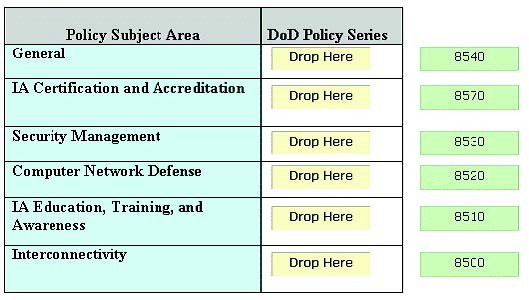
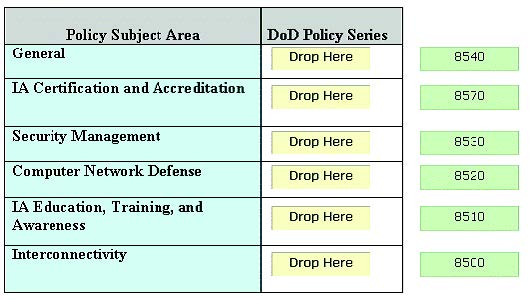
DRAG DROP

the correct DoD Policy Series at their appropriate places.

Question diagram
Show answer and explanation
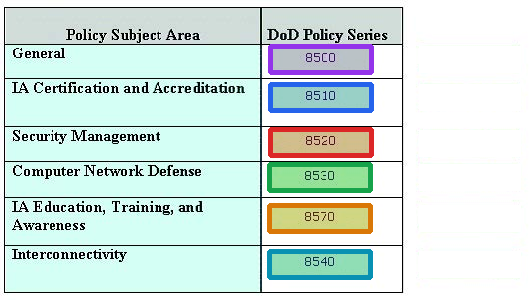
Correct answer diagram
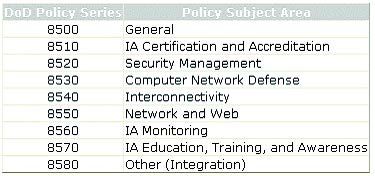
Explanation

The various DoD policy series are as follows:

Question 9 Multiple choice

Penetration tests are sometimes called white hat attacks because in a pen test, the good guys are attempting to break in.
What are the different categories of penetration testing?
Each correct answer represents a complete solution. Choose all that apply.

  1. A

    Open-box

  2. B

    Closed-box

  3. C

    Zero-knowledge test

  4. D

    Full-box

  5. E

    Full-knowledge test

  6. F

    Partial-knowledge test

Show answer and explanation

Correct answers: A, B, C, E, F

Explanation

The different categories of penetration testing are as follows: Open-box: In this category of penetration testing, testers have access to internal system code. This mode is basically suited for Unix or Linux.
Closed-box: In this category of penetration testing, testers do not have access to closed systems. This method is good for closed systems. Zero-knowledge test: In this category of penetration testing, testers have to acquire information from scratch and they are not supplied with information concerning the IT system. Partial-knowledge test: In this category of penetration testing, testers have knowledge that may be applicable to a specific type of attack and associated vulnerabilities. Full-knowledge test: In this category of penetration testing, testers have massive knowledge concerning the information system to be evaluated. Answer: D is incorrect.
There is no such category of penetration testing.

Question 10 Multiple choice

A security policy is an overall general statement produced by senior management that dictates what role security plays within the organization. Which of the following are required to be addressed in a well designed policy? Each correct answer represents a part of the solution.
Choose all that apply.

  1. A

    What is being secured?

  2. B

    Where is the vulnerability, threat, or risk?

  3. C

    Who is expected to exploit the vulnerability?

  4. D

    Who is expected to comply with the policy?

Show answer and explanation

Correct answers: A, B, D

Explanation

A security policy is an overall general statement produced by senior management (or a selected policy board or committee) that dictates what role security plays within the organization. A well designed policy addresses the following: What is being secured? - Typically an asset. Who is expected to comply with the policy? - Typically employees. Where is the vulnerability, threat, or risk? - Typically an issue of integrity or responsibility.