CS0-003 Exam Details
-
Exam Code
:CS0-003 -
Exam Name
:CompTIA Cybersecurity Analyst (CySA+) -
Certification
:CompTIA Certifications -
Vendor
:CompTIA -
Total Questions
:680 Q&As -
Last Updated
:Jul 20, 2026
CompTIA CS0-003 Online Questions & Answers
-
Question 251:
A company classifies security groups by risk level. Any group with a high-risk classification requires multiple levels of approval for member or owner changes.
Which of the following inhibitors to remediation is the company utilizing?
A. Organizational governance
B. MOU
C. SLA
D. Business process interruption -
Question 252:
A SOC analyst recommends adding a layer of defense for all endpoints that will better protect against external threats regardless of the device's operating system.
Which of the following best meets this requirement?
A. SIEM
B. CASB
C. SOAR
D. EDR -
Question 253:
When undertaking a cloud migration of multiple SaaS applications, an organization's systems administrators struggled with the complexity of extending identity and access management to cloud-based assets.
Which of the following service models would have reduced the complexity of this project?
A. OpenID
B. SASE
C. ZTNA
D. SWG -
Question 254:
An MSSP received several alerts from customer 1, which caused a missed incident response deadline for customer 2.
Which of the following best describes the document that was violated?
A. KPI
B. SLO
C. SLA
D. MOU -
Question 255:
Joe, a leading sales person at an organization, has announced on social media that he is leaving his current role to start a new company that will compete with his current employer. Joe is soliciting his current employer's customers. However, Joe has not resigned or discussed this with his current supervisor yet.
Which of the following would be the best action for the incident response team to recommend?
A. Isolate Joe's PC from the network
B. Reimage the PC based on standard operating procedures
C. Initiate a remote wipe of Joe's PC using mobile device management
D. Perform no action until HR or legal counsel advises on next steps -
Question 256:
Which of the following entities should an incident manager work with to ensure correct processes are adhered to when communicating incident reporting to the general public, as a best practice? (Select two).
A. Law enforcement
B. Governance
C. Legal
D. Manager
E. Public relations
F. Human resources -
Question 257:
An organization wants to establish a disaster recovery plan for critical applications that are hosted on premises.
Which of the following is the first step to prepare for supporting this new requirement?
A. Choose a vendor to utilize for the disaster recovery location.
B. Establish prioritization of continuity from data and business owners.
C. Negotiate vendor agreements to support disaster recovery capabilities.
D. Advise the leadership team that a geographical area for recovery must be defined. -
Question 258:
A DevOps analyst implements a webhook to trigger code vulnerability scanning for submissions to the repository.
Which of the following is the primary benefit of this enhancement?
A. To increase coverage by making the process occur automatically with uploads
B. To create a single pane of glass dashboard for the vulnerability management process
C. To include a threat feed component into the software development life cycle
D. To employ data enrichment for new code commits to enhance project documentation -
Question 259:
An analyst is reviewing an SSLscan from a web server in an environment: The analyst needs to immediately disable ciphers that do not comply with company security standards.
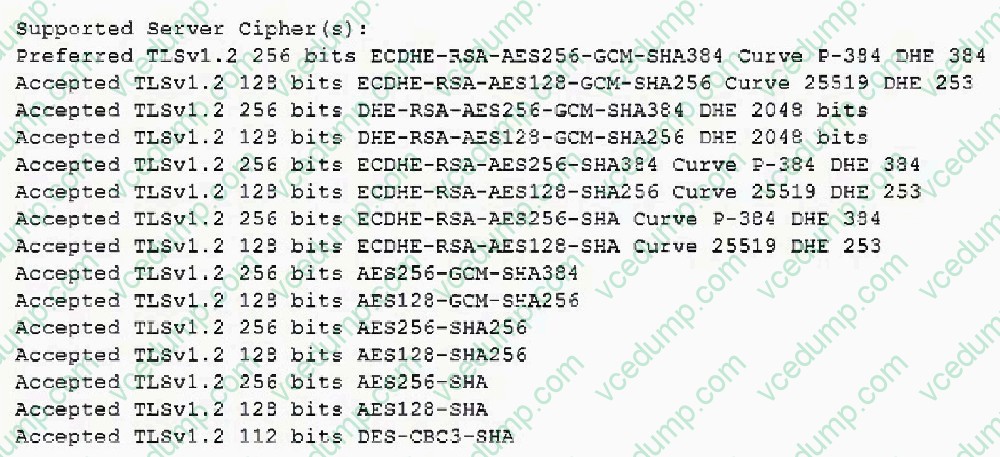
Which of the following ciphers is the least secure and should be disabled?
A. AES128-SHA
B. 128 bits DHE-RSA-AES128-GCM-SHA256 DHE 2048 bits
C. ECDHE-RSA-AES128-SHA Curve 25519 DHE 253
D. ECDHE-RSA-AES256-GCM-SHA384 Curve P-384 DHE 384
E. DES-CBC3-SHA
F. AES256-GCM-SHA384 -
Question 260:
A security analyst has found a moderate-risk item in an organization's point-of-sale application. The organization is currently in a change freeze window and has decided that the risk is not high enough to correct at this time.
Which of the following inhibitors to remediation does this scenario illustrate?
A. Service-level agreement
B. Business process interruption
C. Degrading functionality
D. Proprietary system
Related Exams:
-
220-1001
CompTIA A+ Certification: Core 1 -
220-1002
CompTIA A+ Certification: Core 2 -
220-1101
CompTIA A+ Certification: Core 1 -
220-1102
CompTIA A+ Certification: Core 2 -
220-1201
CompTIA A+ Certification: Core 1 -
220-1202
CompTIA A+ Core 2 (2026) -
220-902
CompTIA A+ Certification -
CAS-004
CompTIA Advanced Security Practitioner (CASP+) -
CAS-005
CompTIA SecurityX -
CLO-001
CompTIA Cloud Essentials+
Tips on How to Prepare for the Exams
Nowadays, the certification exams become more and more important and required by more and more enterprises when applying for a job. But how to prepare for the exam effectively? How to prepare for the exam in a short time with less efforts? How to get a ideal result and how to find the most reliable resources? Here on Vcedump.com, you will find all the answers. Vcedump.com provide not only CompTIA exam questions, answers and explanations but also complete assistance on your exam preparation and certification application. If you are confused on your CS0-003 exam preparations and CompTIA certification application, do not hesitate to visit our Vcedump.com to find your solutions here.