CFA-LEVEL-1 Exam Details
-
Exam Code
:CFA-LEVEL-1 -
Exam Name
:CFA Level I - Chartered Financial Analyst -
Certification
:CFA Institute Certifications -
Vendor
:CFA Institute -
Total Questions
:3960 Q&As -
Last Updated
:Jul 23, 2026
CFA Institute CFA-LEVEL-1 Online Questions & Answers
-
Question 1691:
How much would you pay for a 15 year bond with a semiannual coupon rate of 6%, and a par value of $15,000 if you want a 14% percent annual return on your investment? What would be the value of the coupons and principal to you?
A. The value of the bond would be $15,024. The present value of the coupons would be $10,833, and that of the principal would be $4,191.
B. The value of the bond would be $13,860. The present value of the coupons would be $11,457, and that of the principal would be $2,403.
C. The value of the bond would be $17,239. The present value of the coupons would be $14,828, and that of the principal would be $2,411.
D. Not enough information.
E. The value of the bond would be $13,140. The present value of the coupons would be $11,169, and that of the principal would be $1,971. -
Question 1692:
Which of the following best describes an income statement?
A. It reports revenues and expenses for a specific accounting period.
B. It reports the amount and composition of assets and liabilities for a specific accounting period.
C. None of these answers.
D. It reports investment activities for a specified accounting period.
E. It reports cash receipts and cash disbursements for a specific accounting period. -
Question 1693:
The Keynesian model indicates that when individuals plan to save more (and spend less), the result may be a(n)
A. increase in investment because investment always equals saving.
B. decline in the equilibrium level of income.
C. increase in the marginal propensity to consume.
D. increase in equilibrium income by some multiple of the increase in saving. -
Question 1694:
A firm's quick ratio equals 1.31 and its cash ratio equals 1.19. If the firm has receivables of 693, its current liabilities equal ________.
A. 8,129
B. 4,693
C. 5,775
D. 7,926 -
Question 1695:
If alpha = .05 for a two-tailed test, how large is the acceptance area?
A. .975
B. None of these answers
C. .950
D. .025
E. .050 -
Question 1696:
When a firm records a lease as a capital lease:
A. Its working capital increases.
B. Its current ratio decreases.
C. Its debt-to-asset ratio increases.
D. Its financial leverage ratio decreases. -
Question 1697:
A stock has an expected dividend growth rate of 3. 5%. The firm has just paid a dividend of $1.5 per share. With a required rate of return of 8%, the stock is trading at $36. 40. The stock is ________.
A. overpriced
B. underpriced
C. fairly priced
D. insufficient information -
Question 1698:
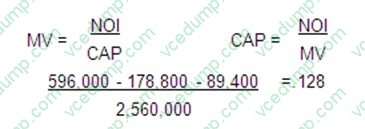
A real estate analysis estimates the market value of an income-producing property at $2,560,000. The annual gross potential rental income is $596,000, the annual property operating expanses and taxes are $178,800, and the annual vacancy and collection losses are $89,400. What capitalization rate was used by the analysis to assess the property at $2,560,000.
A. 0.128.
B. 0.1275.
C. 0.129.
D. 0.127. -
Question 1699:
The semiannually compounded rate is 6% quoted on an annualized basis. The equivalent quarterly compounded rate is:
A. 6. 12%
B. 5. 91%
C. 5. 96%
D. 5. 76% -
Question 1700:
Three banks have quoted interest rates as follows:
Bank A: 10% per year, compounded quarterly.
Bank B: 11% per year, compounded annually.
Bank C: 10.5% per year, compounded semi-annually.
Which bank should you choose to invest with for a period of one year and what's the effective annual rate?
A. Bank B, 11%
B. Bank A, 10.38%
C. Bank C, 12. 01%
D. Bank A, 11.19%
Tips on How to Prepare for the Exams
Nowadays, the certification exams become more and more important and required by more and more enterprises when applying for a job. But how to prepare for the exam effectively? How to prepare for the exam in a short time with less efforts? How to get a ideal result and how to find the most reliable resources? Here on Vcedump.com, you will find all the answers. Vcedump.com provide not only CFA Institute exam questions, answers and explanations but also complete assistance on your exam preparation and certification application. If you are confused on your CFA-LEVEL-1 exam preparations and CFA Institute certification application, do not hesitate to visit our Vcedump.com to find your solutions here.