CCRN-ADULT Exam Details
-
Exam Code
:CCRN-ADULT -
Exam Name
:CCRN (Adult) - Direct Care Eligibility Pathway -
Certification
:AACN Certifications -
Vendor
:AACN -
Total Questions
:150 Q&As -
Last Updated
:May 25, 2026
AACN CCRN-ADULT Online Questions & Answers
-
Question 71:
Which of the following are most indicative of acute pancreatitis?
A. abdominal distention, decreased lipase level, hypertension
B. Grey Turner's sign, hyperkalemia, right shoulder pain
C. hypotension, jaundice, hyperalbuminuria
D. severe mid-epigastric pain, leukocytosis, hypocalcemia -
Question 72:
The underlying pathophysiology of disseminated intravascular coagulation (DIC) is best explained as
A. depression of platelet aggregation.
B. inactivation of tissue thromboplastin.
C. depletion of clotting factors.
D. fragmentation of erythrocytes. -
Question 73:
A patient with hypertension received tPA for an acute embolic stroke with complete resolution of symptoms. Twenty-four hours after tPA administration, the nurse should anticipate an order for
A. diuretics.
B. beta blockers.
C. antiplatelet agents.
D. calcium channel blockers. -
Question 74:
A patient develops the dysrhythmia shown below:
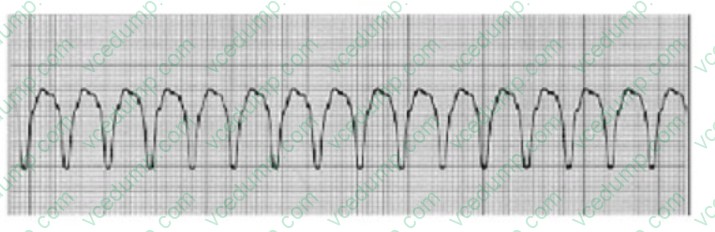
Blood pressure is 83/40. The patient is pale, diaphoretic, lethargic, and disoriented. The most appropriate treatment is
A. defibrillation at 200 J.
B. adenosine (Adenocard), 6 mg rapid IV bolus.
C. lidocaine (Xylocaine), 1.5 mg/kg IV.
D. cardioversion at 100 J. -
Question 75:
A family member asks permission to visit a patient after work at 12:30 AM. On previous visits, the family member has been disruptive. To address the situation, a nurse should
A. ask the family member to visit during scheduled visiting hours.
B. ask the family member to visit before work.
C. not allow the visit, as the patient will be sleeping.
D. allow the family member to visit after setting behavioral limits. -
Question 76:
In a patient with hypertensive crisis, neurologic changes are caused by
A. excessive secretion of catecholamines.
B. vasospasm of the cerebral arterioles.
C. hypoxemia as a result of pulmonary interstitial edema.
D. increased ICP as a result of loss of cerebral autoregulation. -
Question 77:
A nurse has responded to a rapid response call on a medical-surgical floor in the hospital. The nurse finds the patient with the following data:
BP72/30
HR132
RR24
T102.3°F (39.0°C)
SpO295%
Ph7.13
PaCO234 mm Hg
PaO288 mm Hg
HCO3 14 mEq/L
Na+ 142 mEq/L
The nurse should anticipate an order to administer which of the following?
A. 8.4% sodium bicarbonate
B. phenylephrine (Neo-Synephrine)
C. 0.9% sodium chloride
D. amiodarone (Cordarone) -
Question 78:
The spouse of a critically ill patient is indecisive, withdrawn, and tells the nurse, "I feel so helpless." Appropriate nursing interventions include
A. offering solutions to problems identified by the spouse.
B. encouraging other family members to make necessary decisions.
C. providing reassurance that visiting is not always necessary.
D. identifying and reinforcing the spouse's support systems. -
Question 79:
A patient post-surgical externalized ventricular drain placement has treatment orders that include continuous cerebrospinal fluid (CSF) drainage at 10 mm
Hg. Which of the following should the nurse anticipate with an increase in the ICP above 25 mm Hg?
A. a decrease in the pulse pressure
B. a change in CSF drainage from clear to pink
C. the amplitude of P2 greater than P1 on the waveform morphology
D. an increase in the cerebral perfusion pressure from 65 to 70 -
Question 80:
When caring for a patient with septic shock secondary to osteomyelitis, which of the following laboratory tests will best monitor response to therapy?
A. basic metabolic panel
B. complete blood count
C. erythrocyte sedimentation rate
D. blood cultures
Tips on How to Prepare for the Exams
Nowadays, the certification exams become more and more important and required by more and more enterprises when applying for a job. But how to prepare for the exam effectively? How to prepare for the exam in a short time with less efforts? How to get a ideal result and how to find the most reliable resources? Here on Vcedump.com, you will find all the answers. Vcedump.com provide not only AACN exam questions, answers and explanations but also complete assistance on your exam preparation and certification application. If you are confused on your CCRN-ADULT exam preparations and AACN certification application, do not hesitate to visit our Vcedump.com to find your solutions here.