CAS-005 Exam Details
-
Exam Code
:CAS-005 -
Exam Name
:CompTIA SecurityX -
Certification
:CompTIA Certifications -
Vendor
:CompTIA -
Total Questions
:406 Q&As -
Last Updated
:May 28, 2026
CompTIA CAS-005 Online Questions & Answers
-
Question 151:
A company is rewriting a vulnerable application and adding the mprotect() system call in multiple parts of the application's code that was being leveraged by a recent exploitation tool. Which of the following should be enabled to ensure the application can leverage the new system call against similar attacks in the future?
A. TPM
B. Secure boot
C. NX bit
D. HSM -
Question 152:
While performing threat-hunting functions, an analyst is using the Diamond Model of Intrusion Analysis. The analyst identifies the likely adversary, the infrastructure involved, and the target. Which of the following must the threat hunter document to use the model effectively?
A. Knowledge
B. Capabilities
C. Phase
D. Methodologies -
Question 153:
A security technician is trying to connect a remote site to the central office over a site-to-site VPN. The technician has verified the source and destination IP addresses are correct, but the technician is unable to get the remote site to connect. The following error message keeps repeating:
An error has occurred during Phase 1 handshake. Deleting keys and retrying...
Which of the following is most likely the reason the connection is failing?
A. The IKE hashing algorithm uses different key lengths on each VPN device.
B. The IPSec settings allow more than one cipher suite on both devices.
C. The Diffie-Hellman group on both sides matches but is a legacy group.
D. The remote VPN is attempting to connect with a protocol other than SSL/TLS. -
Question 154:
A software vendor provides routine functionality and security updates to its global customer base. The vendor would like to ensure distributed updates are authorized, originate from only the company, and have not been modified by others. Which of the following solutions best supports these objectives?
A. Envelope encryption
B. File integrity monitoring
C. Application control
D. Code signing -
Question 155:
A company's security policy states that any publicly available server must be patched within 12 hours after a patch is released. A recent llS zero-day vulnerability was discovered that affects all versions of the Windows Server OS:
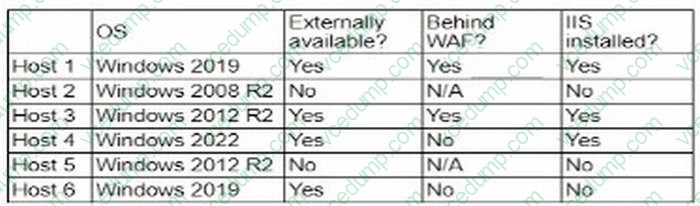
Which of the following hosts should a security analyst patch first once a patch is available?
A. 1
B. 2
C. 3
D. 4
E. 5
F. 6 -
Question 156:
A security engineer is developing a solution to meet the following requirements:
1.
All endpoints should be able to establish telemetry with a SIEM.
2.
All endpoints should be able to be integrated into the XDR platform.
3.
SOC services should be able to monitor the XDR platform.
Which of the following should the security engineer implement to meet the requirements? (Select Two.)
A. EDR
B. HIDS
C. Web application firewall
D. Central logging
E. Host-based firewall
F. TPM -
Question 157:
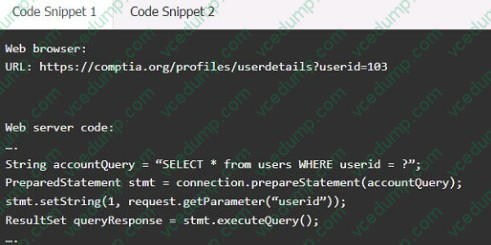
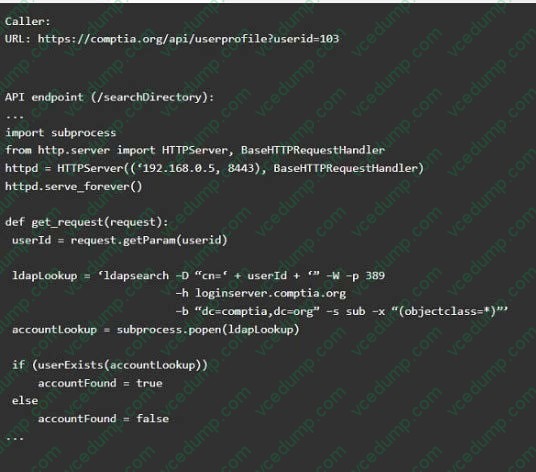
SIMULATION A product development team has submitted code snippets for review prior to release. INSTRUCTIONS Analyze the code snippets, and then select one vulnerability, and one fix for each code snippet.
Code Snippet 1
Code Snippet 2
Vulnerability 1:
1. SQL injection
2. Cross-site request forgery
3. Server-side request forgery
4. Indirect object reference
5. Cross-site scripting
Fix 1:
1. Perform input sanitization of the userid field.
2. Perform output encoding of queryResponse,
3. Ensure usex:ia belongs to logged-in user.
4. Inspect URLS and disallow arbitrary requests.
5. Implement anti-forgery tokens.
Vulnerability 2
1) Denial of service
2) Command injection
3) SQL injection
4) Authorization bypass
5) Credentials passed via GET
Fix 2
1. Implement prepared statements and bind variables.
2. Remove the serve_forever instruction.
3. Prevent the "authenticated" value from being overridden by a GET parameter.
4. HTTP POST should be used for sensitive parameters.
5. Perform input sanitization of the userid field.
A. See the complete solution below in Explanation.
B. PlaceHolder
C. PlaceHolder
D. PlaceHolder -
Question 158:
After a penetration test on the internal network, the following report was generated: Attack Target Result Compromised host ADMIN01S.CORP.LOCAL Successful Hash collected KRBTGT.CORP.LOCAL Successful Hash collected SQLSV.CORP.LOCAL Successful Pass the hash SQLSV.CORP.LOCAL Failed Domain control CORP.LOCAL Successful Which of the following should be recommended to remediate the attack?
A. Deleting SQLSV
B. Reimaging ADMIN01S
C. Rotating KRBTGT password
D. Resetting the local domain -
Question 159:
An auditor is reviewing the logs from a web application to determine the source of an incident. The web application architecture includes an internet-accessible application load balancer, a number of web servers in a private subnet, application servers, and one database server in a tiered configuration. The application load balancer cannot store the logs. The following are sample log snippets:
Web server logs:
192.168.1.10 - - [24/Oct/2020 11:24:34 +05:00] "GET /bin/bash" HTTP/1.1" 200 453 Safari/536.36
192.168.1.10 - - [24/Oct/2020 11:24:35 +05:00] "GET / HTTP/1.1" 200 453 Safari/536.36
Application server logs:
24/Oct/2020 11:24:34 +05:00 - 192.168.2.11 - request does not match a known local user. Querying DB
24/Oct/2020 11:24:35 +05:00 - 192.168.2.12 - root path. Begin processing
Database server logs:
24/Oct/2020 11:24:34 +05:00 [Warning] 'option read_buffer_size1 unassigned value 0 adjusted to 2048
24/Oct/2020 11:24:35 +05:00 [Warning] CA certificate ca.pem is self-signed.
Which of the following should the auditor recommend to ensure future incidents can be traced back to the sources?
A. Enable the X-Forwarded-For header at the load balancer.
B. Install a software-based HIDS on the application servers.
C. Install a certificate signed by a trusted CA.
D. Use stored procedures on the database server.
E. Store the value of the $_SERVER['REMOTE_ADDR'] received by the web servers. -
Question 160:
A software company deployed a new application based on its internal code repository Several customers are reporting anti-malware alerts on workstations used to test the application
Which of the following is the most likely cause of the alerts?
A. Misconfigured code commit
B. Unsecure bundled libraries
C. Invalid code signing certificate
D. Data leakage
Related Exams:
-
220-1001
CompTIA A+ Certification: Core 1 -
220-1002
CompTIA A+ Certification: Core 2 -
220-1101
CompTIA A+ Certification: Core 1 -
220-1102
CompTIA A+ Certification: Core 2 -
220-1201
CompTIA A+ Certification: Core 1 -
220-1202
CompTIA A+ Core 2 (2026) -
220-902
CompTIA A+ Certification -
CAS-004
CompTIA Advanced Security Practitioner (CASP+) -
CAS-005
CompTIA SecurityX -
CLO-001
CompTIA Cloud Essentials+
Tips on How to Prepare for the Exams
Nowadays, the certification exams become more and more important and required by more and more enterprises when applying for a job. But how to prepare for the exam effectively? How to prepare for the exam in a short time with less efforts? How to get a ideal result and how to find the most reliable resources? Here on Vcedump.com, you will find all the answers. Vcedump.com provide not only CompTIA exam questions, answers and explanations but also complete assistance on your exam preparation and certification application. If you are confused on your CAS-005 exam preparations and CompTIA certification application, do not hesitate to visit our Vcedump.com to find your solutions here.