CAS-004 Exam Details
-
Exam Code
:CAS-004 -
Exam Name
:CompTIA Advanced Security Practitioner (CASP+) -
Certification
:CompTIA Certifications -
Vendor
:CompTIA -
Total Questions
:792 Q&As -
Last Updated
:Jul 17, 2026
CompTIA CAS-004 Online Questions & Answers
-
Question 221:
Which of the following ensures that certain inbound traffic from third-party vendors is restricted from being sourced from high-risk countries?
A. Microsegmentation
B. Supply chain visibility
C. Geocoded firewall rules
D. Source code reviews -
Question 222:
A company with customers in the United States and Europe wants to ensure its content is delivered to end users with low latency. Content includes both sensitive and public information. The company's data centers are located on the West Coast of the United States. Users on the East Coast of the United States and users in Europe are experiencing slow application response. Which of the following would allow the company to improve application response quickly?
A. Installing reverse caching proxies in both data centers and implementing proxy auto scaling
B. Using HTTPS to serve sensitive content and HTTP for public content
C. Using colocation services in regions where the application response is slow
D. Implementing a CDN and forcing all traffic through the CDN -
Question 223:
Which of the following technologies would benefit the most from the use of biometric readers proximity badge entry systems, and the use of hardware security tokens to access various environments and data entry systems?
A. Deep learning
B. Machine learning
C. Nanotechnology
D. Passwordless authentication
E. Biometric impersonation -
Question 224:
Leveraging cryptographic solutions to protect data that is in use ensures the data is encrypted:
A. when it is passed across a local network.
B. in memory during processing
C. when it is written to a system's solid-state drive.
D. by an enterprise hardware security module. -
Question 225:
The CI/CD pipeline requires code to have close to zero defects and zero vulnerabilities. The current process for any code releases into production uses two-week Agile sprints. Which of the following would BEST meet the requirement?
A. An open-source automation server
B. A static code analyzer
C. Trusted open-source libraries
D. A single code repository for all developers -
Question 226:
A cybersecunty analyst receives a ticket that indicates a potential incident is occurring. There has been a large increase in log files generated by a website containing a `Contact Us' form. The analyst must determine if the increase in website traffic is due to a recent marketing campaign or if this is a potential incident.
Which of the following would BEST assist the analyst?
A. Ensuring proper input validation is configured on the `Contact Us' form
B. Deploying a WAF in front of the public website
C. Checking for new rules from the inbound network IPS vendor
D. Running the website log files through a log reduction and analysis tool -
Question 227:
A SaaS startup is maturing its DevSecOps program and wants to identify weaknesses earlier in the development process in order to reduce the average time to identify serverless application vulnerabilities and the costs associated with remediation.
The startup began its early security testing efforts with DAST to cover public-facing application components and recently implemented a bug bounty program.
Which of the following will BEST accomplish the company's objectives?
A. RASP
B. SAST
C. WAF
D. CMS -
Question 228:
A forensic investigator started the process of gathering evidence on a laptop in response to an incident. The investigator took a snapshot of the hard drive, copied relevant log files, and then performed a memory dump. Which of the following steps in the process should have occurred FIRST?
A. Preserve secure storage.
B. Clone the disk.
C. Collect the most volatile data.
D. Copy the relevant log files. -
Question 229:
Users from the marketing department (192.168.0.1/24) are reporting performance issues with an on-premises application server (192.168.0.9). The application server should only be accessed internally. A security analyst reviews various logs and finds the following information:
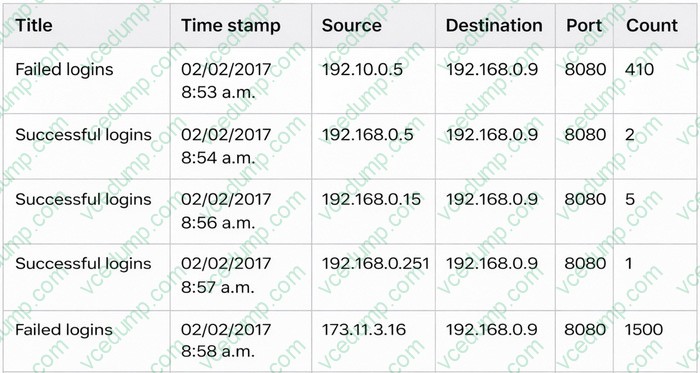
Which of the following should the security analyst perform next to improve performance and ensure the application server is secured as required?
A. Configure NGFW to deny access from subnets not in 192.168.0.0/24.
B. Modify the cloud security group rules to deny all external traffic to 192.168.0.9.
C. Update the IDS/IPS software with the latest OS/firmware to ensure all brute-force attacks are prevented.
D. Update the DLP system to include policies for data exfiltration attempts on the application server. -
Question 230:
ACSP, which wants to compete in the market, has been approaching companies in an attempt to gain business, The CSP is able to provide the same uptime as other CSPs at a markedly reduced cost. Which of the following would be the MOST significant business risk to a company that signs a contract with this CSP?
A. Resource exhaustion
B. Geographic location
C. Control plane breach
D. Vendor lock-in
Related Exams:
-
220-1001
CompTIA A+ Certification: Core 1 -
220-1002
CompTIA A+ Certification: Core 2 -
220-1101
CompTIA A+ Certification: Core 1 -
220-1102
CompTIA A+ Certification: Core 2 -
220-1201
CompTIA A+ Certification: Core 1 -
220-1202
CompTIA A+ Core 2 (2026) -
220-902
CompTIA A+ Certification -
CAS-004
CompTIA Advanced Security Practitioner (CASP+) -
CAS-005
CompTIA SecurityX -
CLO-001
CompTIA Cloud Essentials+
Tips on How to Prepare for the Exams
Nowadays, the certification exams become more and more important and required by more and more enterprises when applying for a job. But how to prepare for the exam effectively? How to prepare for the exam in a short time with less efforts? How to get a ideal result and how to find the most reliable resources? Here on Vcedump.com, you will find all the answers. Vcedump.com provide not only CompTIA exam questions, answers and explanations but also complete assistance on your exam preparation and certification application. If you are confused on your CAS-004 exam preparations and CompTIA certification application, do not hesitate to visit our Vcedump.com to find your solutions here.