CAS-004 Exam Details
-
Exam Code
:CAS-004 -
Exam Name
:CompTIA Advanced Security Practitioner (CASP+) -
Certification
:CompTIA Certifications -
Vendor
:CompTIA -
Total Questions
:792 Q&As -
Last Updated
:Jul 17, 2026
CompTIA CAS-004 Online Questions & Answers
-
Question 151:
A new VM server (Web Server C) was spun up in the cloud and added to the load balancer to an existing web application (Application A) that does not require internet access. Sales users arereporting intermittent issues with this application when processing orders that require access to the warehouse department.
Given the following information:
1. Firewall rules: Existing rules do not account for Web Server C's IP address (10.2.0.92).
2. Application A Security Group: Inbound rules and outbound rules are insufficient for the new server.
The security team wants to minimize the firewall rule set by avoiding specific host rules whenever possible.
Which of the following actions must be taken to resolve the issue and meet the security team's requirements?
A. Reconfigure Web Server C to 10.2.0.62
B. Modify the firewall rules to include the new IP address of Web Server C
C. Alter the security group outbound rules to be more restrictive
D. Change the security group inbound rules to include the new IP address of Web Server C -
Question 152:
A company processes sensitive cardholder information that is stored in an internal production database and accessed by internet-facing web servers. The company's Chief Information Security Officer (CISO) is concerned with the risks related to sensitive data exposure and wants to implement tokenization of sensitive information at the record level. The company implements a one-to-many mapping of primary credit card numbers to temporary credit card numbers.
Which of the following should the CISO consider in a tokenization system?
A. Data field watermarking
B. Field tagging
C. Single-use translation
D. Salted hashing -
Question 153:
A Chief Information Security Officer (CISO) received a call from the Chief Executive Officer (CEO) about a data breach from the SOC lead around 9:00 a.m. At 10:00 a.m. The CEO informs the CISO that a breach of the firm is being reported on national news. Upon investigation, it is determined that a network administrator has reached out to a vendor prior to the breach for information on a security patch that failed to be installed. Which of the following should the CISO do to prevent this from happening again?
A. Properly triage events based on brand imaging and ensure the CEO is on the call roster.
B. Create an effective communication plan and socialize it with all employees.
C. Send out a press release denying the breach until more information can be obtained.
D. Implement a more robust vulnerability identification process. -
Question 154:
An analyst reviews the following output collected during the execution of a web application security assessment: Which of the following attacks would be most likely to succeed, given the output?
A. NULL and unauthenticated cipher downgrade attack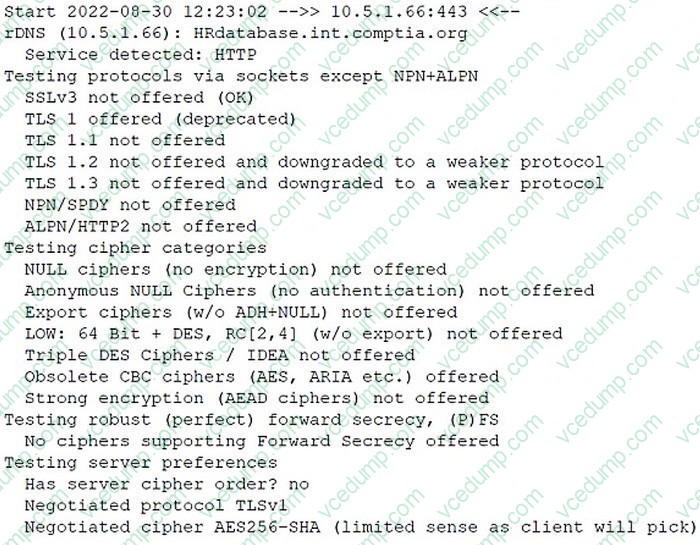
B. Availability attack from manipulation of associated authentication data
C. Padding oracle attack
D. On-path forced renegotiation to insecure ciphers -
Question 155:
An analyst needs to evaluate all images and documents that are publicly shared on a website.
Which of the following would be the best tool to evaluate the metadata of these files?
A. OllyDbg
B. ExifTool
C. Volatility
D. Ghidra -
Question 156:
During the development process, the team identifies major components that need to be rewritten. As a result, the company hires a security consultant to help address major process issues. Which of the following should the consultant recommend to best prevent these issues from reoccurring in the future?
A. Implementing a static analysis tool within the CI/CD system
B. Configuring a dynamic application security testing tool
C. Performing software composition analysis on all third-party components
D. Utilizing a risk-based threat modeling approach on new projects
E. Setting up an interactive application security testing tool -
Question 157:
The Chief Information Security Officer (CISO) asked a security manager to set up a system that sends an alert whenever a mobile device enters a sensitive area of the company's data center. The CISO would also like to be able to alert the individual who is entering the area that the access was logged and monitored. Which of the following would meet these requirements?
A. Near-field communication
B. Short Message Service
C. Geofencing
D. Bluetooth -
Question 158:
A security analyst wants to keep track of alt outbound web connections from workstations. The analyst's company uses an on-premises web filtering solution that forwards the outbound traffic to a perimeter firewall. When the security analyst gets the connection events from the firewall, the source IP of the outbound web traffic is the translated IP of the web filtering solution. Considering this scenario involving source NAT. Which of the following would be the BEST option to inject in the HTTP header to include the real source IP from workstations?
A. X-Forwarded-Proto
B. X-Forwarded-For
C. Cache-Control
D. Strict-Transport-Security
E. Content-Security-Policy -
Question 159:
A security administrator needs to recommend an encryption protocol after a legacy stream cipher was deprecated when a security flaw was discovered. The legacy cipher excelled at maintaining strong cryptographic security and provided great performance for a streaming video service. Which of the following AES modes should the security administrator recommend given these requirements?
A. CTR
B. ECB
C. OF8
D. GCM -
Question 160:
A security analyst is examining a former employee's laptop for suspected evidence of suspicious activity. The analyst uses dd during the investigation.
Which of the following best explains why the analyst is using this tool?
A. To capture an image of the hard drive
B. To reverse engineer binary programs
C. To recover deleted logs from the laptop
D. To deduplicate unnecessary data from the hard drive
Related Exams:
-
220-1001
CompTIA A+ Certification: Core 1 -
220-1002
CompTIA A+ Certification: Core 2 -
220-1101
CompTIA A+ Certification: Core 1 -
220-1102
CompTIA A+ Certification: Core 2 -
220-1201
CompTIA A+ Certification: Core 1 -
220-1202
CompTIA A+ Core 2 (2026) -
220-902
CompTIA A+ Certification -
CAS-004
CompTIA Advanced Security Practitioner (CASP+) -
CAS-005
CompTIA SecurityX -
CLO-001
CompTIA Cloud Essentials+
Tips on How to Prepare for the Exams
Nowadays, the certification exams become more and more important and required by more and more enterprises when applying for a job. But how to prepare for the exam effectively? How to prepare for the exam in a short time with less efforts? How to get a ideal result and how to find the most reliable resources? Here on Vcedump.com, you will find all the answers. Vcedump.com provide not only CompTIA exam questions, answers and explanations but also complete assistance on your exam preparation and certification application. If you are confused on your CAS-004 exam preparations and CompTIA certification application, do not hesitate to visit our Vcedump.com to find your solutions here.