CAMS-FCI Exam Details
-
Exam Code
:CAMS-FCI -
Exam Name
:Advanced CAMS-Financial Crimes Investigations -
Certification
:ACAMS Certifications -
Vendor
:ACAMS -
Total Questions
:101 Q&As -
Last Updated
:May 26, 2026
ACAMS CAMS-FCI Online Questions & Answers
-
Question 91:
SAR/STR NARRATIVE
A SAR/STR has been submitted on five transactions conducted on the correspondent banking relationship with ABC Bank.
Client Information:
Remitter information: DEF Oil Resource Ltd. is the oldest member of the DEF Group. It was founded in 1977 as a general trading business with a primary focus on exports from Africa and North America. The group has business activities that span the entire energy value chain. Their core field of endeavor is centered within the oil and gas industry and its associated sub-sectors.
Beneficiary Information:
As per the response received from ABC Bank, it was determined that the beneficiaries are related to DEF Oil Resource Ltd. These were created by DEF Oil Resource Ltd. to purchase property in a foreign country on behalf of their senior management as part of a bonus scheme. The purpose behind this payment was for the purchase of property in another country.
Payment Reference:
ABCXXXXX31PZFG2H
ABCXXXXXX51PQGEH
ABCXXXXXX214QWVG
ABCXXXXXX41PSXA2
ABCXXXXXX815QWS3
Concerns:
1.
We are unsure about the country of incorporation of the beneficiaries.
2.
We are concerned about the transactional activity since the payment made towards entities (conducted on behalf of individuals) appears to be possible tax evasion.
3.
There appears to be an attempt to conceal the identity of individuals (senior management), which again raises concerns about the source of funds.
4.
Referring to the response received from ABC Bank, we are unclear about the ultimate beneficiary of funds.
5.
The remitter is involved in a high-risk business, (i.e., oil and crude products trading), and the beneficiary is involved in real estate business which again poses a higher risk.
When drafting the SAR/STR narrative, the investigator notes several payment references. What additional information should the investigator include in the narrative?
A. The investigator's concerns based on their subjective opinion
B. The suspicious accounts and transactions identified
C. All relevant tables, spreadsheets, and other supporting documentation
D. Personal tax records pertinent to the owners to indicate tax evasion -
Question 92:
A U.S. financial institution (Fl) receives a grand jury subpoena for a corporate client's account. The Fl should:
A. request the client's consent for the disclosure of account information.
B. review the corporate account's activity and transactions.
C. file a SAR/STR.
D. provide the client with a copy of the subpoena. -
Question 93:
In a review of the account activity associated with Nadine Kien, an investigator observes a large number of small- to medium-size deposits from numerous individuals from several different global regions. The money is then transferred to a numbered company. Which is the next best course of action for the investigator?
A. Complete the monthly review and note the activity for next month's review.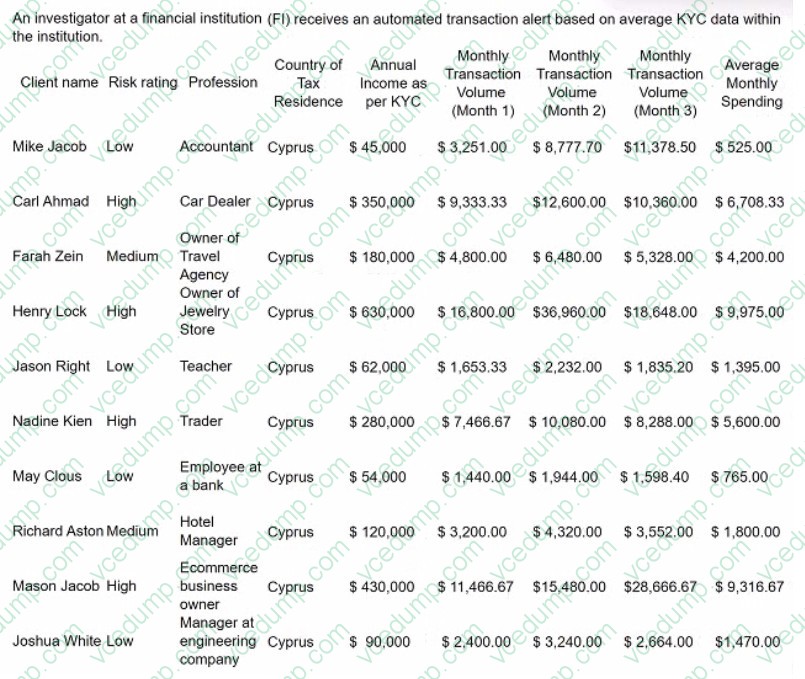
B. File a SAR/STR on the account activity in relation to a potential funnel account.
C. Recommend the account for exit due to frequent global transactions.
D. No further action is required as the customer is already rated at high-risk and the monthly spending is within expectations. -
Question 94:
How does the Financial Action Task Force (FATF) measure the effectiveness of a country's efforts to combat money laundering and terrorist financing?
A. Mutual evaluation
B. FATF Evaluation Committee
C. Basel Committee
D. Series of internal audits followed by reporting to FATF -
Question 95:
Law enforcement (LE) suspects human trafficking to occur during a major sporting event. LE officers asked several financial institutions (FIs) to monitor financial transactions occurring before, during, and after the event.
An investigator identified a pattern linked to a business. The business' account received multiple even dollar deposits between midnight and 4:00 AM. They occurred each day for several days prior to the date of the sporting event. Also, large
cash deposits, typically between 2,000 USD and 3,000 USD. made by a person to the business' account occurred in many branches in the days after the sports event.
There was little information about the company. The company did not have any history of employee payroll expenses or paying taxes. Expenses from the business account included air travel and hotel expenses. Searches about the person
making cash deposits showed little. An online social media platform webpage with the individual's name showed ads for dates" and "companionship."
The Fl receives a keep open' letter from LE for the identified account and agrees to keep the account open. What is the Fl required to do?
A. Contact the client for information relating to the account.
B. Stop filing SAR/STR reports on the account and/or customer.
C. Ensure that the request includes an end date.
D. Notify LE immediately after new transactions. -
Question 96:
The intended benefits of section 314(b) of the USA PATRIOT Act include: (Select Three.)
A. sharing the existence and content of SARs/STRs with other participating FIs.
B. participating FIs sharing information about suspicious activity by customers that may have otherwise gone unnoticed.
C. providing mandatory results to law enforcement agencies so that they can more easily obtain useful information.
D. expediting the filing of SARs/STRs due to the information sharing facilitated by 314(b).
E. detecting money laundering and TF approaches and schemes across multiple financial institutions (FIs).
F. obtaining additional information on customers or transactions regarding potential money laundering or terrorist financing (TF). -
Question 97:
A financial institution (Fl) has considered the available relevant factors in a transaction and has determined it will file a SAR^STR. Which is needed to support the contents of the report to the financial intelligence unit?
A. Definitive proof that suspicious activity occurred
B. Enough circumstantial evidence about the suspicious activity for a criminal proceeding
C. No factual description of the suspicious activity
D. Low evidentiary threshold about the suspicious activity -
Question 98:
As part of an internal fraud investigation, an AML officer has decided to interview an employee. Which statement is most consistent with best practices?
A. Information on the employee can be gathered from coworkers and supervisors before the employee is interviewed.
B. Prior to the interview, the investigator should inform the employee about the allegations.
C. The employee should be supplied with all information about any ongoing fraud investigations.
D. The employee should be notified that failing to cooperate can lead to loss of employment. -
Question 99:
Which payment method for purchasing luxury items is a red flag for potential money laundering?
A. Personal loan
B. Cash
C. Wire transfer
D. Credit card -
Question 100:
SAR/STR NARRATIVE
A SAR/STR has been submitted on five transactions conducted on the correspondent banking relationship with ABC Bank.
Client Information:
Remitter information: DEF Oil Resource Ltd. is the oldest member of the DEF Group. It was founded in 1977 as a general trading business with a primary focus on exports from Africa and North America. The group has business activities that
span the entire energy value chain. Their core field of endeavor is centered within the oil and gas industry and its associated sub-sectors.
Beneficiary Information:
As per the response received from ABC Bank, it was determined that the beneficiaries are related to DEF Oil Resource Ltd. These were created by DEF Oil Resource Ltd. to purchase property in a foreign country on behalf of their senior
management as part of a bonus scheme. The purpose behind this payment was for purchase of property in another country.
Payment Reference:
ABCXXXXX31PZFG2H
ABCXXXXXX51PQGEH
ABCXXXXXX214QWVG
ABCXXXXXX41PSXA2
ABCXXXXXX815QWS3
Concerns:
1.
We are unsure about the country of incorporation of the beneficiaries.
2.
We are concerned about the transactional activity since the payment made towards entities (conducted on behalf of individuals) appears to be possible tax evasion.
3.
There appears to be an attempt to conceal the identity of individuals (senior management), which again raises concerns about the source of funds.
4.
Referring to the response received from ABC Bank, we are unclear about the ultimate beneficiary of funds.
5.
The remitter is involved in a high-risk business, (i.e., oil and crude products trading), and the beneficiary is involved in a real estate business which again poses a higher risk.
The monitoring system of the correspondent institution flags the transaction as suspicious activity. The correspondent bank needs to send a request for information to the respondent bank. Which elements should be included in the request? (Select Three.)
A. Details of DEF Oil Resource Ltd parent company and the name(s) of the beneficial owner(s)
B. Full transaction history of the correspondent bank's customer
C. The account profile of the customer and their KYC data
D. The respondent bank's customer's senior management bonus plan
E. The contract pertaining to the purchase of property in another country
F. The last 6 months of transactional history
Related Exams:
-
ACAMS-CGSS
Certified Global Sanctions Specialist (ACAMS CGSS) -
ADVANCED-CAMS-AUDIT
Advanced CAMS-Audit Certification -
CAMS
Certified Anti-Money Laundering Specialist (the 6th edition) -
CAMS-FCI
Advanced CAMS-Financial Crimes Investigations -
CCACS
Certified Cryptoasset Anti-Financial Crime Specialist -
CKYCA
Certified Know Your Customer Associate
Tips on How to Prepare for the Exams
Nowadays, the certification exams become more and more important and required by more and more enterprises when applying for a job. But how to prepare for the exam effectively? How to prepare for the exam in a short time with less efforts? How to get a ideal result and how to find the most reliable resources? Here on Vcedump.com, you will find all the answers. Vcedump.com provide not only ACAMS exam questions, answers and explanations but also complete assistance on your exam preparation and certification application. If you are confused on your CAMS-FCI exam preparations and ACAMS certification application, do not hesitate to visit our Vcedump.com to find your solutions here.