C2090-645 Exam Details

  • Exam Code
    :C2090-645
  • Exam Name
    :IBM Cognos 10 BI Multidimensional Author
  • Certification
    :IBM Certifications
  • Vendor
    :IBM
  • Total Questions
    :56 Q&As
  • Last Updated
    :Jan 12, 2026

IBM C2090-645 Online Questions & Answers

  • Question 1:

    The following expression is used in a crosstab report: filter([sales_and_marketing]. [Product brand].[Product brand].[Product brand type],[Revenue]<100000000). There are 26 product brand types in the OLAP data source.

    Why does the report only return 11 product brand type rows?

    A. A relational function was used to filter on the measure values, not the members.
    B. A dimensional functionwas used to filter on each column.
    C. A relational function was used to filter on the members, not the measure values.
    D. A dimensional function was used to filter on the total of the opposite edge.

  • Question 2:

    A report runs, and is 433pages long, with 19,010 rows. Many of the rows are blank. The report author uses a filter function to filter nulls, and runs the report again. The result is 143 pages, with 6273 rows, and none of the rows are blank. What filtering style did the report author decide to use?

    A. Conventional
    B. Dimensional
    C. Relational
    D. Functional

  • Question 3:

    To display all individual campaigns in a crosstabreport, a report author could use the expression set([TrailChef Campaign],[EverGlow Campaign],[Course Pro Campaign]). Instead, the report author decides to use the parent member of the campaigns in the set expression "children([All Campaigns])".

    Which statement is true about the method that was used?

    A. In the future, when a campaign is deleted or new ones are added, the report author must modify the expression.
    B. In the future, when a campaign is deleted or new ones are added, the unmodified expression will be valid.
    C. The report author should not have used the method chosen, as the first method is best in this situation.
    D. To be accurate, the report author should avoid using a set expression.

  • Question 4:

    A report author creates a revenue report from an OLAP data source. On the rows, there are nested levels, each from different dimensions having a large number of members. The report author filters out empty rows using the expression "[Revenue] > 0".

    When running this report, there is poor performance. What could cause this?

    A. There are too many members or levels nested on the rowedge.
    B. Filtering on measure values is incompatible with an OLAP data source.
    C. Limiting the crosstab measures with a filter function.
    D. A relational filter was applied.

  • Question 5:

    Which of the following statements is true about a slicer?

    A. It keeps the summary column in the report, and removes the detail columns.
    B. It affects the values of the cells of the report but not the rows or columns.
    C. It determines which set of members are displayed onthe edges of the report.
    D. It removes all blank rows in the report to make it more focused.

  • Question 6:

    The report author wants tocreate a report to compare the sales of product types for special sales promotions in 2005 and 2006, but the report will exclude regular sales. Which style of authoring and which function will the report author use to create this report from a cube data source?

    A. Relational authoring style, except function
    B. Dimensional authoring style, filter function
    C. Dimensional authoring style, except function
    D. Relational authoring style, filter function

  • Question 7:

    Which of the following is true if a report author nests members in a crosstab report?

    A. Nested members are also known as complex members.
    B. The inner membermust be on the level immediately below the outer member.
    C. Nested members must be members of hierarchies, not of the Measures folder.
    D. It is possible to nest members from different dimensions.

  • Question 8:

    A report author creates the following nestedreport using 2 adjacent levels of the same hierachy. Users should be able to drill down on the inner nesting with the outer nesting remaining unchanged.
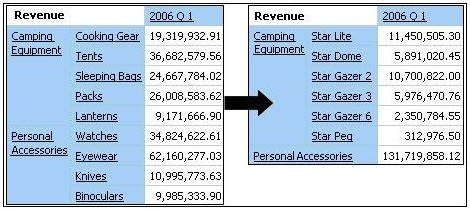
    What advanced drilling behavior should the report author use to achieve this?

    A. Replace Expression
    B. Depth Based Expression
    C. Preserve
    D. Replace Item

  • Question 9:

    Why would a report author consider overriding the default drill behavior?

    A. To maintain the behavior of a complex edge expression after drilling, such as one which returns the top 5 members of a set.
    B. To replace all members within a hierarchy when drilling through to a report with more detail.
    C. To drill down to the lowest level of the hierarchy and then drill down again to display only one member.
    D. To drill down on a member and have its children display as details and have the member drilled on display as summary.

  • Question 10:

    Which of the following statements is true about explicitly defined member sets?

    A. They must have drill behavior defined manually.
    B. They assume the drill behavior from the top member setin the same branch.
    C. They are automatically configured for default drill behavior.
    D. They are too complex to enable drilling.

Tips on How to Prepare for the Exams

Nowadays, the certification exams become more and more important and required by more and more enterprises when applying for a job. But how to prepare for the exam effectively? How to prepare for the exam in a short time with less efforts? How to get a ideal result and how to find the most reliable resources? Here on Vcedump.com, you will find all the answers. Vcedump.com provide not only IBM exam questions, answers and explanations but also complete assistance on your exam preparation and certification application. If you are confused on your C2090-645 exam preparations and IBM certification application, do not hesitate to visit our Vcedump.com to find your solutions here.