
C2090-623 Real Exam Questions

IBM Cognos Analytics Administrator V11

60 questions available · Page 1 of 6

Updated Exam DumpsVerified AnswersPass Guarantee

Get Complete Exam Dumps
Question 1 Single choice

An environment is configured to use Compatible Query Mode (CQM).

Which statement is true about request flow?

  1. A

    OLAP, DMR and Relational components reside in the same Adapters layer.

  2. B

    OLAP, UDA and DMR components reside in the same Query Execution layer.

  3. C

    OLAP, Relational and DMR components reside in the same Query Planning layer.

  4. D

    OLAP, DMR and Relational components reside in the same Query Execution layer.

Show answer and explanation

Correct answer: C

Explanation

OLAP style queries, like those against SAP BW, Oracle Essbase and IBM Cubing Services type data sources, will go to the OLAP query planner.
References:
The IBM Cognos 10 Dynamic Query Cookbook (2010), page 7
Question 2 Single choice

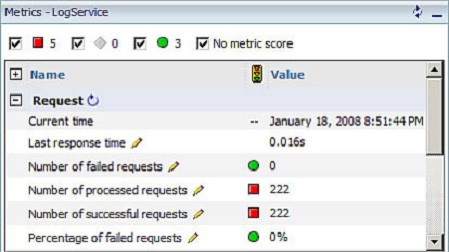
To monitor performance, an administrator has set thresholds on a system metric and notices that over time, the metric score has changed from green, to yellow, to red, and then back to yellow.

Which system metric is the administrator monitoring?

  1. A

    Dispatcher: JVM: Current heap size

  2. B

    ContentManageService: Request: Number of failed requests

  3. C

    ReportService: Process: Number of processes high watermark

  4. D

    BatchReportService: Request: Percentage of successful requests

Show answer and explanation

Correct answer: B

Explanation

Figure: A detailed view showing the status of individual system metrics for a service

References:
https://www.ibm.com/developerworks/data/library/cognos/infrastructure/cognos_specific/
page589.html

Question 3 Single choice

An administrator is implementing security by modifying access to the secured functions and secured features.

Which statement is true?

  1. A

    A hyperlink on the Capabilities page represents a secures function that contains secured features.

  2. B

    Granting execute permission on a secured function automatically grants execute permission to all secured features.

  3. C

    As part of the initial security implementation, an administrator must grant access to secured functions

    and features to the predefined roles.

  4. D

    To view a list of the second functions and features available to them, a user must contact their administrator because only the administrator can perform this function.

Show answer and explanation

Correct answer: B

Explanation

You set access to the secured functions and features by granting execute permissions for them to specified namespaces, users, groups, or roles.

Incorrect Answers:
C: When a content store is initialized, the initial permissions for the secured functions and features are created. The permissions define which of the predefined and built-in Cognos groups and roles have access to which secured functions and features, and the type of access. The initial permissions grant unrestricted access to IBM Cognos software because the built-in role System Administrators includes the group Everyone in its membership.

References:
IBM Cognos Administration Version 10.1.0, Administration and Security Guide

Question 4 Single choice

An administrator would like to log the activity for a single user.

Which action is required?

  1. A

    Set the Report service logging to Trace.

  2. B

    Modify the ipfcogconfig.xml file in the bin64 directory.

  3. C

    Use the Remote Process service for Java Management Extensions (JMX).

  4. D

    Set the advanced parameter RSVP.REPORTUSER.LOG for the Report service.

Show answer and explanation

Correct answer: C

Explanation

You can use logs to diagnose a problem that is occurring for one or more specific users.
You enable and disable logging for specific users by using the Remote Process service for Java Management Extensions (JMX), a technology that supplies tools to manage and monitor applications and service-oriented networks. You connect to the JMX Remote Process service using the jconsole executable that is provided with the Java JDK.
References:
https://www.ibm.com/support/knowledgecenter/en/SSEP7J_11.0.0/com.ibm.swg.ba.cognos.ug_cra.doc/t_disableipfuser.html

Question 5 Single choice

An administrator created a Content Store export and included the user account information.

How can a listing of the content be exported?

  1. A

    Within the export, ensure the Recording level option is set to Trace.

  2. B

    By default when the Content Store is backed up, a full detailed listing is generated and available in the Logs folder.

  3. C

    Modify the Advanced settings on the ContentManagerService by adding the parameter CM.DeploymentDetailEntireContent with a value of true.

  4. D

    Modify the Advanced settings on the ContentManagerService by adding the parameter CM.DeploymentIncludeConfiguration with a value of true.

Show answer and explanation

Correct answer: D

Explanation

You can specify if configuration objects and their children are included as part of deployment. By default, they are not included.
You can change the default setting using the advanced setting
CM.DEPLOYMENTINCLUDECONFIGURATION.
By default, it is set to False (do not include configuration objects in deployments).
To change the default to include configuration objects and their children, set it to True.

Incorrect Answers:
C: The CM.DeploymentDetailEntireContent setting affects deployment history. By default, the information saved in deployment records includes the progress and summary reports only. If you want to include more detailed information, change the recording level using the advanced setting
CM.DEPLOYMENTDETAILENTIRECONTENT.

References:
IBM Cognos Administration Version 10.1.0, Administration and Security Guide, page 384

Question 6 Single choice

Why would an administrator use IPF (Indication Processing Facility) logging?

  1. A

    As a wrapper tool for gateway related errors.

  2. B

    To process the audit logging data and write it to the audit database.

  3. C

    As a wrapper for log4j to configure what information is written to log files.

  4. D

    For tracing performance and communication between XQE and the BIBus.

Show answer and explanation

Correct answer: C

Explanation

Some error messages may contain sensitive information, such as server names. By default, error message details in IBM Cognos software are routed to IPF log files, and the secure error message option is enabled.
The information presented to users indicates only the occurrence of an error, without any details.

References:
https://www.ibm.com/support/knowledgecenter/en/SSEP7J_11.0.0/com.ibm.swg.ba.cognos.ug_cra.doc/c_cafloggingandmonitoring.html

Question 7 Single choice

A CQM report successfully runs in another environment but fails in IBM Cognos Analytics. Environments are identical except for the versions.

How could the issue be identified?

  1. A

    Perform a UDA trace.

  2. B

    Modify the ipfserverconfig.xml.

  3. C

    Increase the logging level of the Query service.

  4. D

    Restart the IBM Cognos Analytics service to eliminate all remaining BIBus processes.

Show answer and explanation

Correct answer: B

Explanation

The method for performing a UDA trace is different in Cognos 10 to previous versions due to the removal of the Cognos Logging Console Program. This is specific to CQM datasources.

Please follow these steps:
1. Navigate to <cognos location>/configuration 2. Rename ipfUDAclientconfig.xml.sample it to ipfclientconfig.xml
3. Wait 30 seconds 4. Now run any reports that you wish to use the trace on.
5. After running the reports the trace will generate a file named "UDA_Trace.log" within <cognos location>/ logs. The log name and location can be changed by the user by editing the ipfclientconfig.xml file.
6. Rename ipfclientconfig.xml to ipfUDAclientconfig.xml.sample to turn off the tracing.

This trace records all database activity so should be turned off as soon as the possible.

References:
http://www-01.ibm.com/support/docview.wss?uid=swg21620597

Question 8 Single choice

An administrator must troubleshoot query execution related issues in a DQM executed report.

How is this achieved?

  1. A

    By default, settings to trace DQM Query execution are enabled in the system.

  2. B

    Open IBM Cognos Configuration, under IBM Cognos Services/IBM Cognos, select QueryService and check Enable Query execution trace and view logs in /logs/XQE.

  3. C

    Open IBM Cognos Administration portal, on the Configuration tab, select Dispatchers and locate QueryService and check Enable Query execution trace and view logs in /logs/XQE.

  4. D

    Edit the install_location/configuration/qfs_config.xml.sample file and set <parameter
    name="EnableQueryTrace" value="true">, save as qfs_config.xml, restart services.

Show answer and explanation

Correct answer: C

Explanation

A query execution trace (run tree trace) shows queries that run against a data source. You use the trace to
troubleshoot query-related issues.
You can find execution trace logs in the following location:
c10_location/logs/XQE/reportName/runtreeLog.xml.

References:
https://www.ibm.com/support/knowledgecenter/en/SSEP7J_10.2.0/com.ibm.swg.ba.cognos.ug_cog_rlp.10.2.0.doc/t_configsettings.html

Question 9 Single choice

An administrator is evaluating system status using the Scorecard pane on the Status > System page in the
IBM Cognos Administration console.

Which statement is true?

  1. A

    If a service is disabled in IBM Cognos Configuration, it is listed in the Scorecard pane.

  2. B

    The status that is displayed for each entry reflects the lowest status for all child entries.

  3. C

    A status of Available is displayed when at least 80% of the child entries have a status of Available.

  4. D

    A status of Unavailable is displayed when at least 80% of the child entries have a status of Unavailable.

Show answer and explanation

Correct answer: B

Explanation

The metric score for each entry is based on the performance of individual child entries. The status that is displayed for each entry is the lowest status of the child entries. For example, if all the metrics for a dispatcher are good, but one service on that dispatcher has a poor metric, the metric score shown for the dispatcher is poor.

Status is one of the following: Available if all components are available Partially available if at least one component is available and at least one component is unavailable or partially unavailable.
Unavailable if all components are unavailable

References:
https://www.ibm.com/support/knowledgecenter/SSEP7J_11.0.0/com.ibm.swg.ba.cognos.ug_cra.doc/c_panes_system_status_page.html

Question 10 Single choice

Where can a report or dashboard be saved?

  1. A

    folder, package, My content

  2. B

    data module, package, folder

  3. C

    hidden folder, My content, data module

  4. D

    Top Level of Team content, folder, package

Show answer and explanation

Correct answer: A

Explanation

While you are working on your custom dashboard, save it locally in the My content folder. When you finish creating your dashboard, you can make it available to users with the WCM Report User role by copying it to your custom dashboard folder in Team Content.
When you finish creating your dashboard, you can make it available to users with the WCM Report User role by copying it to your custom dashboard folder in Team Content.

References:
https://www.ibm.com/support/knowledgecenter/en/SSRMV7/com.ibm.iwcm.doc/care/
t_reporting_create_dashboards.html