
C2070-587 Real Exam Questions

IBM FileNet P8 V5.1

126 questions available · Page 1 of 13

Updated Exam DumpsVerified AnswersPass Guarantee

Get Complete Exam Dumps
Question 1 Single choice

A customer is trying to create an object store using a database storage area. When attempting to create an

object store, the following error occurs in IBM FileNet Enterprise Manager.
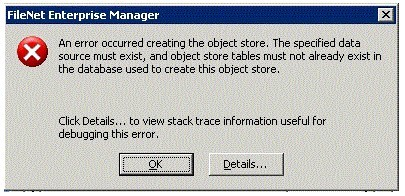
How would the customer overcome this error to create the object store?

  1. A

    Create a new database.Use the database name as the Object Store Data Source name in the Create Object Store wizard.

  2. B

    Create a new database.Create a new Object Store Data Source using FileNet Configuration Manager.Use this new Object Store Data Source name in the Create Object store wizard

  3. C

    Create a new database.Set an application server variable to map the datasource name.Use this application server variable as the Object Store Data Source name in the Create Object store wizard.

  4. D

    Drop the database pointed by the Object Store datasource used in the Create Object store wizard.Create a new Object Store Data Source using FileNet Configuration Manager.Use this new Object Store Data Source name in the Create Object store wizard.

Show answer and explanation

Correct answer: B
Question 2 Single choice

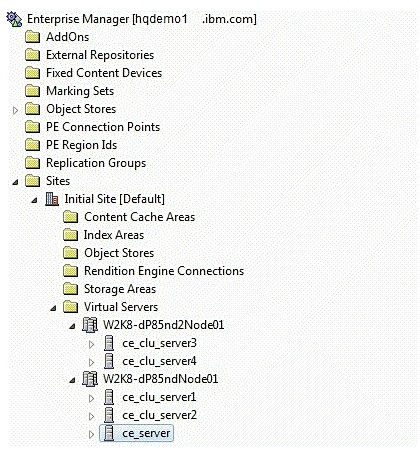
A P8 Administrator from a company needs to turn on IBM FileNet Content Engine tracing for the following servers: ce_clu_server3, ce_clu_server1. Please refer to the screenshot for more information.

What level of tracing should be configured to generated the desired logs?

  1. A

    Domain level.

  2. B

    Site level such as Initial Site.

  3. C

    Individual server level such as ce_clu_server3 and ce_clu_server1.

  4. D

    Virtual servers level such as W2K8-dP8nd2Node1 and W2K8-dP85ndNode01.

Show answer and explanation

Correct answer: C

Question 3 Single choice

A client is planning to deploy their IBM FileNet Content Engine on a 32-bit JVM.

What is the maximum recommended number of object stores allowed?

  1. A

    60

  2. B

    64

  3. C

    75

  4. D

    128

Show answer and explanation

Correct answer: C

Question 4 Single choice

An IBM client is planning the implementation of a IBM FileNet P8 Platform and needs to identify the solution components.

What are the IBM FileNet P8 V5.1 core components?

  1. A

    Content Engine, Process Engine, and Application Engine

  2. B

    Image Manager, Process Engine, Application Engine, Workplace XT and Rendition Engine

  3. C

    Content Engine, Process Engine, Application Engine, Workplace XT, and Rendition Engine

  4. D

    Content Engine, Process Engine, Application Engine, Workplace XT and Enterprise Records

Show answer and explanation

Correct answer: C

Question 5 Single choice

A customer is designing a highly available IBM FileNet P8 system with both horizontally and vertically scaled implementations of Content Engine and Workplace XT. The customer desires to use a hardware load balancer in front of a series of HTTP proxy servers to spread all HTTP/HTTPS traffic. Additionally, a hardware load balancer will be used to spread traffic across multiple Process Engine servers. The hardware load balancer chosen in this configuration is configured to use a dynamic DNS server.

What must be configured in order to facilitate proper high availability functionality of the P8 environment?

  1. A

    Session Affinity must be configured for the Process Engine servers.

  2. B

    The Content Engine EJB ports must be configured in the load balancer.

  3. C

    Time-To-Live (TTL) settings in the application server cluster must be configured.

  4. D

    FileNet Enterprise Manager must be configured to connect via the load balancer.

Show answer and explanation

Correct answer: C

Question 6 Single choice

A solution developer wants to copy the initial deployment of a IBM FileNet P8 application from a development environment to a different destination environment.

Which configuration file is used by Workplace XT to determine what Java Server Pages, servlets, or custom applications are used when a user attempts to view content from inside Workplace XT?

  1. A

    Actions.xml

  2. B

    ServerConfig.xml

  3. C

    content_redir.properties

  4. D

    WcmApiConfig.properties

Show answer and explanation

Correct answer: C

Question 7 Single choice

A customer is building multiple stand-alone development servers with IBM FileNet P8 V5.1, but is concerned with the amount of time required to perform all the prerequisites and configuration for each server. They are seeking input from the consultant to reduce the workload implementing this requirement.

What would be the best recommendation?

  1. A

    Install the core engines and all middleware on each server using the Composite Platform Installation Tool.

  2. B

    Help them complete the Installation and Upgrade Worksheet for the first server, and install the core engines and all middleware usinginformation in the worksheet to configure the Composite Platform Installation Tool. Copy the installed directories to the remaining servers.

  3. C

    Help them complete the Installation and Upgrade Worksheet for the first server, install the core engines using the information in the worksheetand the silent install scripts on the first server. Copy the software directories to the others servers and install using the silent install scripts.

  4. D

    Help them complete the Installation and Upgrade Worksheet for the first server, install the core engines using the information in the worksheetand the standard installation. Then, copy the worksheet and replace the server names for the remaining servers and perform the installationon each server.

Show answer and explanation

Correct answer: A

Question 8 Single choice

An IBM FileNet P8 client user is receiving authentication errors while attempting to logon to Workplace XT.
The network administrator has determined that the clock on the client machine is not in sync with the application server.

What steps must be taken to remedy this problem?

  1. A

    Sync the clock on the Content Engine and Process Engine.

  2. B

    Sync the clock on the Process Engine and Application Engine.

  3. C

    Sync the clock on the Application Engine server with all client machines.

  4. D

    Sync the clock on Workplace XT, Process Engine and Content Engine.

Show answer and explanation

Correct answer: D

Question 9 Multiple choice

A customer wants to upgrade a distributed IBM FileNet P8 V3.5 installation on Microsoft Windows consisting of 2 Application Engines (AE), a Microsoft Windows 2-node cluster Content Engine (CE), and a single Process Engine (PE). The RDBMS for CE and PE is a remote dedicated Microsoft SQL 2005 server.

What two best practices should be considered when migrating to new UNIX servers as part of an upgrade?

  1. A

    When migrating the file store devices, you must copy the storage directories and files to the new UNIX server before the upgrade.

  2. B

    The Content Engine Web Upgrade Tool requires a NFS mount to the Content Engine V3.5 file system where the sysinit.dat file is located.

  3. C

    Set up a duplicate, or replica, P8 V3.5 system that contains a copy of production data. On the replica system, run all upgrade tasks that mightalter data in a P8 V3.5 production system

  4. D

    The Content Engine Web Upgrade Tool requires special steps to configure access for UNIX File Stores. You must include this in your plan oruse the Command Line Content Engine Upgrader.

  5. E

    Plan a staged upgrade of CE, PE, AE so you can break the process into smaller tasks. Make sure to include a database version that iscompatible with both P8 V3.5 and P8 V5.1 to ensure that the CE and PE database schemas can be upgraded independently.

Show answer and explanation

Correct answers: A, C

Question 10 Single choice

A client is planning the implementation of an IBM FileNet P8 platform and needs to identify and plan for deployment environments.

What are the installation types that should be considered while planning for a IBM FileNet P8 deployment?

  1. A

    Development and Production.

  2. B

    Preproduction, Disaster recovery, and Production.

  3. C

    Development, Test, Disaster recovery, and Production.

  4. D

    Development, Test, Preproduction, Disaster recovery, and Production.

Show answer and explanation

Correct answer: D