AZ-700 Exam Details
-
Exam Code
:AZ-700 -
Exam Name
:Designing and Implementing Microsoft Azure Networking Solutions -
Certification
:Microsoft Certifications -
Vendor
:Microsoft -
Total Questions
:452 Q&As -
Last Updated
:Jul 16, 2026
Microsoft AZ-700 Online Questions & Answers
-
Question 311:
You have an on-premises network.
You have an Azure subscription that includes a virtual network named VNet1 and a private Azure Kubernetes Service (AKS) cluster named AKS1. VNet1 is connected to your on-premises environment via an Azure ExpressRoute circuit.
AKS1 is connected to VNet1.
You need to implement an off-cluster ingress controller for AKS1. The solution must provide connectivity from the on-premises environment to containerized workloads hosted on AKS1.
Which Azure service should you use?
A. Azure Application Gateway
B. Azure Front Door
C. Azure Traffic Manager
D. Azure Load Balancer -
Question 312:
DRAG DROP
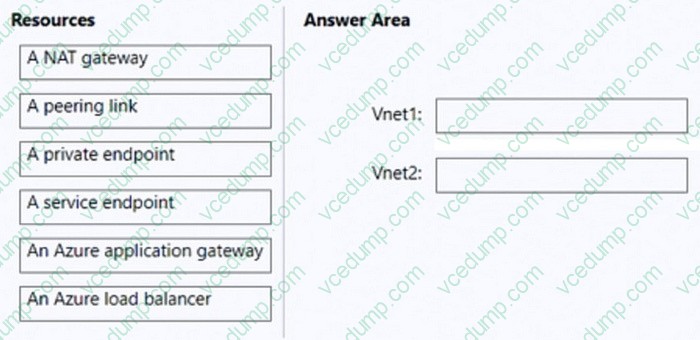
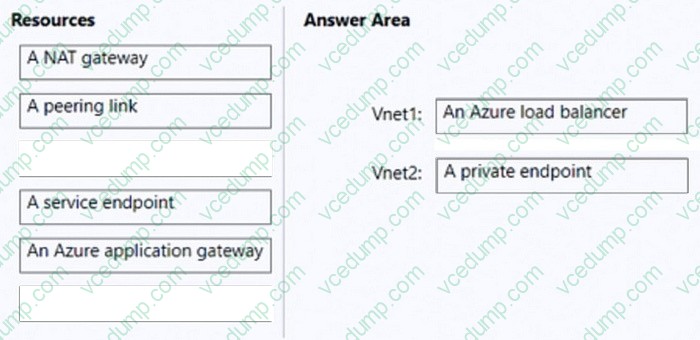
You have an Azure subscription that contains a virtual network named Vnet1 and an Azure SQL database named SQL1. SQL1 has a private endpoint on Vnet1.
You have a partner company named Fabrikam, Inc. Fabrikam has an Azure subscription that contains a virtual network named Vnet2 and a virtual machine named VM1. VM1 is connected to Vnet2.
You need to provide VM1 with access to SQL1 by using an Azure Private Link service.
What should you implement on each virtual network? To answer, drag the appropriate resources to the correct virtual networks. Each resource may be used once, more than once, or not at all. You may need to drag the split bar between panes or scroll to view content.
NOTE: Each correct selection is worth one point.
Select and Place:
-
Question 313:
You have an Azure subscription that contains two virtual networks named VritualNetwork1 and VritualNetwork2.
You have a Windows 10 device that connects to VritualNetwork1 by using a Point-to-Site (P2S) IKEv2 VPN. You have implemented virtual network peering between VritualNetwork1 and VritualNetwork2.
VritualNetwork1 allows gateway transit. VritualNetwork2 can use the remote gateway. You discover that you cannot communicate with VritualNetwork2 from the Windows 10 device. You need to ensure that you can communicate with VritualNetwork2 from the Windows 10 device.
To achieve the requirement, you download and reinstall the VPN client configuration.
Did you achieve the requirement?
A. Yes
B. No -
Question 314:
SIMULATION
Username and password
Use the following login credentials as needed:
To enter your username, place your cursor in the Sign in box and click on the username below.
To enter your password, place your cursor in the Enter password box and click on the password below.
Azure Username: [email protected] Azure Password: xxxxxxxxxx
If the Azure portal does not load successfully in the browser, press CTRL-K to reload the portal in a new browser tab.
The following information is for technical support purposes only:
Lab Instance: 12345678
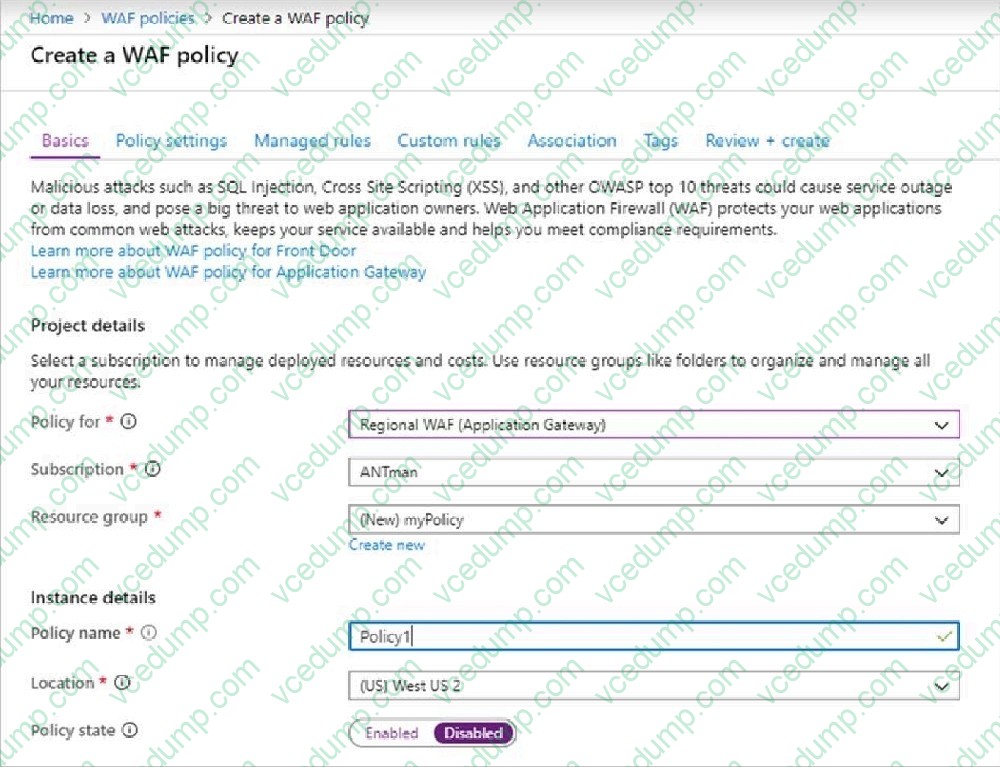
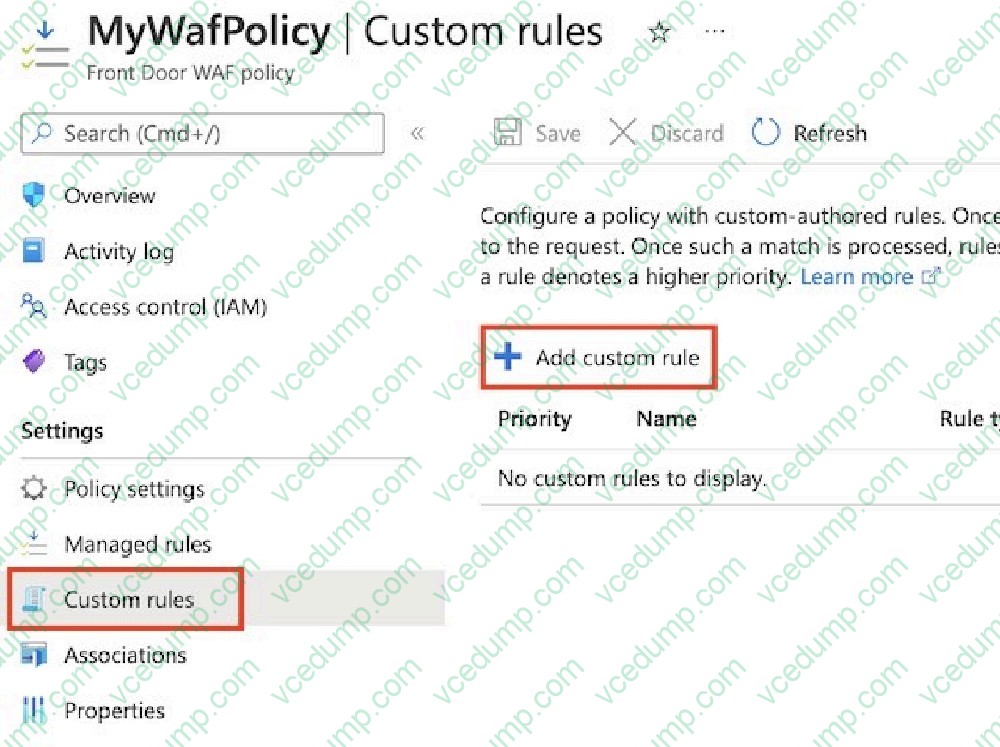
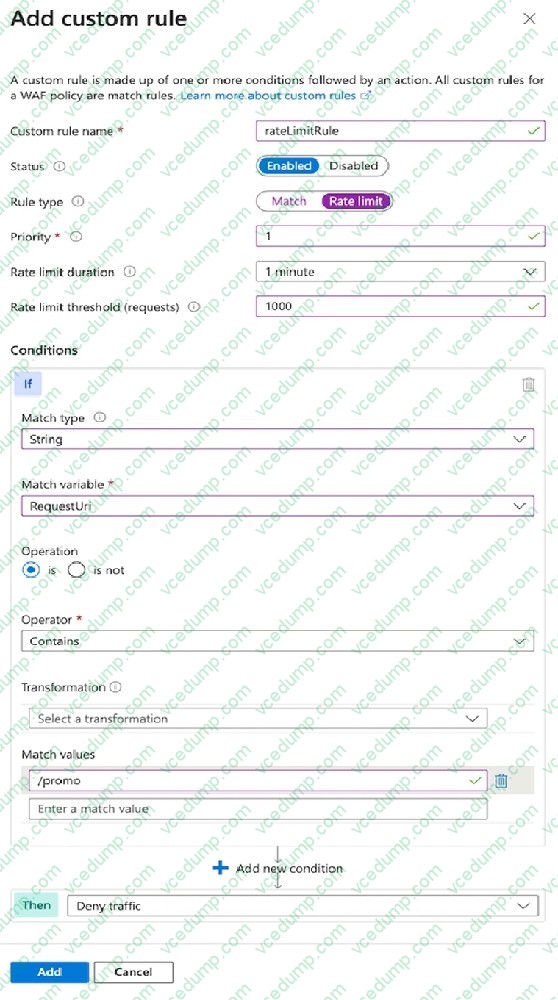
You are planning security for Azure Front Door.
You need to create a rule that can be applied to Front Door hosts. The rule must prevent hosts in Japan from making more than 50 requests per minute. You do NOT need to associate the rule to a Front Door instance to complete this task.
To complete this task, sign in to the Azure portal.
A. See explanation below.
B. PlaceHolder
C. PlaceHolder
D. PlaceHolder -
Question 315:
You have an Azure subscription that contains a virtual machine named VM1 and a network security group (NSG) named NSG1. NSG1 has the default rules configured. VM1 runs Windows Server 2022 and contains a single NIC named NIC1. NIC1 is associated with NSG1.
You need to prevent access to the Azure Instance Metadata Service (IMDS) REST API on VM1. The solution must minimize administrative effort.
What should you add to NSG1?
A. an outbound rule that blocks traffic to an IP address
B. an outbound rule that blocks traffic to a service tag
C. an inbound and outbound rule that blocks traffic to an application security group.
D. an inbound rule that blocks traffic to an IP address -
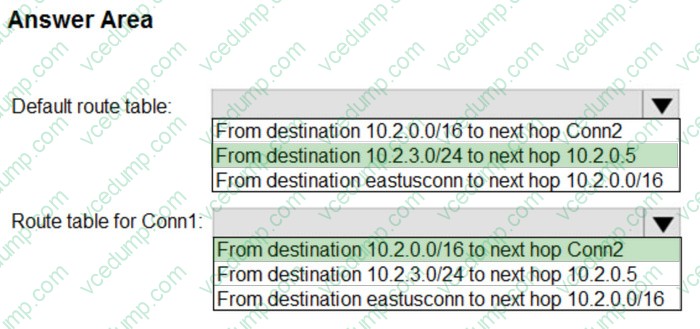
Question 316:
HOTSPOT
You plan to implement an Azure Virtual WAN named VWAN1 that will contain a hub named Hub1. VWAN1 will include the virtual networks shown in the following table.
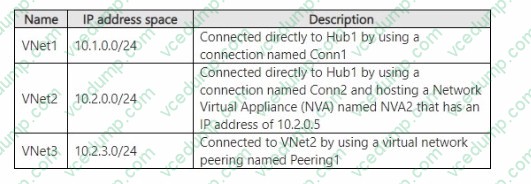
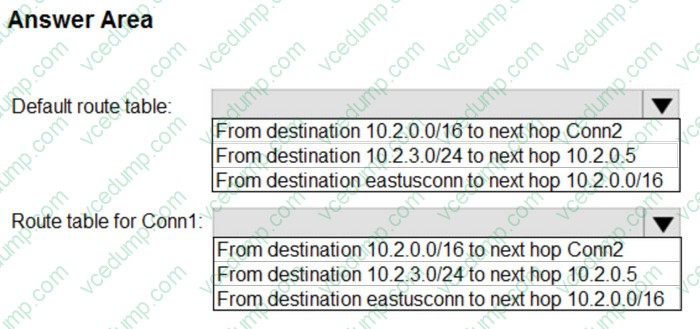
You need to ensure that hosts connected to VNet1 can communicate with hosts connected to VNet3.
How should you configure the routing tables for VWAN1? To answer, select the appropriate options in the answer area.
NOTE: Each correct selection is worth one point.
-
Question 317:
You have an on-premises server named Server1 that runs Windows Server.
You have an Azure subscription that contains a virtual network named VNet1.
You plan to connect Server1 to VNet1 by using Azure Network Adapter.
You need to minimize how long it takes to deploy the adapter to Server1.
What should you create first?
A. an Azure VPN gateway
B. a route server
C. a private endpoint
D. an Azure Bastion host -
Question 318:
You have an Azure subscription that contains a virtual network named Vnet1. Vnet1 contains a virtual machine named VM1 and an Azure firewall named FW1.
You have an Azure Firewall Policy named FP1 that is associated to FW1.
You need to ensure that RDP requests to the public IP address of FW1 route to VM1.
What should you configure on FP1?
A. a network rule
B. URL filtering
C. a DNAT rule
D. an application rule -
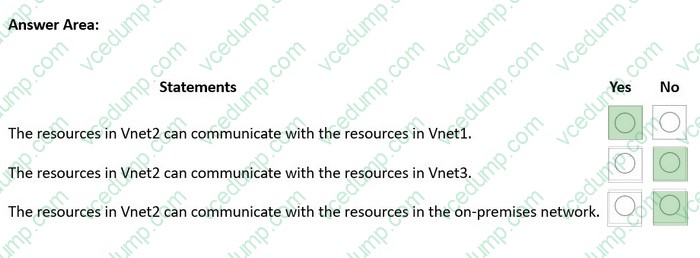
Question 319:
HOTSPOT
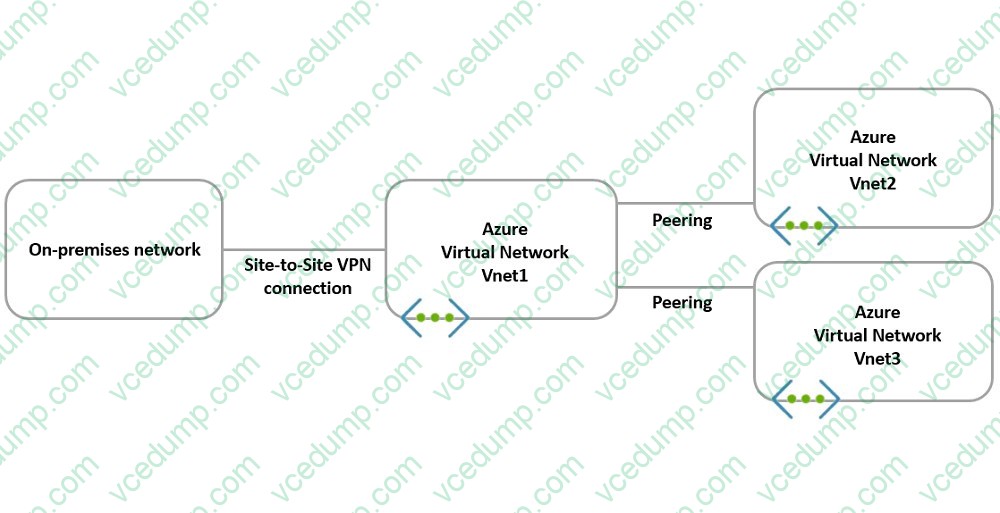
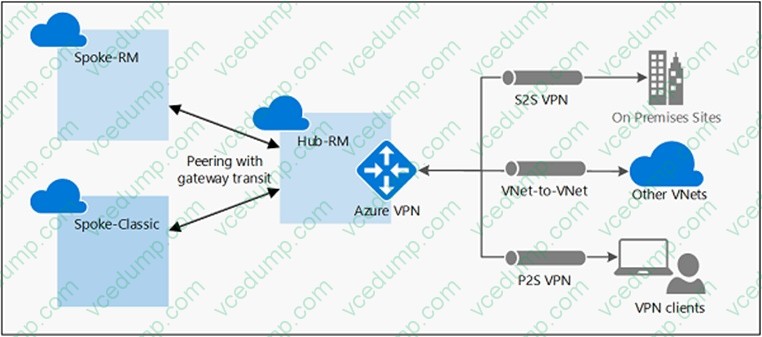
You have the hybrid network shown in the Network Diagram exhibit.
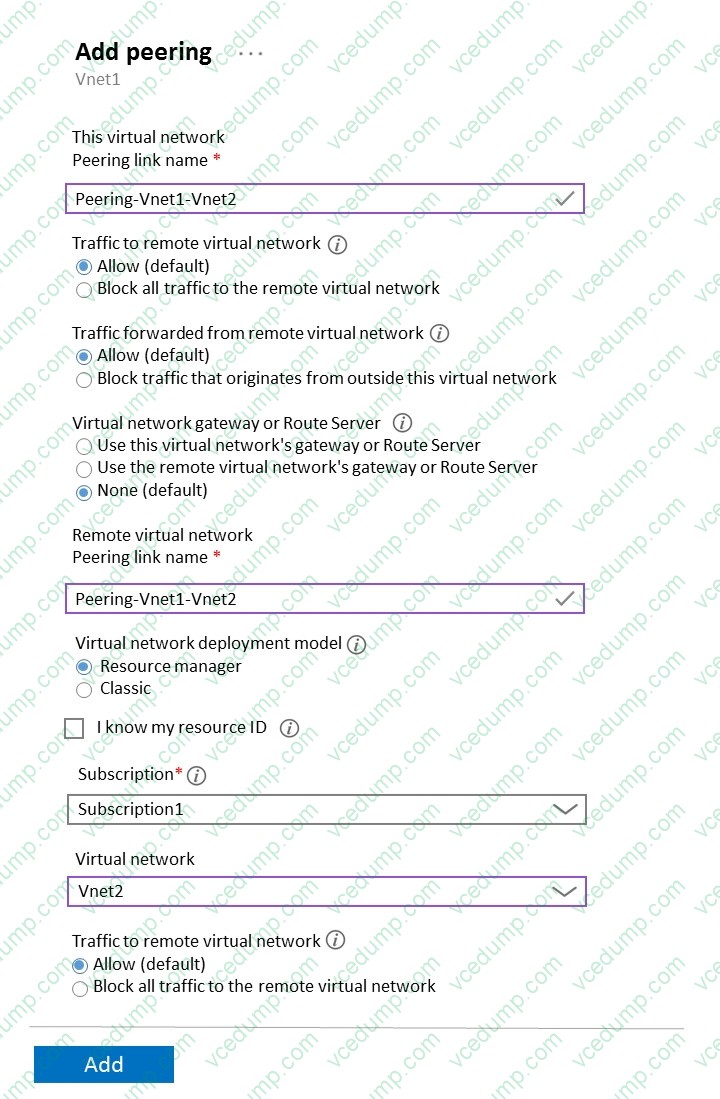
You have a peering connection between Vnet1 and Vnet2 as shown in the Peering-Vnet1-Vnet2 exhibit.
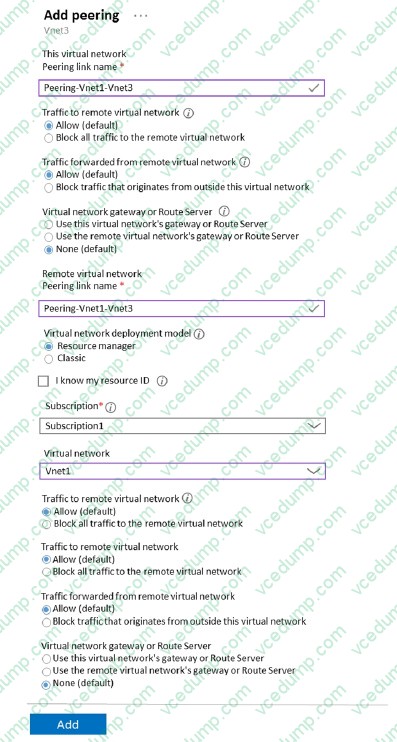
You have a peering connection between Vnet1 and Vnet3 as shown in the Peering-Vnet1-Vnet3 exhibit.
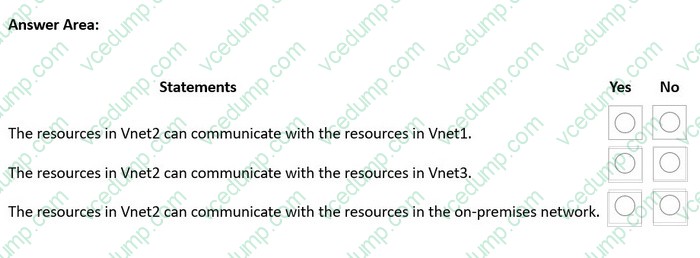
For each of the following statements, select Yes if the statement is true. Otherwise, select No.
NOTE: Each correct selection is worth one point.
-
Question 320:
You have an Azure Private Link service named PL1 that uses an Azure load balancer named LB1.
You need to ensure that PL1 can support a higher volume of outbound traffic.
What should you do?
A. Increase the number of frontend IP configurations for LB1.
B. Increase the number of NAT IP addresses assigned to PL1.
C. Deploy an Azure Application Gateway v2 instance to the source NAT subnet.
D. Redeploy LB1 with a different SKU.
Related Exams:
-
62-193
Technology Literacy for Educators -
70-243
Administering and Deploying System Center 2012 Configuration Manager -
70-355
Universal Windows Platform – App Data, Services, and Coding Patterns -
77-420
Excel 2013 -
77-427
Excel 2013 Expert Part One -
77-725
Word 2016 Core Document Creation, Collaboration and Communication -
77-726
Word 2016 Expert Creating Documents for Effective Communication -
77-727
Excel 2016 Core Data Analysis, Manipulation, and Presentation -
77-728
Excel 2016 Expert: Interpreting Data for Insights -
77-731
Outlook 2016 Core Communication, Collaboration and Email Skills
Tips on How to Prepare for the Exams
Nowadays, the certification exams become more and more important and required by more and more enterprises when applying for a job. But how to prepare for the exam effectively? How to prepare for the exam in a short time with less efforts? How to get a ideal result and how to find the most reliable resources? Here on Vcedump.com, you will find all the answers. Vcedump.com provide not only Microsoft exam questions, answers and explanations but also complete assistance on your exam preparation and certification application. If you are confused on your AZ-700 exam preparations and Microsoft certification application, do not hesitate to visit our Vcedump.com to find your solutions here.