AZ-305 Exam Details
-
Exam Code
:AZ-305 -
Exam Name
:Designing Microsoft Azure Infrastructure Solutions -
Certification
:Microsoft Certifications -
Vendor
:Microsoft -
Total Questions
:395 Q&As -
Last Updated
:Jul 13, 2026
Microsoft AZ-305 Online Questions & Answers
-
Question 211:
You need to recommend a data storage solution that meets the following requirements:
1. Ensures that applications can access the data by using a REST connection
2. Hosts 20 independent tables of varying sizes and usage patterns
3. Automatically replicates the data to a second Azure region
Minimizes costs
What should you recommend?
A. an Azure SQL Database elastic pool that uses active geo-replication
B. tables in an Azure Storage account that use geo-redundant storage (GRS)
C. tables in an Azure Storage account that use read-access geo-redundant storage (RA-GRS)
D. an Azure SQL database that uses active geo-replication -
Question 212:
HOTSPOT
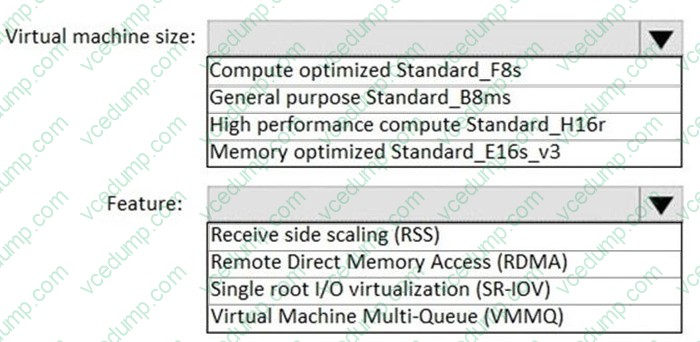
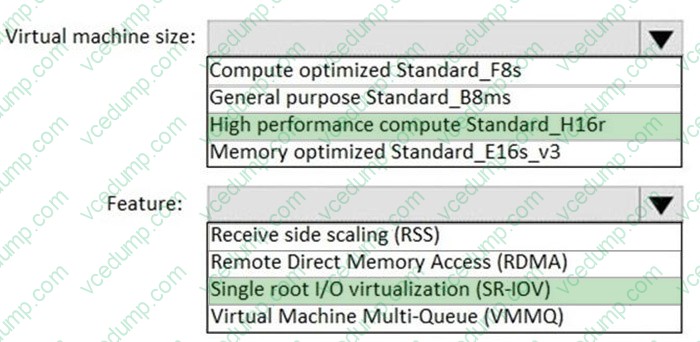
You plan to deploy a network-intensive application to several Azure virtual machines.
You need to recommend a solution that meets the following requirements:
Minimizes the use of the virtual machine processors to transfer data Minimizes network latency
Which virtual machine size and feature should you use? To answer, select the appropriate options in the answer area.
NOTE: Each correct selection is worth one point.
-
Question 213:
Note: This question is part of a series of questions that present the same scenario. Each question in the series contains a unique solution that might meet the stated goals. Some question sets might have more than one correct solution, while others might not have a correct solution.
After you answer a question in this section, you will NOT be able to return to it. As a result, these questions will not appear in the review screen.
You have an app named App1 that uses data from two on-premises Microsoft SQL Server databases named DB1 and DB2.
You plan to move DB1 and DB2 to Azure.
You need to implement Azure services to host DB1 and DB2. The solution must support server-side transactions across DB1 and DB2.
Solution: You deploy DB1 and DB2 to an Azure SQL Database managed instance.
Does this meet the goal?
A. Yes
B. No -
Question 214:
HOTSPOT
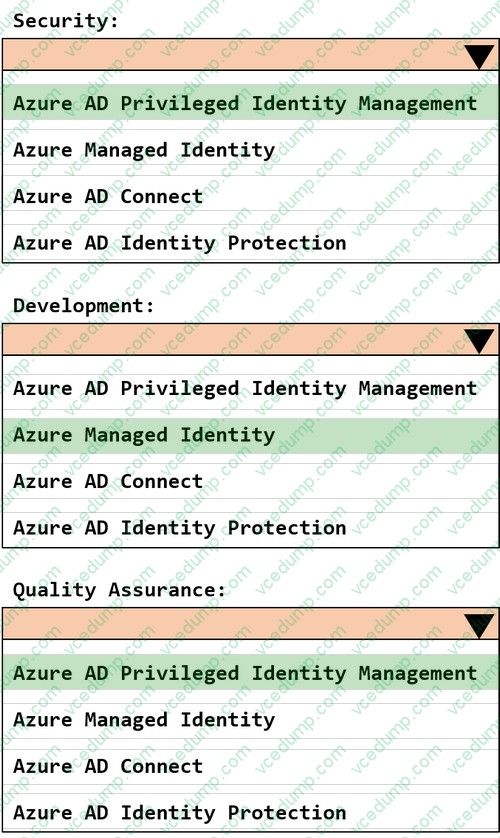
You have several Azure App Service web apps that use Azure Key Vault to store data encryption keys. Several departments have the following requests to support the web app:
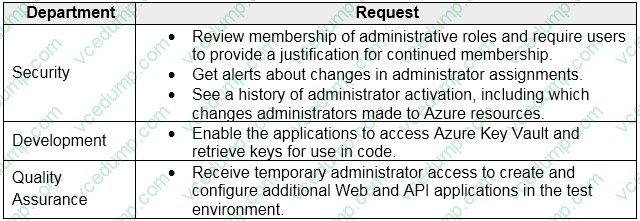
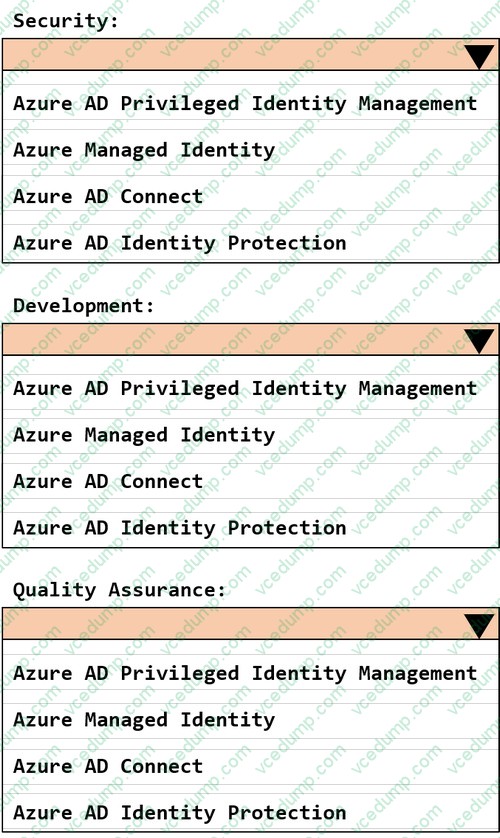
Which service should you recommend for each department's request?
To answer, configure the appropriate options in the answer area.
NOTE: Each correct selection is worth one point.
-
Question 215:
You plan to deploy an application named App1 that will run on five Azure virtual machines. Additional virtual machines will be deployed later to run App1.
You need to recommend a solution to meet the following requirements for the virtual machines that will run App1:
1. Ensure that the virtual machines can authenticate to Azure Active Directory (Azure AD) to gain access to an Azure key vault, Azure Logic Apps instances, and an Azure SQL database.
2. Avoid assigning new roles and permissions for Azure services when you deploy additional virtual machines.
3. Avoid storing secrets and certificates on the virtual machines.
Which type of identity should you include in the recommendation?
A. a service principal that is configured to use a certificate
B. a system-assigned managed identity
C. a service principal that is configured to use a client secret
D. a user-assigned managed identity -
Question 216:
HOTSPOT
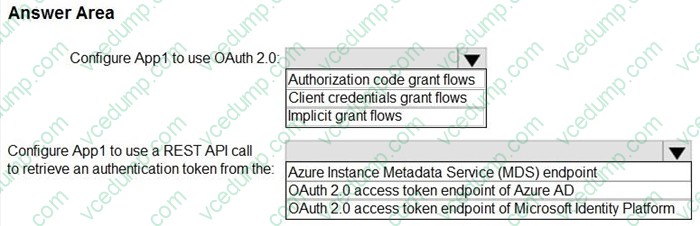
You have an Azure subscription that contains an Azure key vault named KV1 and a virtual machine named VM1. VM1 runs Windows Server 2022: Azure Edition.
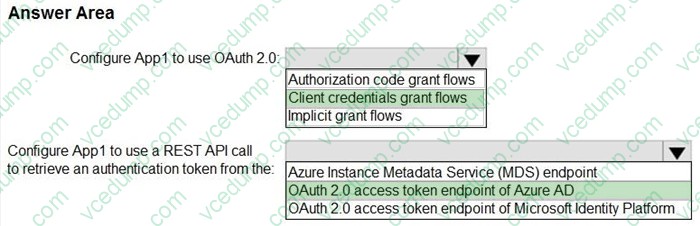
You plan to deploy an ASP.Net Core-based application named App1 to VM1.
You need to configure App1 to use a system-assigned managed identity to retrieve secrets from KV1. The solution must minimize development effort.
What should you do? To answer, select the appropriate options in the answer area.
NOTE: Each correct selection is worth one point.
-
Question 217:
You need to recommend a data storage strategy for WebApp1.
What should you include in in the recommendation?
A. an Azure SQL Database elastic pool
B. a vCore-based Azure SQL database
C. an Azure virtual machine that runs SQL Server
D. a fixed-size DTU AzureSQL database. -
Question 218:
You have an application that is hosted across multiple Azure regions.
You need to ensure that users connect automatically to their nearest application host based on network latency.
What should you implement?
A. Azure Application Gateway
B. Azure Load Balancer
C. Azure Traffic Manager
D. Azure Bastion -
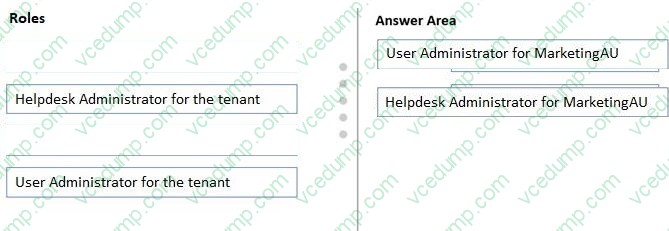
Question 219:
DRAG DROP
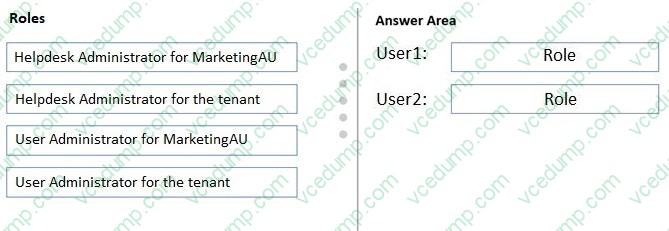
You have an Azure AD tenant that contains an administrative unit named MarketingAU. MarketingAU contains 100 users.
You create two users named User1 and User2.
You need to ensure that the users can perform the following actions in MarketingAU:
User1 must be able to create user accounts.
User2 must be able to reset user passwords.
Which role should you assign to each user? To answer, drag the appropriate roles to the correct users. Each role may be used once, more than once, or not at all. You may need to drag the split bar between panes or scroll to view content.
NOTE: Each correct selection is worth one point.
Select and Place:
-
Question 220:
You need to design a solution that will execute custom C# code in response to an event routed to Azure Event Grid. The solution must meet the following requirements:
1. The executed code must be able to access the private IP address of a Microsoft SQL Server instance that runs on an Azure virtual machine.
2. Costs must be minimized.
What should you include in the solution?
A. Azure Logic Apps in the integrated service environment
B. Azure Functions in the Dedicated plan and the Basic Azure App Service plan
C. Azure Logic Apps in the Consumption plan
D. Azure Functions in the Consumption plan
Related Exams:
-
62-193
Technology Literacy for Educators -
70-243
Administering and Deploying System Center 2012 Configuration Manager -
70-355
Universal Windows Platform – App Data, Services, and Coding Patterns -
77-420
Excel 2013 -
77-427
Excel 2013 Expert Part One -
77-725
Word 2016 Core Document Creation, Collaboration and Communication -
77-726
Word 2016 Expert Creating Documents for Effective Communication -
77-727
Excel 2016 Core Data Analysis, Manipulation, and Presentation -
77-728
Excel 2016 Expert: Interpreting Data for Insights -
77-731
Outlook 2016 Core Communication, Collaboration and Email Skills
Tips on How to Prepare for the Exams
Nowadays, the certification exams become more and more important and required by more and more enterprises when applying for a job. But how to prepare for the exam effectively? How to prepare for the exam in a short time with less efforts? How to get a ideal result and how to find the most reliable resources? Here on Vcedump.com, you will find all the answers. Vcedump.com provide not only Microsoft exam questions, answers and explanations but also complete assistance on your exam preparation and certification application. If you are confused on your AZ-305 exam preparations and Microsoft certification application, do not hesitate to visit our Vcedump.com to find your solutions here.