AZ-305 Exam Details
-
Exam Code
:AZ-305 -
Exam Name
:Designing Microsoft Azure Infrastructure Solutions -
Certification
:Microsoft Certifications -
Vendor
:Microsoft -
Total Questions
:395 Q&As -
Last Updated
:Jul 13, 2026
Microsoft AZ-305 Online Questions & Answers
-
Question 151:
You have an on-premises line-of-business (LOB) application that uses a Microsoft SQL Server instance as the backend.
You plan to migrate the on-premises SQL Server instance to Azure virtual machines.
You need to recommend a highly available SQL Server deployment that meets the following requirements:
1. Minimizes costs
2. Minimizes failover time if a single server fails
What should you include in the recommendation?
A. an Always On availability group that has premium storage disks and a virtual network name (VNN)
B. an Always On Failover Cluster Instance that has a virtual network name (VNN) and a standard file share
C. an Always On availability group that has premium storage disks and a distributed network name (DNN)
D. an Always On Failover Cluster Instance that has a virtual network name (VNN) and a premium file share -
Question 152:
HOTSPOT
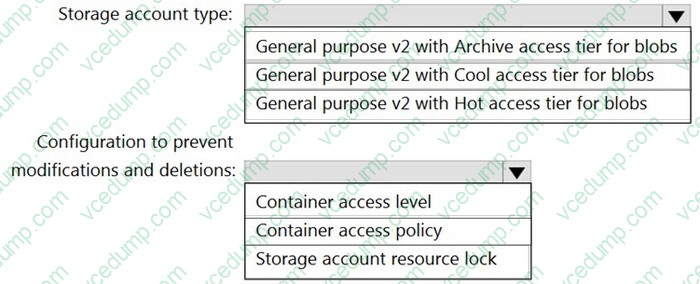
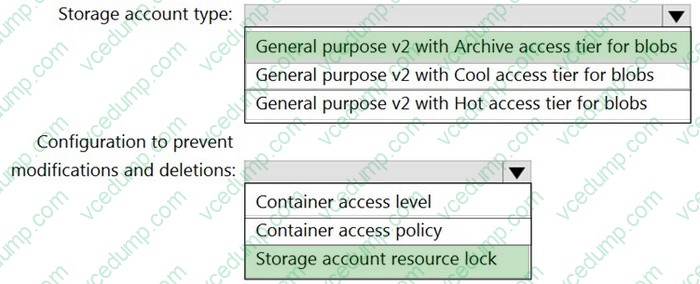
You are planning an Azure Storage solution for sensitive data. The data will be accessed daily. The data set is less than 10 GB.
You need to recommend a storage solution that meets the following requirements:
1. All the data written to storage must be retained for five years.
2. Once the data is written, the data can only be read. Modifications and deletion must be prevented.
3. After five years, the data can be deleted, but never modified.
4. Data access charges must be minimized.
What should you recommend? To answer, select the appropriate options in the answer area.
NOTE: Each correct selection is worth one point.
-
Question 153:
You have multiple on-premises locations. The locations host loT endpoints that generate real-time telemetry data.
You have an Azure subscription.
You need to process the telemetry data and provide real-time insights. The solution must minimize development effort.
What should you use?
A. Azure Data Factory
B. Azure Data Lake Analytics
C. Log Analytics
D. Azure Stream Analytics -
Question 154:
HOTSPOT
You are designing an access policy for your company.
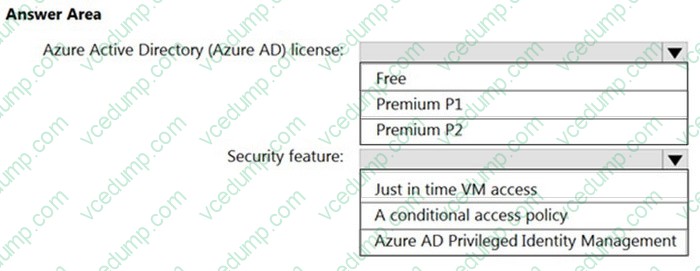
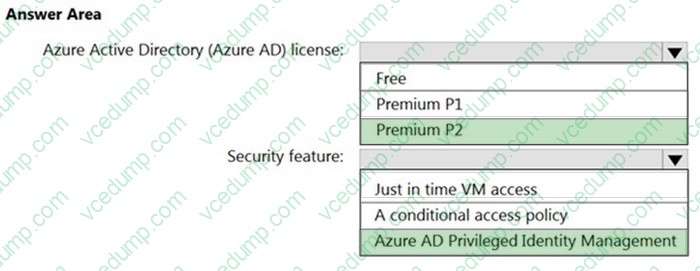
Occasionally, the developers at the company must stop, start, and restart Azure virtual machines. The development team changes often.
You need to recommend a solution to provide the developers with the required access to the virtual machines. The solution must meet the following requirements:
1. Provide permissions only when needed.
2. Use the principle of least privilege.
3. Minimize costs.
What should you include in the recommendation? To answer, select the appropriate options in the answer area.
NOTE: Each correct selection is worth one point.
-
Question 155:
Your company has an app named App1 that uses data from the on-premises Microsoft SQL Server databases shown in the following table.
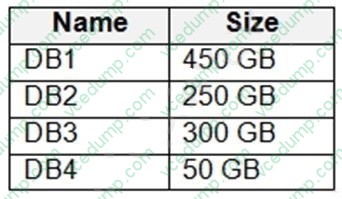
App1 and the data are used on the first day of the month only. The data is not expected to grow more than 3% each year.
The company is rewriting App1 as an Azure web app and plans to migrate all the data to Azure.
You need to migrate the data to Azure SQL Database. The solution must minimize costs.
Which service tier should you use?
A. vCore-based Business Critical
B. vCore-based General Purpose
C. DTU-based Standard
D. DTU-based Basic -
Question 156:
You have an Azure subscription that contains the resources shown in the following table.
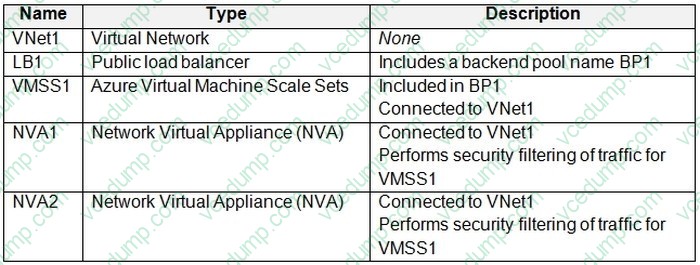
You need to recommend a load balancing solution that will distribute incoming traffic for VMSS1 across NVA1 and NVA2. The solution must minimize administrative effort.
What should you include in the recommendation?
A. Gateway Load Balancer
B. Azure Front Door
C. Azure Application Gateway
D. Azure Traffic Manager -
Question 157:
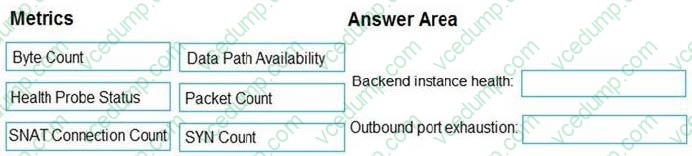
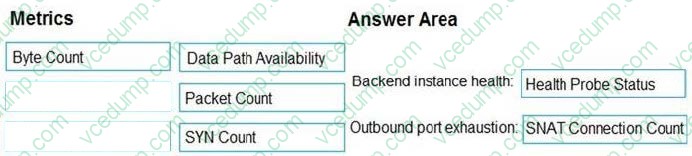
DRAG DROP
You have standard Load balancer configured to support three virtual machines on the same subnet.
You need to recommend a solution to notify administrators when the load balancer fails.
Which metrics should you recommend using to test the load balancer? To answer, drag the appropriate metrics to the correct conditions. Each metric may be used once, more than once, or not at all. You may need to drag the split bar between panes or scroll to view content.
NOTE: Each correct selection is worth one point.
Select and Place:
-
Question 158:
You plan to deploy an Azure SQL database that will store Personally Identifiable Information (Pll). You need to ensure that only privileged users can view the Pll.
What should you include in the solution?
A. Transparent Data Encryption (TDE)
B. Data Discovery & Classification
C. dynamic data masking
D. role-based access control (RBAC) -
Question 159:
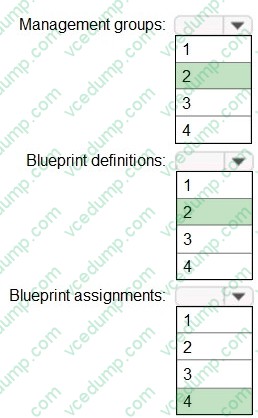
HOTSPOT
Your company has the divisions shown in the following table.

You plan to deploy a custom application to each subscription. The application will contain the following:
1. A resource group
2. An Azure web app
3. Custom role assignments
4. An Azure Cosmos DB account
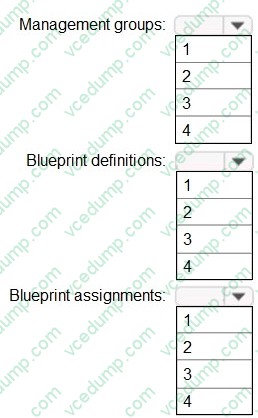
You need to use Azure Blueprints to deploy the application to each subscription.
What is the minimum number of objects required to deploy the application? To answer, select the appropriate options in the answer area.
NOTE: Each correct selection is worth one point.
-
Question 160:
You are planning an Azure IoT Hub solution that will include 50,000 IoT devices.
Each device will stream data, including temperature, device ID, and time data. Approximately 50,000 records will be written every second. The data will be visualized in near real time.
You need to recommend a service to store and query the data.
Which two services can you recommend? Each correct answer presents a complete solution.
NOTE: Each correct selection is worth one point.
A. Azure Table Storage
B. Azure Event Grid
C. Azure Cosmos DB SQL API
D. Azure Time Series Insights
Related Exams:
-
62-193
Technology Literacy for Educators -
70-243
Administering and Deploying System Center 2012 Configuration Manager -
70-355
Universal Windows Platform – App Data, Services, and Coding Patterns -
77-420
Excel 2013 -
77-427
Excel 2013 Expert Part One -
77-725
Word 2016 Core Document Creation, Collaboration and Communication -
77-726
Word 2016 Expert Creating Documents for Effective Communication -
77-727
Excel 2016 Core Data Analysis, Manipulation, and Presentation -
77-728
Excel 2016 Expert: Interpreting Data for Insights -
77-731
Outlook 2016 Core Communication, Collaboration and Email Skills
Tips on How to Prepare for the Exams
Nowadays, the certification exams become more and more important and required by more and more enterprises when applying for a job. But how to prepare for the exam effectively? How to prepare for the exam in a short time with less efforts? How to get a ideal result and how to find the most reliable resources? Here on Vcedump.com, you will find all the answers. Vcedump.com provide not only Microsoft exam questions, answers and explanations but also complete assistance on your exam preparation and certification application. If you are confused on your AZ-305 exam preparations and Microsoft certification application, do not hesitate to visit our Vcedump.com to find your solutions here.