AZ-305 Exam Details
-
Exam Code
:AZ-305 -
Exam Name
:Designing Microsoft Azure Infrastructure Solutions -
Certification
:Microsoft Certifications -
Vendor
:Microsoft -
Total Questions
:395 Q&As -
Last Updated
:Jul 13, 2026
Microsoft AZ-305 Online Questions & Answers
-
Question 101:
You plan to migrate App1 to Azure. The solution must meet the authentication and authorization requirements.
Which type of endpoint should App1 use to obtain an access token?
A. Azure Instance Metadata Service (IMDS)
B. Azure AD
C. Azure Service Management
D. Microsoft identity platform -
Question 102:
HOTSPOT
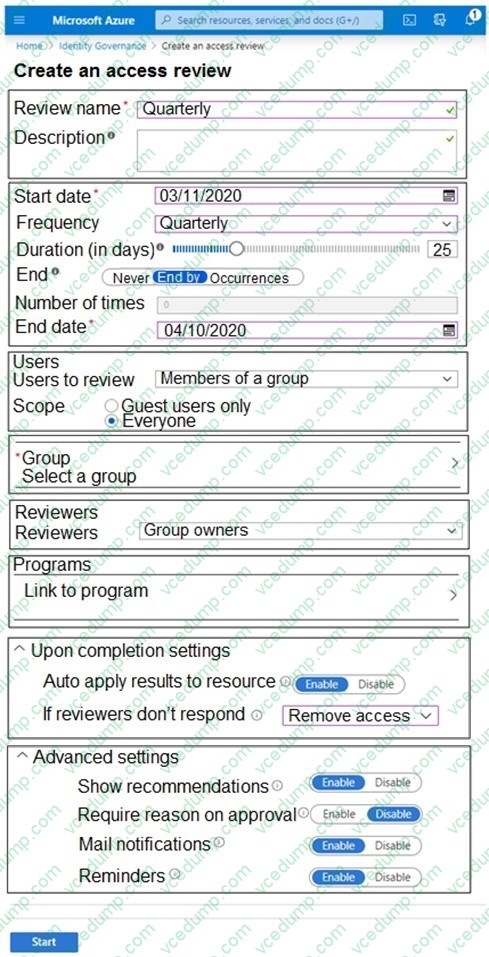
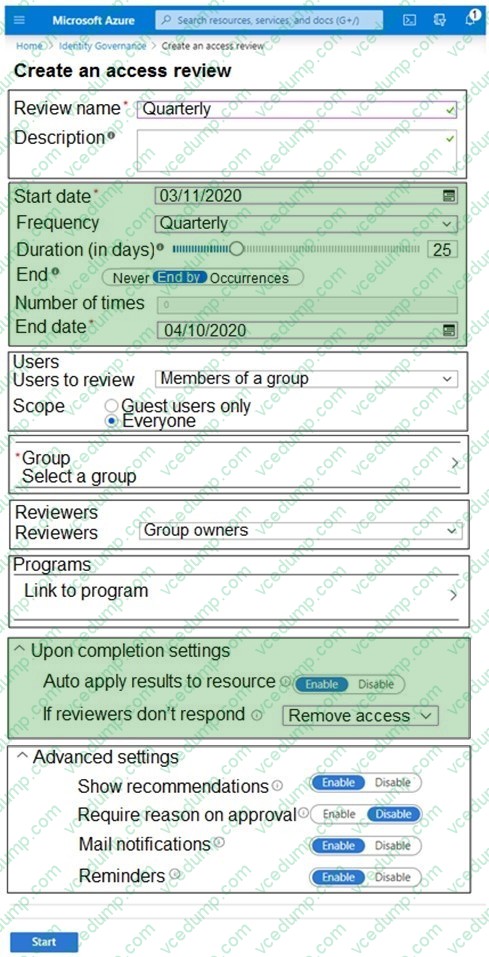
You plan to implement an access review to meet the following requirements:
The access review must be enforced until otherwise configured. Each user or group that has access to the Azure environment must be in the scope of the access review.
The access review must be completed within two weeks. A lack of response must not cause changes in the operational environment.
An administrator creates the access review shown in the answer area.
Which two sections of the access review should you modify to meet the requirements? To answer, select the appropriate sections in the answer area.
NOTE: Each correct selection is worth one point.
-
Question 103:
You have an Azure subscription that contains 1,000 resources.
You need to generate compliance reports for the subscription. The solution must ensure that the resources can be grouped by department.
What should you use to organize the resources?
A. application groups and quotas
B. Azure Policy and tags
C. administrative units and Azure Lighthouse
D. resource groups and role assignments -
Question 104:
HOTSPOT
You have an Azure web app named App1 and an Azure key vault named KV1.
App1 stores database connection strings in KV1.
App1 performs the following types of requests to KV1:
Get
List
Wrap
Delete
Unwrap
Backup
Decrypt
Encrypt
You are evaluating the continuity of service for App1.
You need to identify the following if the Azure region that hosts KV1 becomes unavailable:
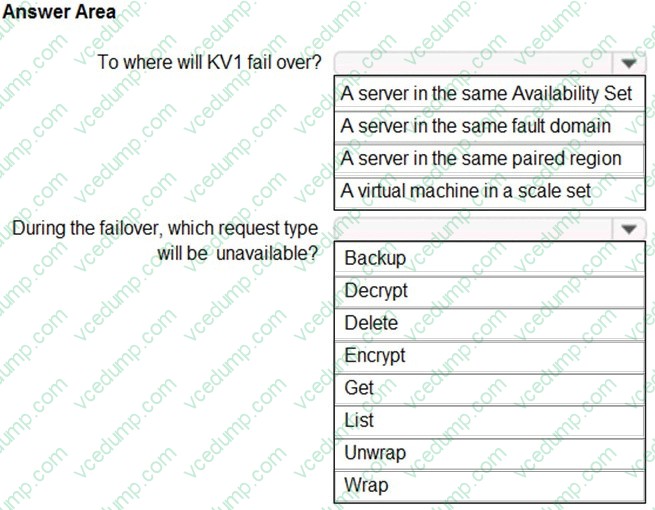
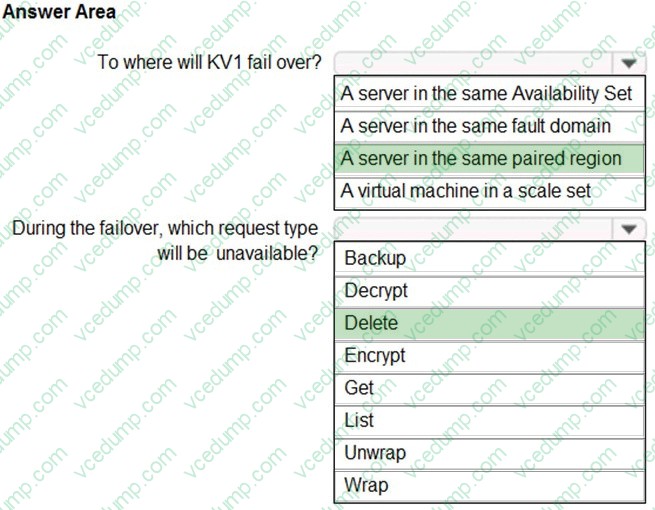
To where will KV1 fail over?
During the failover, which request type will be unavailable?
What should you identify? To answer, select the appropriate options in the answer area.
NOTE: Each correct selection is worth one point.
-
Question 105:
Your company currently has an application that is hosted on their on-premises environment. The application currently connects to two databases in the on-premises environment. The databases are named whizlabdb1 and whizlabdb2.
You have to move the databases onto Azure. The databases have to support server-side transactions across both of the databases.
Solution: You decide to deploy the databases to an Azure SQL database-managed instance.
Would this fulfill the requirement?
A. Yes
B. No -
Question 106:
DRAG DROP
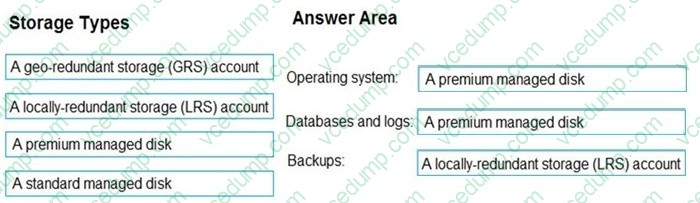
You are planning an Azure solution that will host production databases for a high-performance application. The solution will include the following components:
1. Two virtual machines that will run Microsoft SQL Server 2016, will be deployed to different data centers in the same Azure region, and will be part of an Always On availability group.
2. SQL Server data that will be backed up by using the Automated Backup feature of the SQL Server IaaS Agent Extension (SQLIaaSExtension)
You identify the storage priorities for various data types as shown in the following table.
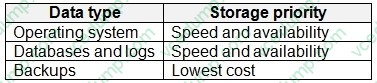
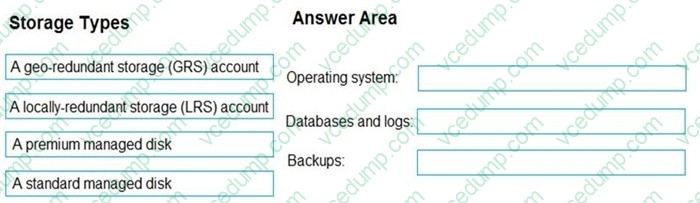
Which storage type should you recommend for each data type? To answer, drag the appropriate storage types to the correct data types.
Each storage type may be used once, more than once, or not at all. You may need to drag the split bar between panes or scroll to view content.
NOTE: Each correct selection is worth one point.
Select and Place:
-
Question 107:
Your company has the divisions shown in the following table.

Sub1 contains an Azure App Service web app named App1. App1 uses Azure AD for single-tenant user authentication. Users from contoso.com can authenticate to App1.
You need to recommend a solution to enable users in the fabrikam.com tenant to authenticate to App1.
What should you recommend?
A. Configure Azure AD join.
B. Configure Azure AD Identity Protection.
C. Configure a Conditional Access policy.
D. Configure Supported account types in the application registration and update the sign-in endpoint. -
Question 108:
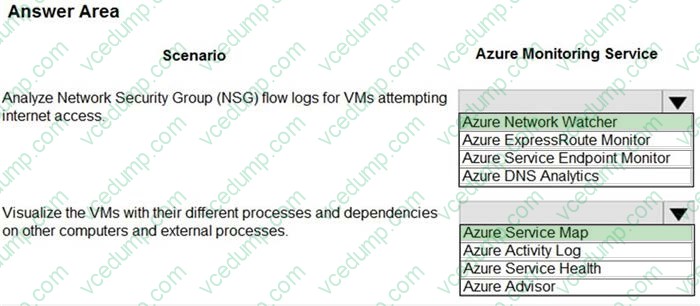
HOTSPOT
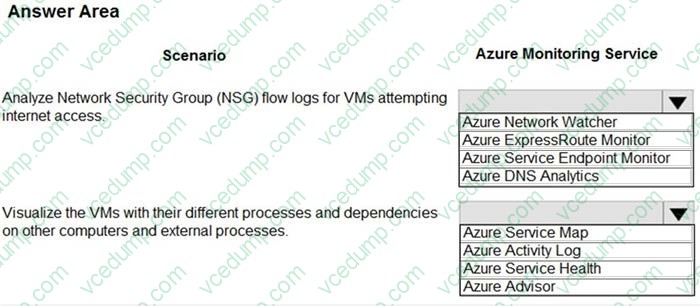
Your company deploys several Linux and Windows virtual machines (VMs) to Azure. The VMs are deployed with the Microsoft Dependency Agent and the Microsoft Monitoring Agent installed by using Azure VM extensions. On-premises connectivity has been enabled by using Azure ExpressRoute.
You need to design a solution to monitor the VMs.
Which Azure monitoring services should you use? To answer, select the appropriate Azure monitoring services in the answer area.
NOTE: Each correct selection is worth one point.
-
Question 109:
A company needs a datastore created in Azure for an application. Below are the key requirements for the data store.
1. Ability to store JSON based items
2. Ability to use SQL like queries on the datastore
3. Ability to provide low latency access to data items
Which of the following would you consider as the data store?
A. Azure BLOB storage
B. Azure CosmosDB
C. Azure HDInsight
D. Azure Redis -
Question 110:
You need to recommend a storage solution for the records of a mission critical application. The solution must provide a Service Level Agreement (SLA) for the latency of write operations and the throughput.
What should you include in the recommendation?
A. Azure Data Lake Storage Gen2
B. Azure Blob Storage
C. Azure SQL
D. Azure Cosmos DB
Related Exams:
-
62-193
Technology Literacy for Educators -
70-243
Administering and Deploying System Center 2012 Configuration Manager -
70-355
Universal Windows Platform – App Data, Services, and Coding Patterns -
77-420
Excel 2013 -
77-427
Excel 2013 Expert Part One -
77-725
Word 2016 Core Document Creation, Collaboration and Communication -
77-726
Word 2016 Expert Creating Documents for Effective Communication -
77-727
Excel 2016 Core Data Analysis, Manipulation, and Presentation -
77-728
Excel 2016 Expert: Interpreting Data for Insights -
77-731
Outlook 2016 Core Communication, Collaboration and Email Skills
Tips on How to Prepare for the Exams
Nowadays, the certification exams become more and more important and required by more and more enterprises when applying for a job. But how to prepare for the exam effectively? How to prepare for the exam in a short time with less efforts? How to get a ideal result and how to find the most reliable resources? Here on Vcedump.com, you will find all the answers. Vcedump.com provide not only Microsoft exam questions, answers and explanations but also complete assistance on your exam preparation and certification application. If you are confused on your AZ-305 exam preparations and Microsoft certification application, do not hesitate to visit our Vcedump.com to find your solutions here.