AZ-204 Exam Details
-
Exam Code
:AZ-204 -
Exam Name
:Developing Solutions for Microsoft Azure -
Certification
:Microsoft Certifications -
Vendor
:Microsoft -
Total Questions
:588 Q&As -
Last Updated
:Jul 12, 2026
Microsoft AZ-204 Online Questions & Answers
-
Question 331:
HOTSPOT
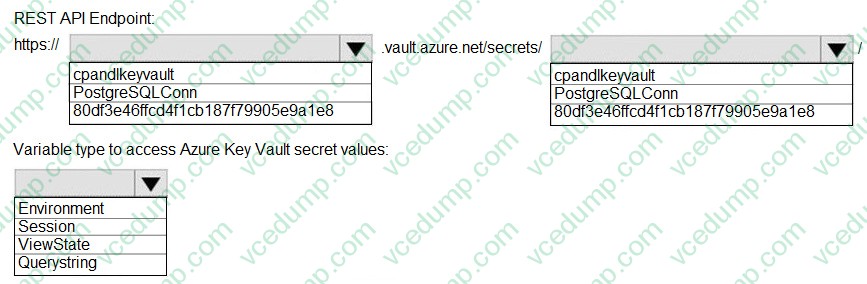
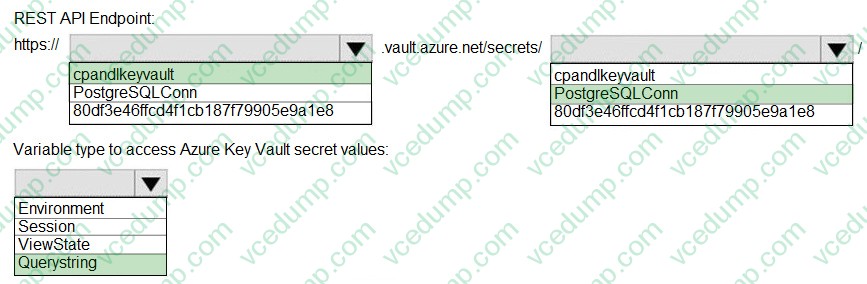
You need to retrieve the database connection string.
Which values should you use? To answer, select the appropriate options in the answer area.
NOTE: Each correct selection is worth one point.
-
Question 332:
You develop a web application that sells access to last-minute openings for child camps that run on the weekends. The application uses Azure Application Insights for all alerting and monitoring.
The application must alert operators when a technical issue is preventing sales to camps.
You need to build an alert to detect technical issues.
Which alert type should you use?
A. Metric alert using multiple time series
B. Metric alert using dynamic thresholds
C. Log alert using multiple time series
D. Log alert using dynamic thresholds -
Question 333:
HOTSPOT
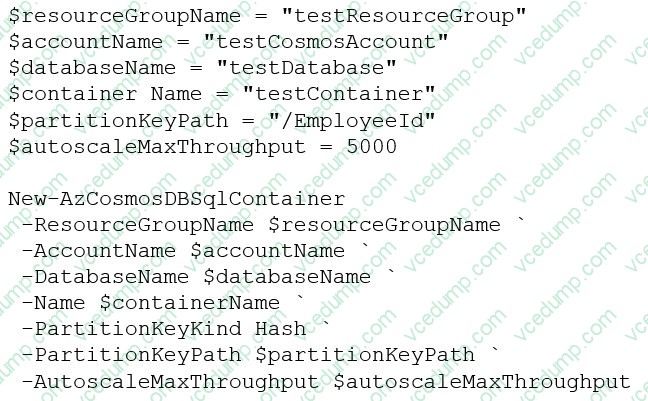
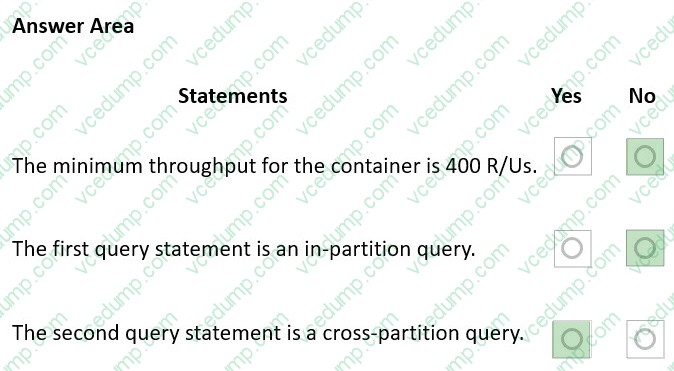
You have an Azure Web app that uses Azure Cosmos DB as a data store. You create a CosmosDB container by running the following PowerShell script:
You create the following queries that target the container:
SELECT * FROM c WHERE c.EmployeeId > '12345'
SELECT * FROM c WHERE c.UserID = '12345'
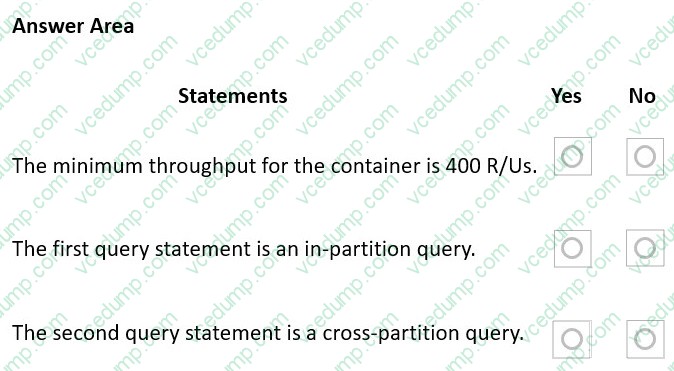
For each of the following statements, select Yes if the statement is true. Otherwise, select No.
NOTE: Each correct selection is worth one point.
-
Question 334:
You need to ensure the security policies are met.
What code do you add at line CS07 of ConfigureSSE.ps1?
A. -PermissionsToKeys create, encrypt, decrypt
B. -PermissionsToCertificates create, encrypt, decrypt
C. -PermissionsToCertificates wrapkey, unwrapkey, get
D. -PermissionsToKeys wrapkey, unwrapkey, get -
Question 335:
You deploy an Azure Container Apps app and disable ingress on the container app.
Users report that they are unable to access the container app. You investigate and observe that the app has scaled to 0 instances.
You need to resolve the issue with the container app.
Solution: Enable ingress, create a custom scale rule, and apply the rule to the container app.
Does the solution meet the goal?
A. Yes
B. No -
Question 336:
DRAG DROP
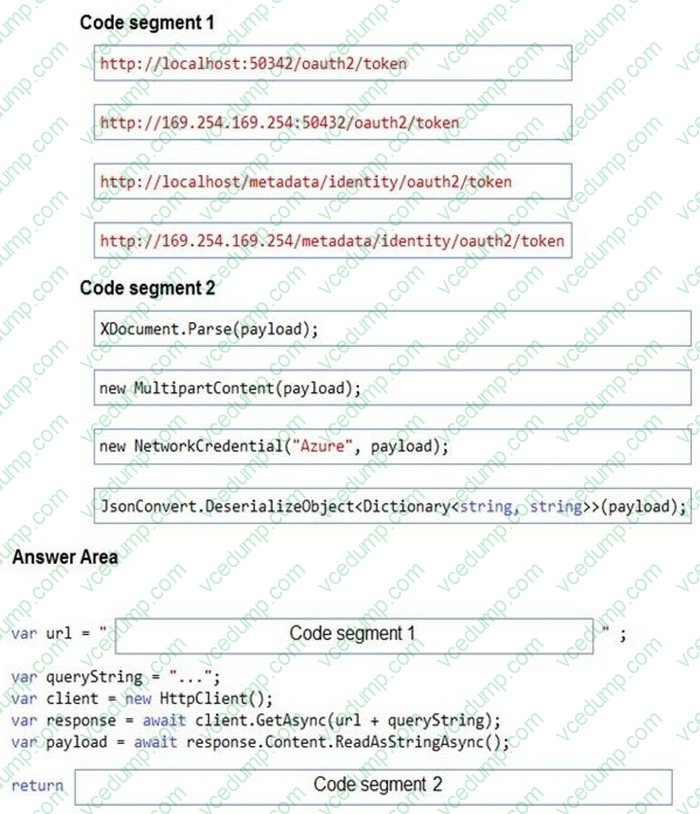
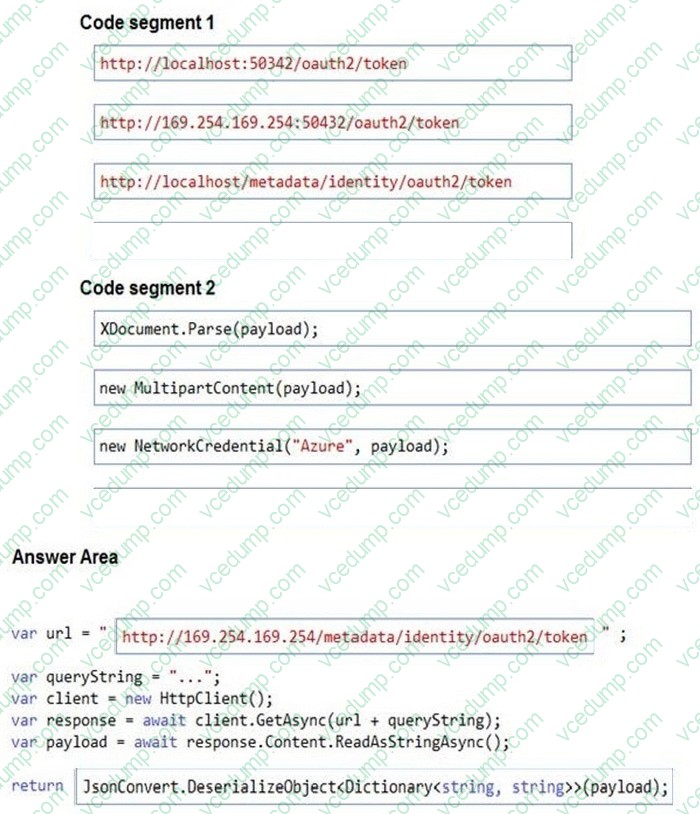
You are developing a web service that will run on Azure virtual machines that use Azure Storage. You configure all virtual machines to use managed identities.
You have the following requirements:
1. Secret-based authentication mechanisms are not permitted for accessing an Azure Storage account.
2. Must use only Azure Instance Metadata Service endpoints.
You need to write code to retrieve an access token to access Azure Storage. To answer, drag the appropriate code segments to the correct locations. Each code segment may be used once or not at all. You may need to drag the split bar between panes or scroll to view content.
NOTE: Each correct selection is worth one point.
Select and Place:
-
Question 337:
You are developing a medical records document management website. The website is used to store scanned copies of patient intake forms. If the stored intake forms are downloaded from storage by a third party, the content of the forms must not be compromised.
You need to store the intake forms according to the requirements.
Solution: uk.co.certification.simulator.questionpool.
PList@1898d9c0 Does the solution meet the goal?
A. Yes
B. No -
Question 338:
HOTSPOT
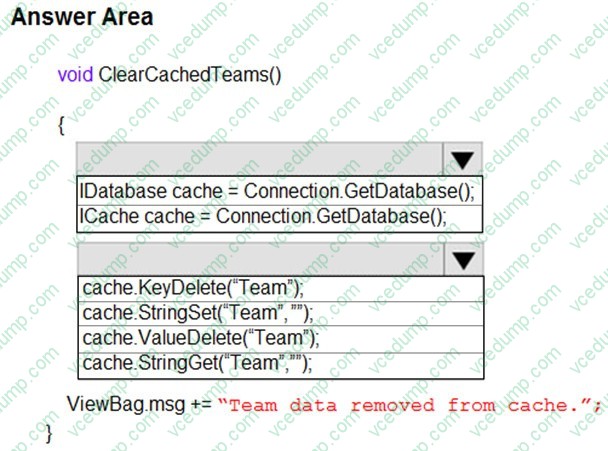
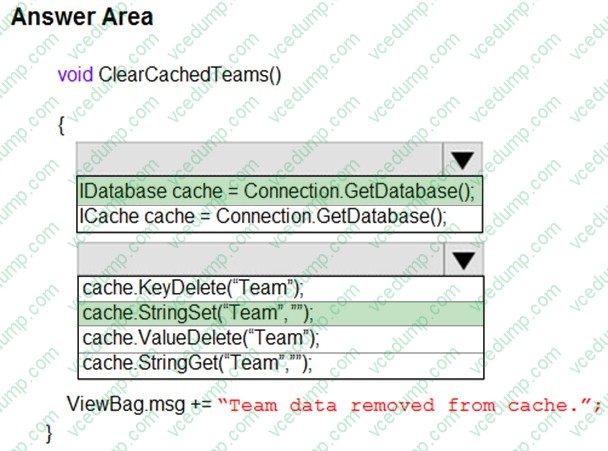
A company is developing a gaming platform. Users can join teams to play online and see leaderboards that include player statistics. The solution includes an entity named Team.
You plan to implement an Azure Redis Cache instance to improve the efficiency of data operations for entities that rarely change.
You need to invalidate the cache when team data is changed.
How should you complete the code? To answer, select the appropriate options in the answer area.
NOTE: Each correct selection is worth one point.
-
Question 339:
Note: This question is part of a series of questions that present the same scenario. Each question in the series contains a unique solution that might meet the stated goals. Some question sets might have more than one correct solution, while others might not have a correct solution.
After you answer a question in this section, you will NOT be able to return to it. As a result, these questions will not appear in the review screen.
You are developing a medical records document management website. The website is used to store scanned copies of patient intake forms.
If the stored intake forms are downloaded from storage by a third party, the contents of the forms must not be compromised.
You need to store the intake forms according to the requirements.
Solution: Store the intake forms as Azure Key Vault secrets.
Does the solution meet the goal?
A. Yes
B. No -
Question 340:
HOTSPOT
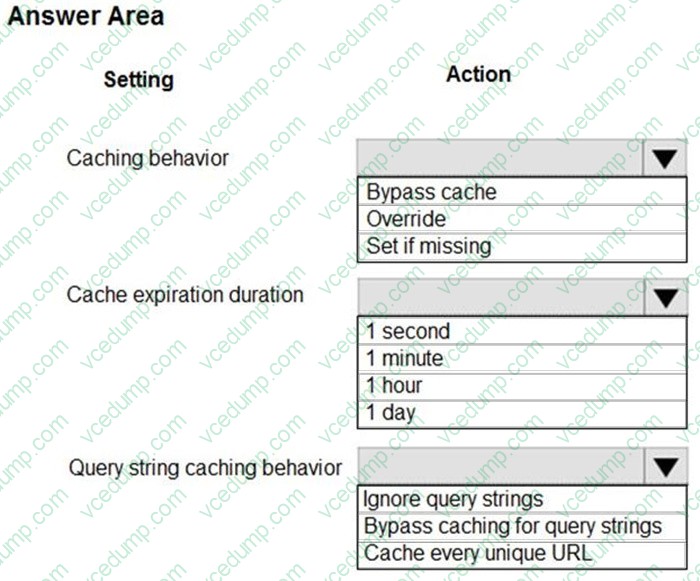
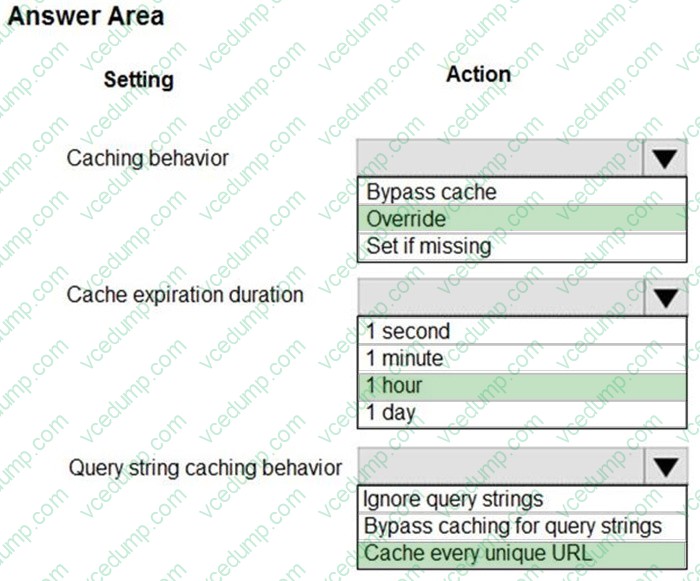
You are developing an Azure App Service hosted ASP.NET Core web app to deliver video on-demand streaming media. You enable an Azure Content Delivery Network (CDN) Standard for the web endpoint. Customer videos are downloaded from the web app by using the following example URL.: http://www.contoso.com/content.mp4?quality=1
All media content must expire from the cache after one hour. Customer videos with varying quality must be delivered to the closest regional point of presence (POP) node.
You need to configure Azure CDN caching rules.
Which options should you use? To answer, select the appropriate options in the answer area.
NOTE: Each correct selection is worth one point.
Related Exams:
-
62-193
Technology Literacy for Educators -
70-243
Administering and Deploying System Center 2012 Configuration Manager -
70-355
Universal Windows Platform – App Data, Services, and Coding Patterns -
77-420
Excel 2013 -
77-427
Excel 2013 Expert Part One -
77-725
Word 2016 Core Document Creation, Collaboration and Communication -
77-726
Word 2016 Expert Creating Documents for Effective Communication -
77-727
Excel 2016 Core Data Analysis, Manipulation, and Presentation -
77-728
Excel 2016 Expert: Interpreting Data for Insights -
77-731
Outlook 2016 Core Communication, Collaboration and Email Skills
Tips on How to Prepare for the Exams
Nowadays, the certification exams become more and more important and required by more and more enterprises when applying for a job. But how to prepare for the exam effectively? How to prepare for the exam in a short time with less efforts? How to get a ideal result and how to find the most reliable resources? Here on Vcedump.com, you will find all the answers. Vcedump.com provide not only Microsoft exam questions, answers and explanations but also complete assistance on your exam preparation and certification application. If you are confused on your AZ-204 exam preparations and Microsoft certification application, do not hesitate to visit our Vcedump.com to find your solutions here.