AZ-204 Exam Details
-
Exam Code
:AZ-204 -
Exam Name
:Developing Solutions for Microsoft Azure -
Certification
:Microsoft Certifications -
Vendor
:Microsoft -
Total Questions
:588 Q&As -
Last Updated
:Jul 12, 2026
Microsoft AZ-204 Online Questions & Answers
-
Question 351:
You are developing an e-Commerce Web App.
You want to use Azure Key Vault to ensure that sign-ins to the e-Commerce Web App are secured by using Azure App Service authentication and Azure Active Directory (AAD).
What should you do on the e-Commerce Web App?
A. Run the az keyvault secret command.
B. Enable Azure AD Connect.
C. Enable Managed Service Identity (MSI).
D. Create an Azure AD service principal. -
Question 352:
DRAG DROP
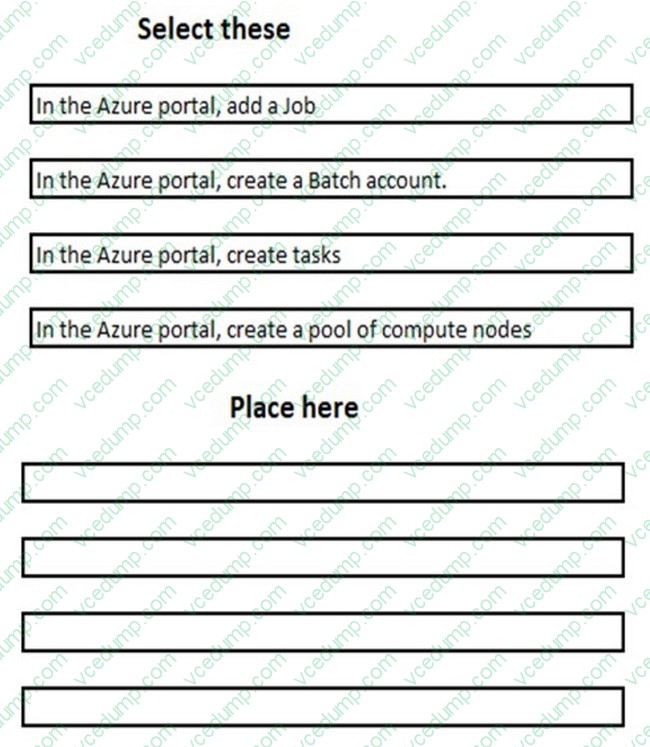
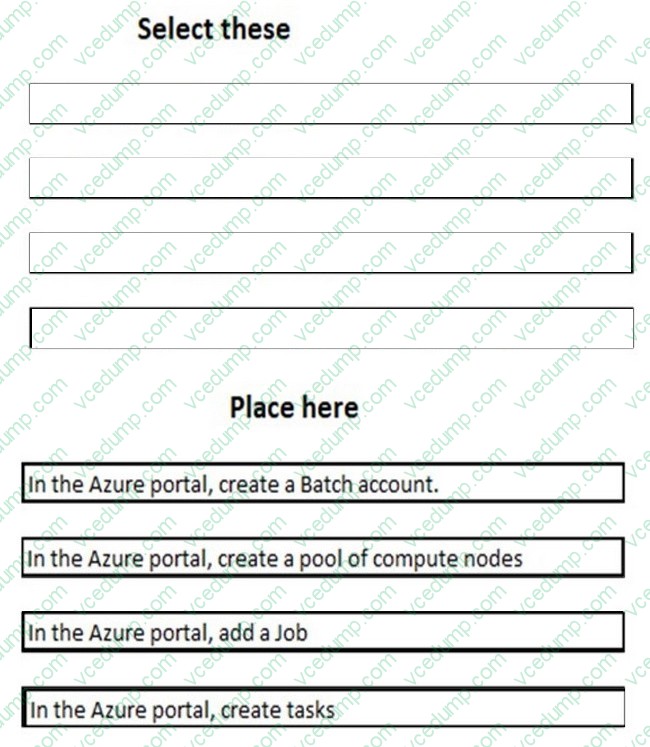
You are developing a software solution for an autonomous transportation system. The solution uses large data sets and Azure Batch processing to simulate navigation sets for entire fleets of vehicles.
You need to create compute nodes for the solution on Azure Batch.
What should you do?
Put the actions in the correct order.
Select and Place:
-
Question 353:
Note: The question is included in a number of questions that depicts the identical set-up. However, every question has a distinctive result. Establish if the solution satisfies the requirements.
You are developing a solution for a public facing API.
The API back end is hosted in an Azure App Service instance. You have implemented a RESTful service for the API back end.
You must configure back-end authentication for the API Management service instance.
Solution: You configure Basic gateway credentials for the HTTP(s) endpoint.
Does the solution meet the goal?
A. Yes
B. No -
Question 354:
You develop a gateway solution for a public facing news API. The news API back end is implemented as a RESTful service and uses an OpenAPI specification.
You need to ensure that you can access the news API by using an Azure API Management service instance.
Which Azure PowerShell command should you run?
A. Import-AzureRmApiManagementApi -Context $ApiMgmtContext -SpecificationFormat "Swagger" -SpecificationPath $SwaggerPath -Path $Path
B. New-AzureRmApiManagementBackend -Context $ApiMgmtContext-Url $Url -Protocol http
C. New-AzureRmApiManagement -ResourceGroupName $ResourceGroup -Name $Name ocation $Location -Organization $Org -AdminEmail $AdminEmail
D. New-AzureRmApiManagementBackendProxy -Url $ApiUrl -
Question 355:
HOTSPOT
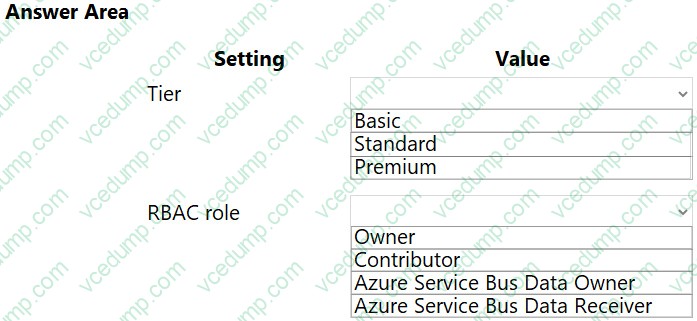
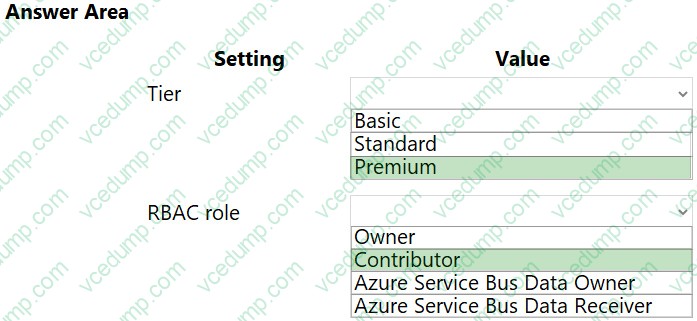
You need to configure Azure Service Bus to Event Grid integration.
Which Azure Service Bus settings should you use? To answer, select the appropriate options in the answer area.
NOTE: Each correct selection is worth one point.
-
Question 356:
You are developing a .NET Core MVC application that allows customers to research independent holiday accommodation providers.
You want to implement Azure Search to allow the application to search the index by using various criteria to locate documents related to accommodation venues.
You want the application to list holiday accommodation venues that fall within a specific price range and are within a specified distance to an airport.
What should you do?
A. Configure the SearchMode property of the SearchParameters class.
B. Configure the QueryType property of the SearchParameters class.
C. Configure the Facets property of the SearchParameters class.
D. Configure the Filter property of the SearchParameters class. -
Question 357:
HOTSPOT
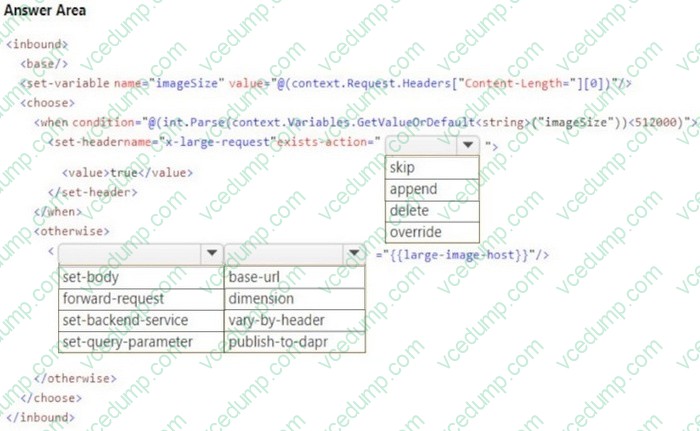
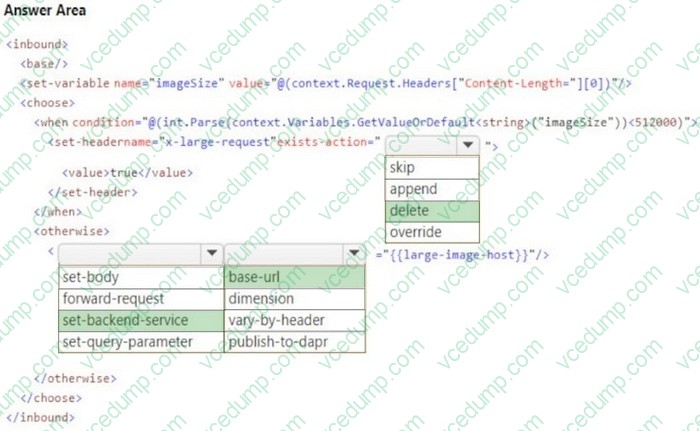
You develop an image upload service that is exposed using Azure API Management. Images are analyzed after upload for automatic tagging.
Images over 500 KB are processed by a different backend that offers a lower tier of service that costs less money. The lower tier of service is denoted by a header named x-large-request. Images over 500 KB must never be processed by backends for smaller images and must always be charged the lower price.
You need to implement API Management policies to ensure that images are processed correctly.
How should you complete the API Management inbound policy? To answer, select the appropriate options in the answer area.
NOTE: Each correct selection is worth one point.
-
Question 358:
You develop and deploy an Azure App Service web app named App1. You create a new Azure Key Vault named Vault 1. You import several API keys, passwords, certificates, and cryptographic keys into Vault1.
You need to grant App1 access to Vault1 and automatically rotate credentials Credentials must not be stored in code.
What should you do?
A. Enable App Service authentication for Appt. Assign a custom RBAC role to Vault1.
B. Add a TLS/SSL binding to App1.
C. Assign a managed identity to App1.
D. Upload a self-signed client certificate to Vault1. Update App1 to use the client certificate. -
Question 359:
HOTSPOT
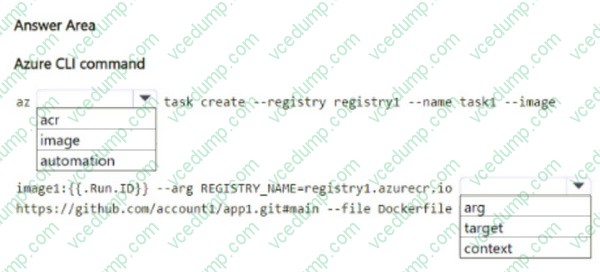
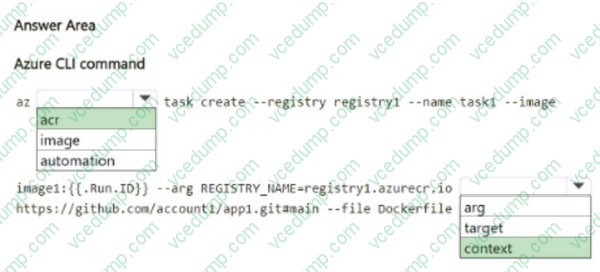
You have a Dockerfile that builds a container image named image1. The container image and its base image are stored in separate repositories of an Azure Container registry named registry1. The codebase of image1 is stored in a GitHub repo named app1 of an account named account1.
You plan to implement automatic updates to image1 whenever its base image is updated or an update to the main branch of the GitHub repo occurs.
You need to complete the Azure CLI command that will apply the planned implementation.
How should you complete the command? To answer, select the appropriate options in the answer area.
NOTE: Each correct selection is worth one point.
-
Question 360:
You manage an Azure subscription that contains 100 Azure App Service web apps. Each web app is associated with an individual Application Insights instance.
You plan to remove Classic availability tests from all Application Insights instances that have this functionality configured.
You have the following PowerShell statement:
Get-AzApplicationInsightsWebTest | Where-Object { $condition }
You need to set the value of the $condition variable.
Which value should you use?
A. $_.Type -eq "ping"
B. $_.WebTestKind -eq "ping"
C. $_.WebTestKind -eq "standard"
D. $_.Type -eq "standard"
Related Exams:
-
62-193
Technology Literacy for Educators -
70-243
Administering and Deploying System Center 2012 Configuration Manager -
70-355
Universal Windows Platform – App Data, Services, and Coding Patterns -
77-420
Excel 2013 -
77-427
Excel 2013 Expert Part One -
77-725
Word 2016 Core Document Creation, Collaboration and Communication -
77-726
Word 2016 Expert Creating Documents for Effective Communication -
77-727
Excel 2016 Core Data Analysis, Manipulation, and Presentation -
77-728
Excel 2016 Expert: Interpreting Data for Insights -
77-731
Outlook 2016 Core Communication, Collaboration and Email Skills
Tips on How to Prepare for the Exams
Nowadays, the certification exams become more and more important and required by more and more enterprises when applying for a job. But how to prepare for the exam effectively? How to prepare for the exam in a short time with less efforts? How to get a ideal result and how to find the most reliable resources? Here on Vcedump.com, you will find all the answers. Vcedump.com provide not only Microsoft exam questions, answers and explanations but also complete assistance on your exam preparation and certification application. If you are confused on your AZ-204 exam preparations and Microsoft certification application, do not hesitate to visit our Vcedump.com to find your solutions here.