AZ-204 Exam Details
-
Exam Code
:AZ-204 -
Exam Name
:Developing Solutions for Microsoft Azure -
Certification
:Microsoft Certifications -
Vendor
:Microsoft -
Total Questions
:588 Q&As -
Last Updated
:Jul 12, 2026
Microsoft AZ-204 Online Questions & Answers
-
Question 281:
DRAG DROP
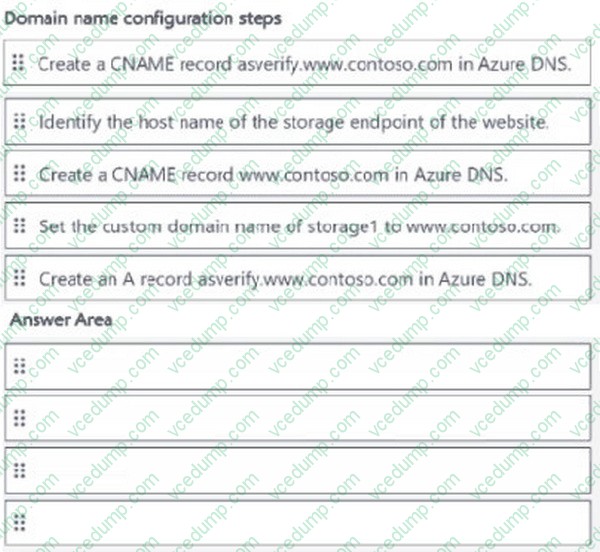
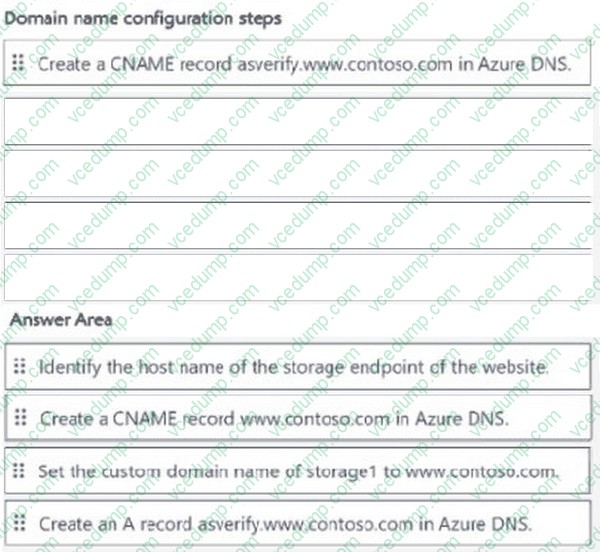
You have a static website hosted in an Azure Storage account named storage1. You access the website by using a URL that ends with the web.core.windows.net suffix.
You plan to configure the website to be accessible through the URL www.contoso.com. The website must be accessible during configuration.
The contoso.com zone is hosted in Azure DNS.
You need to complete the website configuration
Which four actions should you perform in sequence?
To answer, move the appropriate domain name configuration steps from the list of domain name configuration steps to the answer area and arrange them in the correct order.
Select and Place:
-
Question 282:
You need to ensure that all messages from Azure Event Grid are processed.
What should you use?
A. Azure Event Grid topic
B. Azure Service Bus topic
C. Azure Service Bus queue
D. Azure Storage queue
E. Azure Logic App custom connector -
Question 283:
HOTSPOT
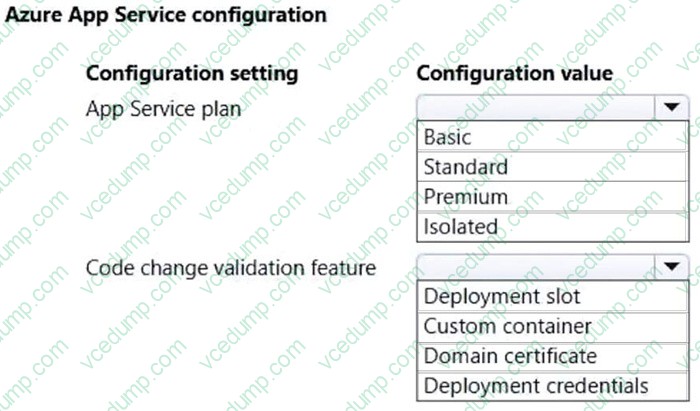
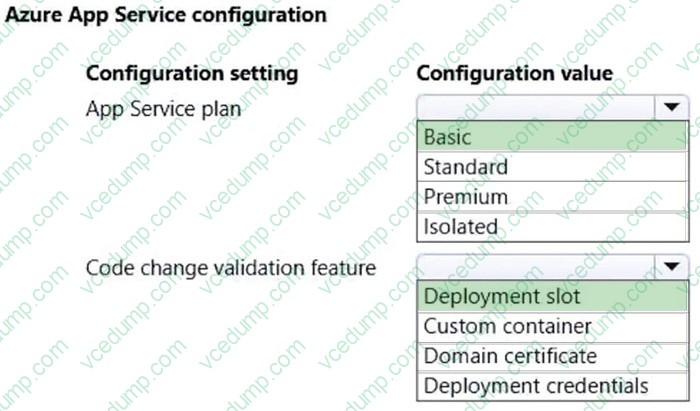
You need to configure App Service to support the corporate website migration.
Which configuration should you use? To answer, select the appropriate options in the answer area.
NOTE: Each correct selection is worth one point.
-
Question 284:
You are developing an ASP.NET Core Web API web service. The web service uses Azure Application Insights for all telemetry and dependency tracking. The web service reads and writes data to a database other than Microsoft SQL Server.
You need to ensure that dependency tracking works for calls to the third-party database.
Which two Dependency Telemetry properties should you store in the database? Each correct answer presents part of the solution.
NOTE: Each correct selection is worth one point.
A. Telemetry.Context.Operation.Id
B. Telemetry.Name
C. Telemetry.Context.Cloud.RoleInstance
D. Telemetry.Context.Session.Id
E. Telemetry.Id -
Question 285:
HOTSPOT
You are developing an application that includes two Docker containers.
The application must meet the following requirements:
1. The containers must not run as root.
2. The containers must be deployed to Azure Container Instances by using a YAML file.
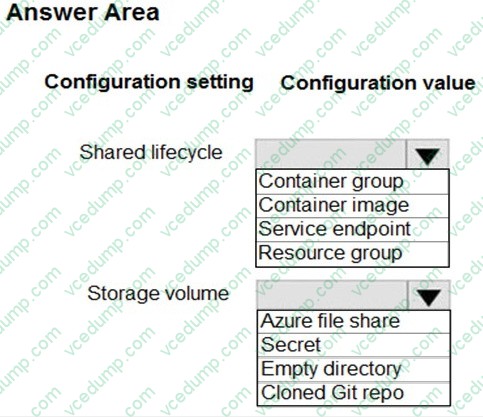
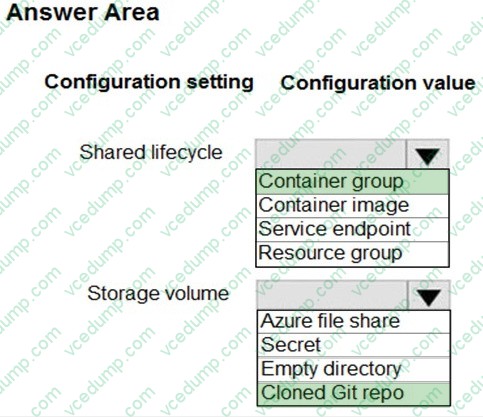
3. The containers must share a lifecycle, resources, local network, and storage volume.
4. The storage volume must persist through container crashes.
5. The storage volume must be deployed on stop or restart of the containers.
You need to configure Azure Container Instances for the application.
Which configuration values should you use? To answer, select the appropriate options in the answer area.
NOTE: Each correct selection is worth one point.
-
Question 286:
Note: This question is part of a series of questions that present the same scenario. Each question in the series contains a unique solution that might meet the stated goals. Some question sets might have more than one correct solution, while others might not have a correct solution.
After you answer a question in this section, you will NOT be able to return to it. As a result, these questions will not appear in the review screen.
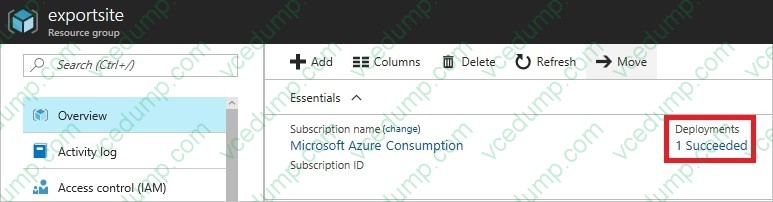
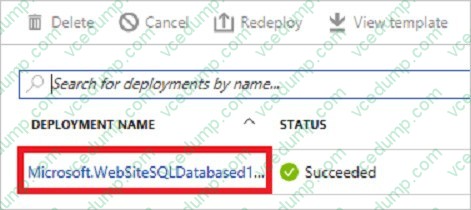
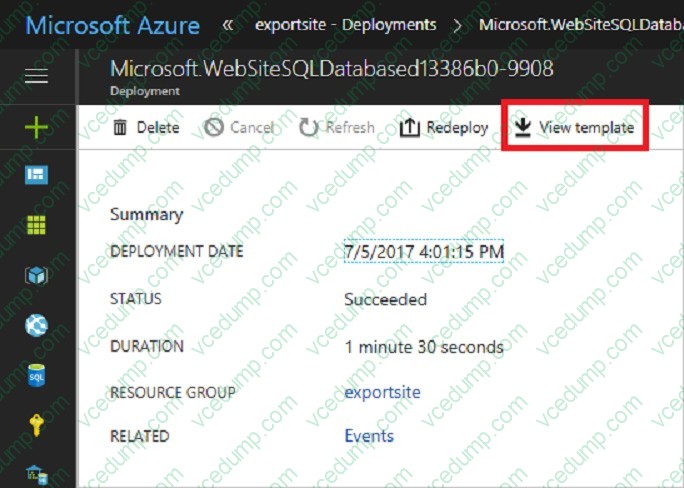
Your company has an azure subscription that includes a storage account, a resource group, a blob container and a file share.
A fellow administrator named Jon Ross used an Azure Resource Manager template to deploy a virtual machine and an Azure Storage account.
You need to identify the Azure Resource Manager template the Jon Ross used.
Solution: You access the Virtual Machine blade.
Does the solution meet the goal?
A. Yes
B. No -
Question 287:
DRAG DROP
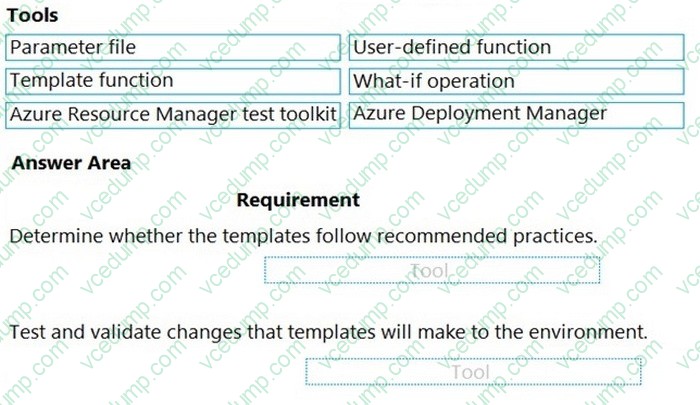
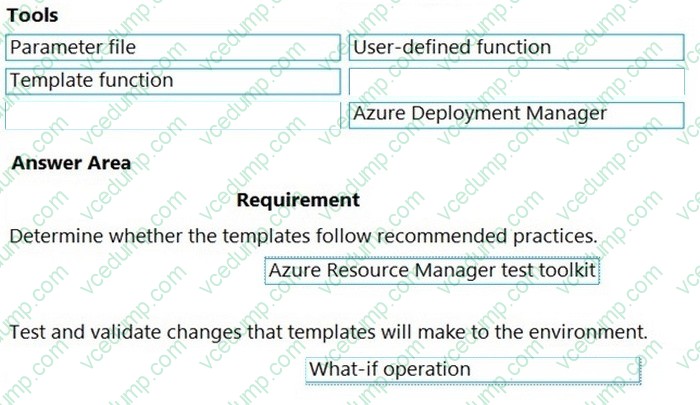
You are authoring a set of nested Azure Resource Manager templates to deploy multiple Azure resources.
The templates must be tested before deployment and must follow recommended practices.
You need to validate and test the templates before deployment.
Which tools should you use? To answer, drag the appropriate tools to the correct requirements. Each tool may be used once, more than once, or not at all. You may need to drag the split bar between panes or scroll to view content.
NOTE: Each correct selection is worth one point.
Select and Place:
-
Question 288:
You are building a loyalty program for a major snack producer. When customers buy a snack at any of 100 participating retailers the event is recorded in Azure Event Hub. Each retailer is given a unique identifier that is used as the primary identifier for the loyalty program.
Retailers must be able to be added or removed at any time. Retailers must only be able to record sales for themselves.
You need to ensure that retailers can record sales.
What should you do?
A. Use publisher policies for retailers.
B. Create a partition for each retailer.
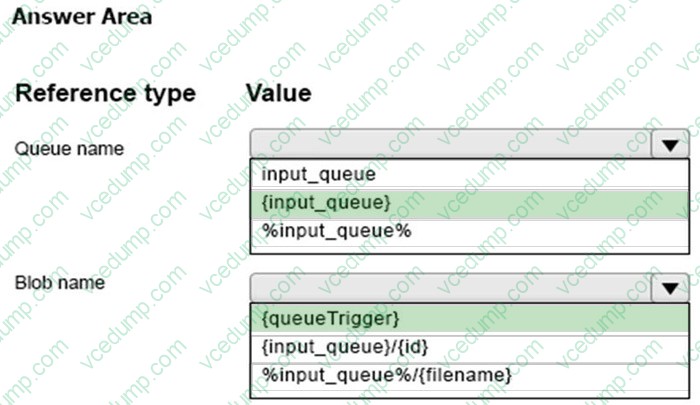
C. Define a namespace for each retailer. -
Question 289:
HOTSPOT
You plan to implement an Azure Functions app.
The Azure Functions app has the following requirements:
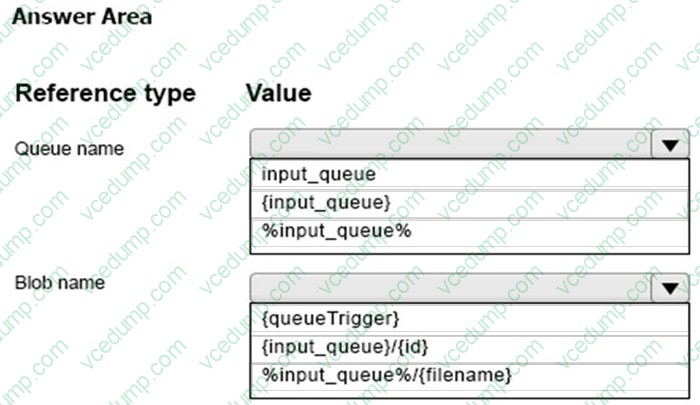
Must be triggered by a message placed in an Azure Storage queue.
Must use the queue name set by an app setting named input_queue.
Must create an Azure Blob Storage named the same as the content of the message.
You need to identify how to reference the queue and blob name in the function.json file of the Azure Functions app.
How should you reference the names? To answer, select the appropriate values in the answer area.
NOTE: Each correct selection is worth one point.
-
Question 290:
You are developing a Java application to be deployed in Azure. The application stores sensitive data in Azure Cosmos DB. You need to configure Always Encrypted to encrypt the sensitive data inside the application.
What should you do first?
A. Create a customer-managed key (CMK) and store the key in a new Azure Key Vault instance.
B. Create an Azure AD managed identity and assign the identity to a new Azure Key Vault instance.
C. Create a data encryption key (DEK) by using the Azure Cosmos DB SDK and store the key in Azure Cosmos DB.
D. Create a new container to include an encryption policy with the JSON properties to be encrypted.
Related Exams:
-
62-193
Technology Literacy for Educators -
70-243
Administering and Deploying System Center 2012 Configuration Manager -
70-355
Universal Windows Platform – App Data, Services, and Coding Patterns -
77-420
Excel 2013 -
77-427
Excel 2013 Expert Part One -
77-725
Word 2016 Core Document Creation, Collaboration and Communication -
77-726
Word 2016 Expert Creating Documents for Effective Communication -
77-727
Excel 2016 Core Data Analysis, Manipulation, and Presentation -
77-728
Excel 2016 Expert: Interpreting Data for Insights -
77-731
Outlook 2016 Core Communication, Collaboration and Email Skills
Tips on How to Prepare for the Exams
Nowadays, the certification exams become more and more important and required by more and more enterprises when applying for a job. But how to prepare for the exam effectively? How to prepare for the exam in a short time with less efforts? How to get a ideal result and how to find the most reliable resources? Here on Vcedump.com, you will find all the answers. Vcedump.com provide not only Microsoft exam questions, answers and explanations but also complete assistance on your exam preparation and certification application. If you are confused on your AZ-204 exam preparations and Microsoft certification application, do not hesitate to visit our Vcedump.com to find your solutions here.