AZ-120 Real Exam Questions

Planning and Administering Microsoft Azure for SAP Workloads

285 questions available · Page 1 of 29

Updated Exam DumpsVerified AnswersPass Guarantee

Get Complete Exam Dumps
Question 1 Hotspot

HOTSPOT

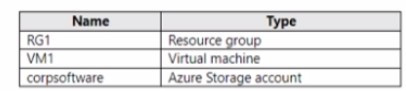
You have an Azure subscription that contains the resources shown in the following table.

You plan to deploy an SAP production landscape.

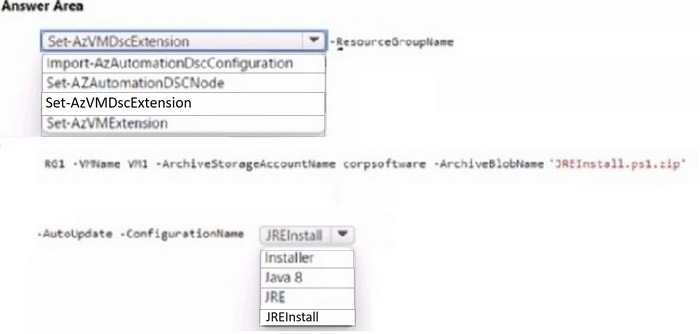
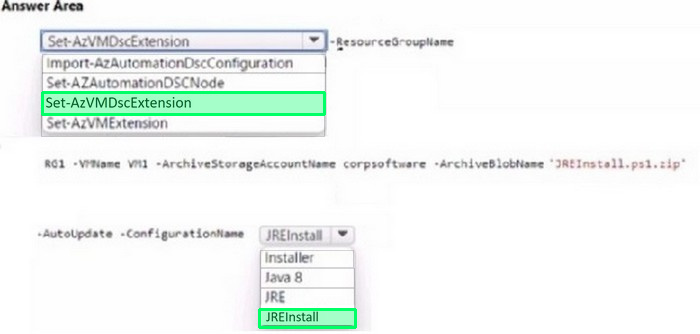
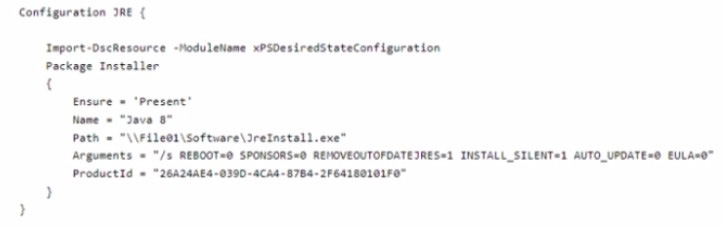
You create the following PowerShell Desired State Configuration (DSC) and publish the DSC configuration to corpsoftware.

You need to deploy the DSC configuration to VM1.

How should you compete the command? To answer, select the appropriate options in the answer area NOTE: Each correct selection is worth one point.

stem image

Question diagram
Show answer and explanation
Correct answer diagram
Question 2 Hotspot

HOTSPOT

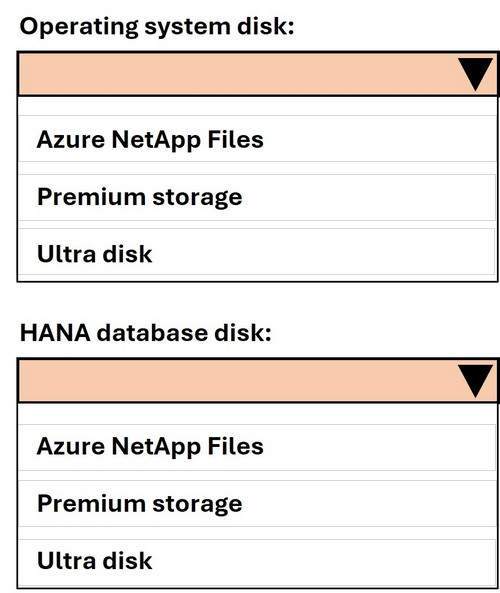
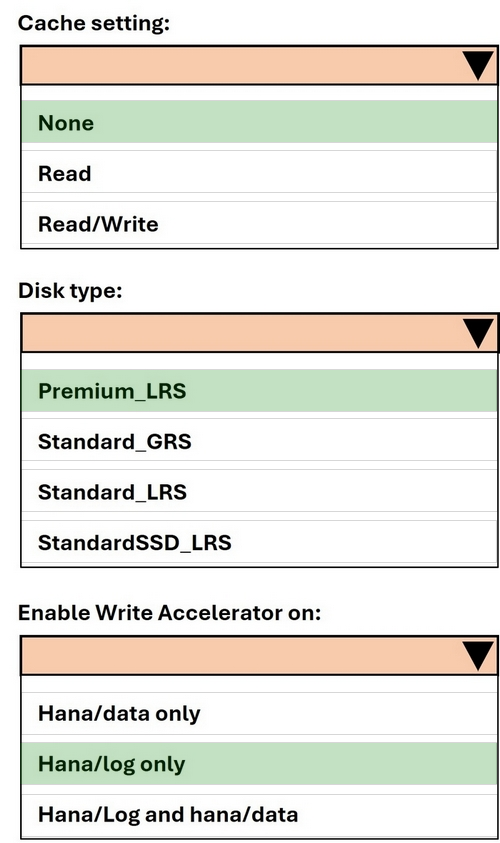
You plan to deploy two Azure virtual machines that will host an SAP HANA database for an SAP landscape.

The virtual machines will be deployed to the same availability set.

You need to meet the following requirements:

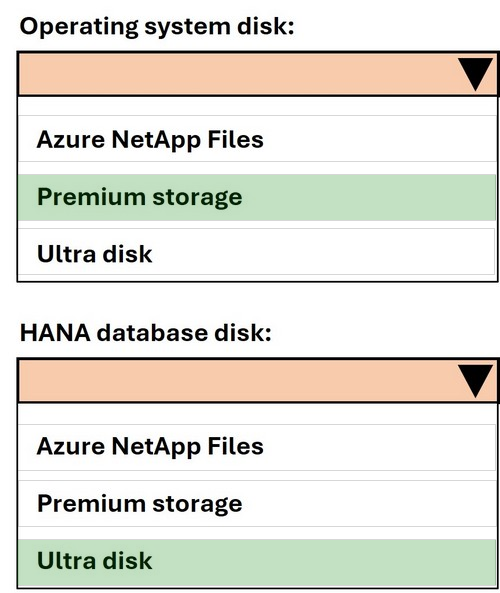
1. Ensure that the virtual machines support disk snapshots.
2. Ensure that the virtual machine disks provide submillisecond latency for writes.
3. Ensure that each virtual machine can be allocated disks from a different storage cluster.

Which type of operating system disk and HANA database disk should you use? To answer, select the appropriate options in the answer area. NOTE Each correct selection is worth one point.

Question diagram
Show answer and explanation
Correct answer diagram
Question 3 Hotspot

HOTSPOT

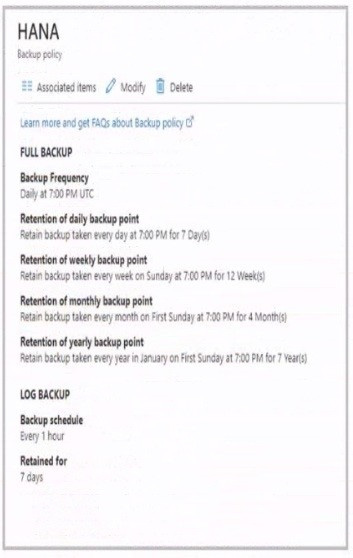
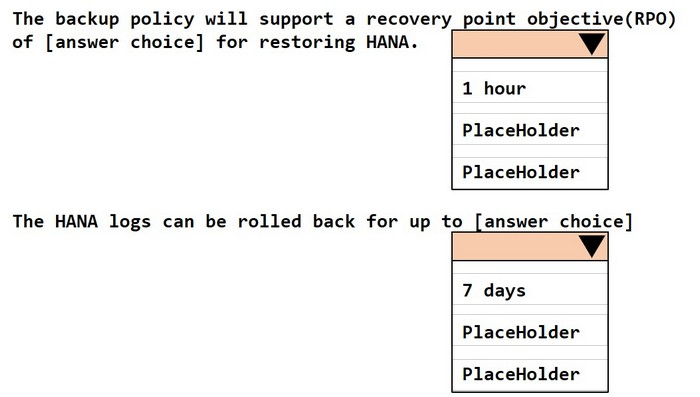
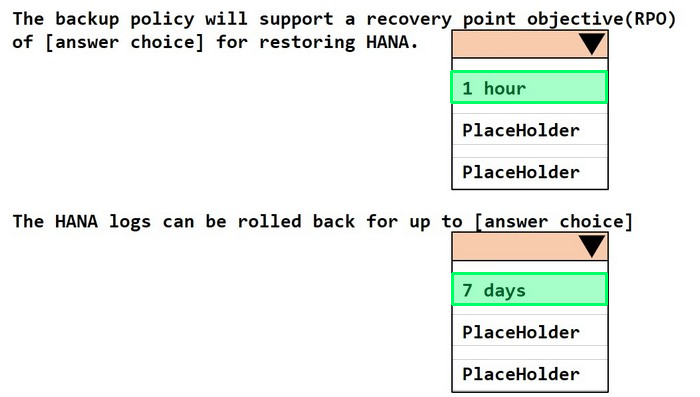
You have a Recovery Services vault backup policy for SAP HANA on an Azure virtual machine as shown in the following exhibit.

Use the drop-down menus to select the answer choice that completes each statement based on the information presented in the graphic.

NOTE: Each correct selection is worth one point.

stem image

Question diagram
Show answer and explanation
Correct answer diagram
Question 4 Single choice

You have two Azure virtual machines that host a Microsoft SQL Server 2019 failover cluster instance (FCI) named FCI1.

FCI1 hosts the database tier of an SAP NetWeaver system.

The application tier connects to FCI1 by using a virtual network name (VNN) of fci1.contoso.com. Name resolution is provided by an Azure Private DNS zone.

On FCI1, you implement a distributed network name (DNN) of FCI1DNN and verify that you can connect to
fci1dnn.contoso.com.

You need to ensure that the application tier can use the DNN when connecting to FCI1.

What should you do first?

  1. A

    From SQL Server Configuration Manager on FCI1, create an alias in the SQL Server Native Client Configuration.

  2. B

    In the private DNS zone, create an A record.

  3. C

    From SQL Server Configuration Manager on FCI1, enable shared memory for the SQL Server Native Client Configuration.

  4. D

    In the private DNS zone, create a CNAME record.

Show answer and explanation

Correct answer: D

Question 5 Hotspot

HOTSPOT

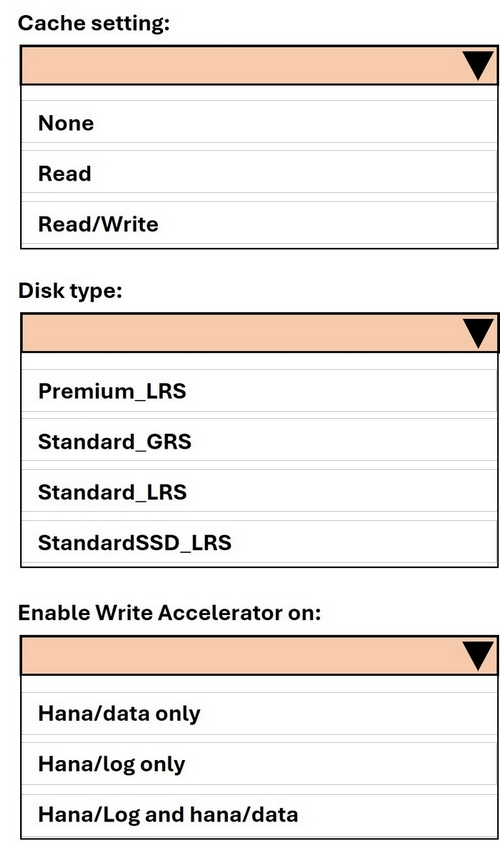
You plan to deploy SAP HANA to an Azure virtual machine for a production landscape.

You need to stripe multiple disks together by using the HANA indexserver.

How should you configure the Azure disks? To answer, select the appropriate options in the answer area.

NOTE: Each correct selection is worth one point.

Question diagram
Show answer and explanation
Correct answer diagram
Question 6 Single choice

You have an on-premises network and an Azure subscription.

You plan to migrate on premises SAP workloads to Azure virtual machines.

You will use an NFS account in Azure NetApp Files as the storage platform.

You need to ensure that data transferred between the NFS account on the virtual machines and the Azure NetApp Files shares is encrypted.

What should you create first?

  1. A

    an Active Directory connection for the NFS account

  2. B

    a system-assigned managed identity in the NFS account

  3. C

    a user-assigned managed identity in the Azure subscription

  4. D

    an Azure key vault in the Azure subscription

Show answer and explanation

Correct answer: D

Question 7 Hotspot

HOTSPOT

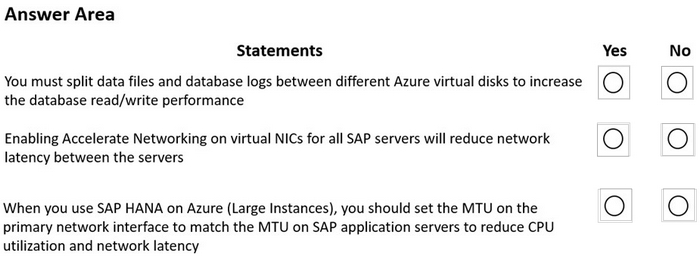
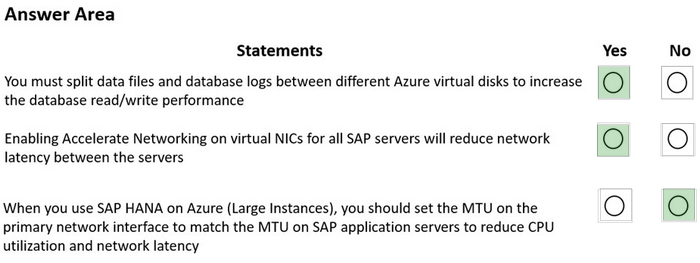
For each of the following statements, select Yes if the statement is true. Otherwise, select No.

NOTE: Each correct selection is worth one point.

Question diagram
Show answer and explanation
Correct answer diagram
Explanation

Box 1: Yes
The following is a quick checklist of storage configuration best practices for running your SQL Server on Azure VM: Place data, log, and tempdb files on separate drives.

Box 2: Yes
Accelerated networking enables single root I/O virtualization (SR-IOV) to a VM, greatly improving its networking performance. This high-performance path bypasses the host from the data path, which reduces latency, jitter, and CPU utilization for the most demanding network workloads on supported VM types.

Box 3: No

Note: The maximum transmission unit (MTU) is the largest size frame (packet), specified in bytes, that can be sent over a network interface. The MTU is a configurable setting. The default MTU used on Azure VMs, and the default setting on most network devices globally, is 1,500 bytes.

References:
https://docs.microsoft.com/en-us/azure/virtual-network/create-vm-accelerated-networking-powershell
https://docs.microsoft.com/en-us/azure/azure-sql/virtual-machines/windows/performance-guidelines-best-practices-checklist
Question 8 Single choice

You have an on-premises SAP landscape that contains a 20-TB IBM DB2 database. The database contains large tables that are optimized for read operations via secondary indexes.

You plan to migrate the database platform to SQL Server on Azure virtual machines.

You need to recommend a database migration approach that minimizes the time of the export stage.

What should you recommend?

  1. A

    log shipping

  2. B

    deleting secondary indexes

  3. C

    SAP Database Migration Option (DMO) in parallel transfer mode

  4. D

    table splitting

Show answer and explanation

Correct answer: B

Explanation

Secondary indexes for very large tables can be removed from the STR file and built ONLINE with scripts after the main portion of the import has finished and post processing tasks such as configuring STMS are occurring.

References:
https://techcommunity.microsoft.com/t5/running-sap-applications-on-the/very-large-database-migration-to-azure-8211-recommendations/ba-p/368146

Question 9 Hotspot

HOTSPOT

Your on-premises network contains SAP and non-SAP applications.

You have JAVA-based SAP systems that use SPNEGO for single-sign on (SSO) authentication.

Your external portal uses multi-factor authentication (MFA) to authenticate users.

You plan to extend the on-premises authentication features to Azure and to migrate the SAP applications to Azure.

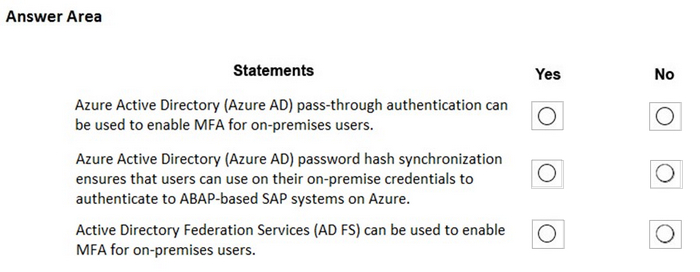
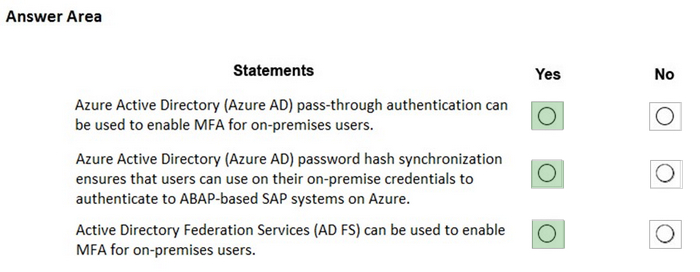
For each of the following statements, select Yes if the statement is true. Otherwise, select No.

NOTE: Each correct selection is worth one point.

Question diagram
Show answer and explanation
Correct answer diagram
Explanation

Box 1: Yes

Box 2: Yes
Password hash synchronization is one of the sign-in methods used to accomplish hybrid identity. Azure AD
Connect synchronizes a hash, of the hash, of a users password from an on-premises Active Directory instance to a cloud-based Azure AD instance.

Password hash synchronization is an extension to the directory synchronization feature implemented by Azure AD Connect sync. You can use this feature to sign in to Azure AD services like Office 365. You sign in to the service by using the same password you use to sign in to your on-premises Active Directory instance.

Box 3: Yes
If your organization is federated with Azure AD, you can use Azure Multi-Factor Authentication to secure AD FS resources, both on-premises and in the cloud. Azure MFA enables you to eliminate passwords and provide a more secure way to authenticate.

References:
https://docs.microsoft.com/en-us/azure/active-directory/hybrid/whatis-phs
https://docs.microsoft.com/en-us/windows-server/identity/ad-fs/operations/configure-ad-fs-and-azure-mfa
https://docs.microsoft.com/en-us/azure/active-directory/hybrid/how-to-connect-pta

Question 10 Single choice

You plan to deploy an SAP environment on Azure.

During a bandwidth assessment, you identify that connectivity between Azure and an on-premises datacenter requires up to 5 Gbps.

You need to identify which connectivity method you must implement to meet the bandwidth requirement.
The solution must minimize costs.

Which connectivity method should you identify?

  1. A

    an ExpressRoute connection

  2. B

    an Azure site-to-site VPN that is route-based

  3. C

    an Azure site-to-site VPN that is policy-based

  4. D

    Global VNet peering

Show answer and explanation

Correct answer: B

Explanation

Azure site-to-site VPN is cheaper.

Incorrect Answers:
A: ExpressRoute could be quite expensive.

C: Policy-based gateways use static routing, and only work with site-to-site connections.

References:
https://docs.microsoft.com/en-us/azure/architecture/reference-architectures/hybrid-networking/vpn