AZ-104 Exam Details
-
Exam Code
:AZ-104 -
Exam Name
:Microsoft Azure Administrator -
Certification
:Microsoft Certifications -
Vendor
:Microsoft -
Total Questions
:852 Q&As -
Last Updated
:May 28, 2026
Microsoft AZ-104 Online Questions & Answers
-
Question 561:
HOTSPOT
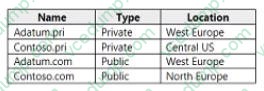
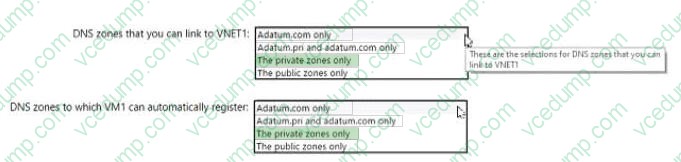
You have an Azure virtual machine mat runs Windows Server 2019 and has the following configurations:
* Name:VM1
* Location: Welt US
* Connected to: VNfT1
* Private IP address: 10.1.0.4
* Public IP address: 52 18685.63
* DNS suffix m Windows Server.Adatum.com
You create the Azure DNS zones shown in the following table.
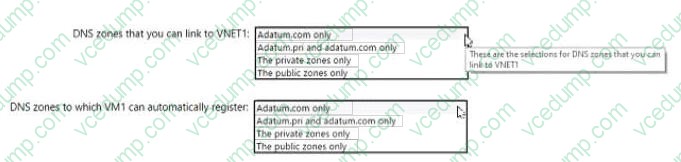
-
Question 562:
You have an Azure subscription that contains a storage account named storage1.
You need to allow access to storage1 from selected networks and your home office. The solution must minimize administrative effort.
What should you do first for storage1?
A. Add a private endpoint.
B. Modify the Public network access settings.
C. Select Internet routing.
D. Modify the Access Control (IAM) settings. -
Question 563:
You have an Azure subscription that contains the resources shown in the following table.

The Not allowed resource types Azure policy is assigned to RG1 and uses the following parameters:
1. Microsoft.Network/virtualNetworks 2. Microsoft.Compute/virtualMachines
In RG1, you need to create a new virtual machine named VM2, and then connect VM2 to VNET1.
What should you do first?
A. Remove Microsoft.Network/virtualNetworks from the policy.
B. Create an Azure Resource Manager template.
C. Remove Microsoft.Compute/virtualMachines from the policy.
D. Add a subnet to VNET1. -
Question 564:
HOTSPOT
You have an Azure Active Directory (Azure AD) tenant.
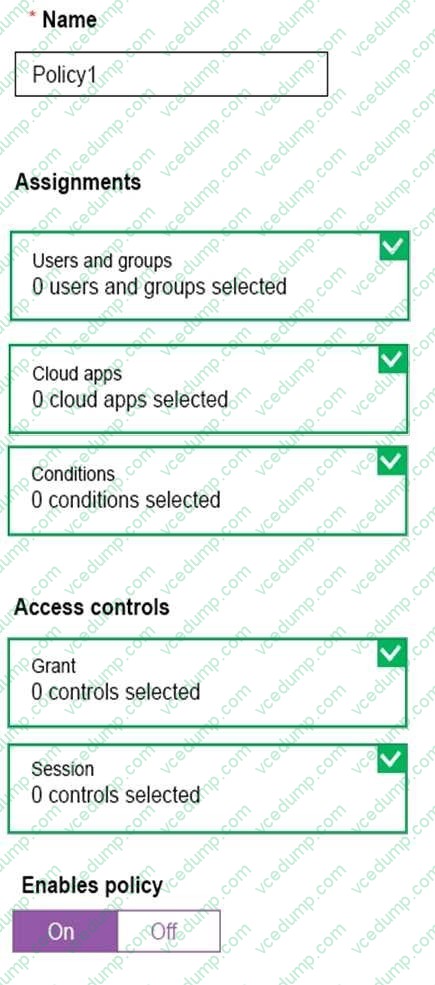
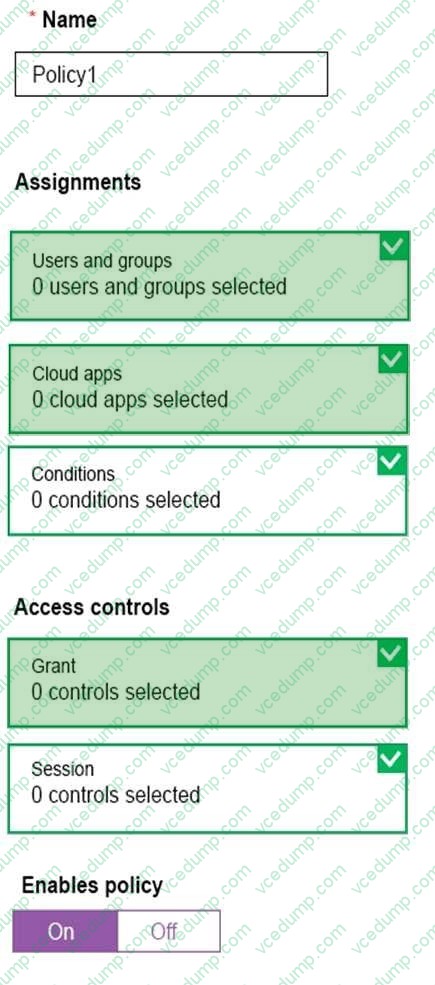
You need to create a conditional access policy that requires all users to use multi-factor authentication when they access the Azure portal.
Which three settings should you configure? To answer, select the appropriate settings in the answer area.
NOTE: Each correct selection is worth one point.
-
Question 565:
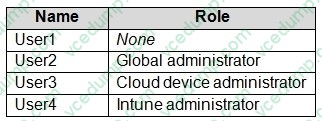
You have an Azure Active Directory (Azure AD) tenant named adatum.com that contains the users shown in the following table.
Adatum.com has the following configurations:
1. Users may join devices to Azure AD is set to User1.
2. Additional local administrators on Azure AD joined devices is set to None.
You deploy Windows 10 to a computer named Computer1. User1 joins Computer1 to adatum.com.
You need to identify the local Administrator group membership on Computer1.
Which users are members of the local Administrators group?
A. User1 only
B. User1, User2, and User3 only
C. User1 and User2 only
D. User1, User2, User3, and User4
E. User2 only -
Question 566:
Note: This question is part of a series of questions that present the same scenario. Each question in the series contains a unique solution that might meet the stated goals. Some question sets might have more than one correct solution, while others might not have a correct solution.
After you answer a question in this section, you will NOT be able to return to it. As a result, these questions will not appear in the review screen.
You have an Azure subscription that contains the resources shown in the following table.
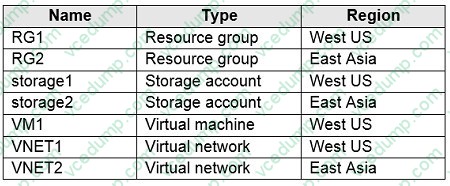
VM1 connects to VNET1.
You need to connect VM1 to VNET2.
Solution: You turn off VM1, and then you add a new network interface to VM1.
Does this meet the goal?
A. Yes
B. No -
Question 567:
HOTSPOT
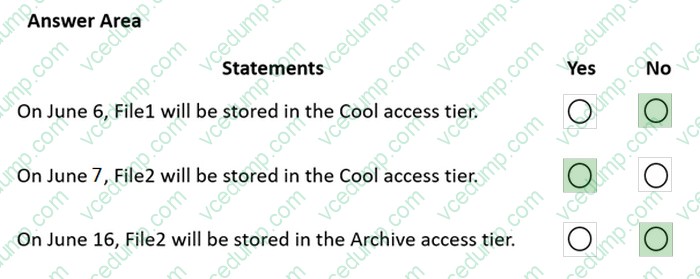
You have an Azure subscription. The subscription contains a storage account named storage1 that has the lifecycle management rules shown in the following table.

On June 1, you store two blobs in storage1 as shown in the following table.
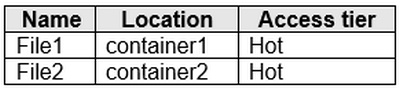
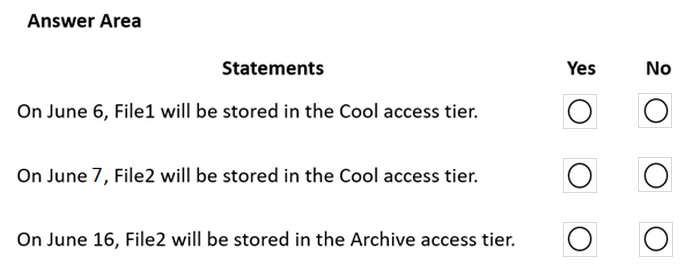
For each of the following statements, select Yes if the statement is true. Otherwise, select No.
NOTE: Each correct selection is worth one point.
-
Question 568:
You have an Azure subscription named Subscription1 that contains two Azure virtual networks named VNet1 and VNet2. VNet1 contains a VPN gateway named VPNGW1 that uses static routing. There is a site-to-site VPN connection between your on-premises network and VNet1.
On a computer named Client1 that runs Windows 10, you configure a point-to-site VPN connection to VNet1.
You configure virtual network peering between VNet1 and VNet2. You verify that you can connect to VNet2 from the on-premises network. Client1 is unable to connect to VNet2.
You need to ensure that you can connect Client1 to VNet2.
What should you do?
A. Select Use the remote virtual network's gateway or Route Server on VNet1 to VNet2 peering.
B. Select Use the remote virtual network s gateway or Route Server on VNet2 to VNet1 peering.
C. Download and re-install the VPN client configuration package on Client1.
D. Enable BGP on VPNGW1. -
Question 569:
DRAG DROP
You have an Azure subscription that contains a storage account.
You have an on-premises server named Server1 that runs Windows Server 2016. Server1 has 2 TB of data.
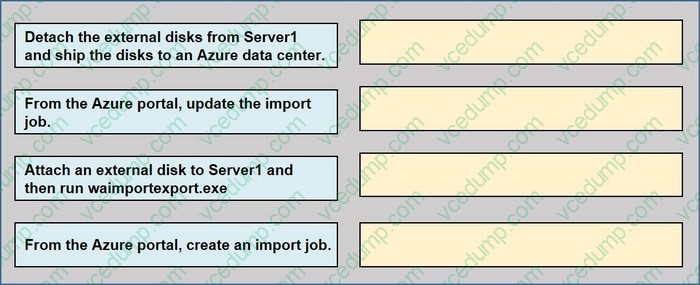
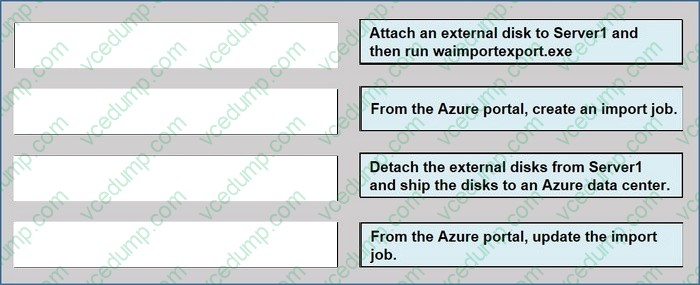
You need to transfer the data to the storage account by using the Azure Import/Export service.
In which order should you perform the actions? To answer, move all actions from the list of actions to the answer area and arrange them in the correct order.
NOTE: More than one order of answer choices is correct. You will receive credit for any of the correct orders you select.
Select and Place:
-
Question 570:
You have an Azure Active Directory (Azure AD) tenant named contoso.com.
You have a CSV file that contains the names and email addresses of 500 external users.
You need to create a guest user account in contoso.com for each of the 500 external users.
Solution: You create a PowerShell script that runs the
New-AzureADMSInvitationcmdlet for each external user.Does this meet the goal?
A. Yes
B. No
Related Exams:
-
62-193
Technology Literacy for Educators -
70-243
Administering and Deploying System Center 2012 Configuration Manager -
70-355
Universal Windows Platform – App Data, Services, and Coding Patterns -
77-420
Excel 2013 -
77-427
Excel 2013 Expert Part One -
77-725
Word 2016 Core Document Creation, Collaboration and Communication -
77-726
Word 2016 Expert Creating Documents for Effective Communication -
77-727
Excel 2016 Core Data Analysis, Manipulation, and Presentation -
77-728
Excel 2016 Expert: Interpreting Data for Insights -
77-731
Outlook 2016 Core Communication, Collaboration and Email Skills
Tips on How to Prepare for the Exams
Nowadays, the certification exams become more and more important and required by more and more enterprises when applying for a job. But how to prepare for the exam effectively? How to prepare for the exam in a short time with less efforts? How to get a ideal result and how to find the most reliable resources? Here on Vcedump.com, you will find all the answers. Vcedump.com provide not only Microsoft exam questions, answers and explanations but also complete assistance on your exam preparation and certification application. If you are confused on your AZ-104 exam preparations and Microsoft certification application, do not hesitate to visit our Vcedump.com to find your solutions here.